
The Best Way to Organize Closet Clothes

The absolute best way to organize your closet clothes for good is to follow a proven, systematic method: empty everything out, evaluate each item, categorize what you're keeping, and then put it all back in an organized way. This is the only approach that breaks the cycle of just shuffling things around and creates a system you can actually maintain.
Your Journey to an Organized Closet Starts Here
Let’s be honest, staring into a jam-packed, chaotic closet is stressful. It turns the simple act of getting dressed into a daily frustration and can really set a negative tone for the rest of your day. Instead of trying quick fixes that fall apart in a week, we're going to walk through a sustainable four-step method that genuinely works.
This isn't about creating some picture-perfect, color-coded masterpiece for social media. It's about building a functional, manageable space that fits your real life. The goal here is simple: make it easy to find what you need and even easier to put it away.
Before we dive into the nitty-gritty, let's get a high-level view of the process. This framework is the backbone of our entire approach.
The 4-Step Closet Organization Framework
| Step | Action | Primary Goal |
|---|---|---|
| 1. The Great Empty-Out | Take every single item out of your closet. | Create a completely blank slate and understand the full scope of your wardrobe. |
| 2. The Decisive Sort | Evaluate each item individually using specific criteria. | Make conscious decisions about what to keep, donate, toss, or repair. |
| 3. Strategic Categorization | Group your "keep" pile into logical categories. | Create a system that makes sense for your lifestyle and clothing types. |
| 4. The Rebuild | Place items back into the closet using space-saving techniques. | Design an organized, accessible, and easy-to-maintain wardrobe. |
This table lays out the roadmap we'll follow. It’s a logical progression from chaos to clarity.
The Foundation of a Tidy Wardrobe
A truly organized closet is built on intentional choices, not just on clever folding techniques. It requires a bit of a mental shift—from just owning a bunch of clothes to curating a wardrobe of pieces you actually love and wear. The link between a clear space and a clear mind is incredibly powerful.
This isn't just a fleeting trend; it's a significant lifestyle adjustment for many. In fact, the global market for home organization products is expected to jump from $13.27 billion to over $20.21 billion by 2033. This surge shows a real cultural shift toward minimalism, the need for smarter space usage in smaller homes, and a growing awareness of how our surroundings affect our mental health. You can learn more about the factors driving the home organization market to see the data for yourself.
A cluttered closet often mirrors a cluttered mind. By taking control of your physical space, you create a sense of order that extends into other areas of your life, reducing daily decision fatigue and stress.
This simple process flow captures the core steps for getting your closet organization project off the ground.
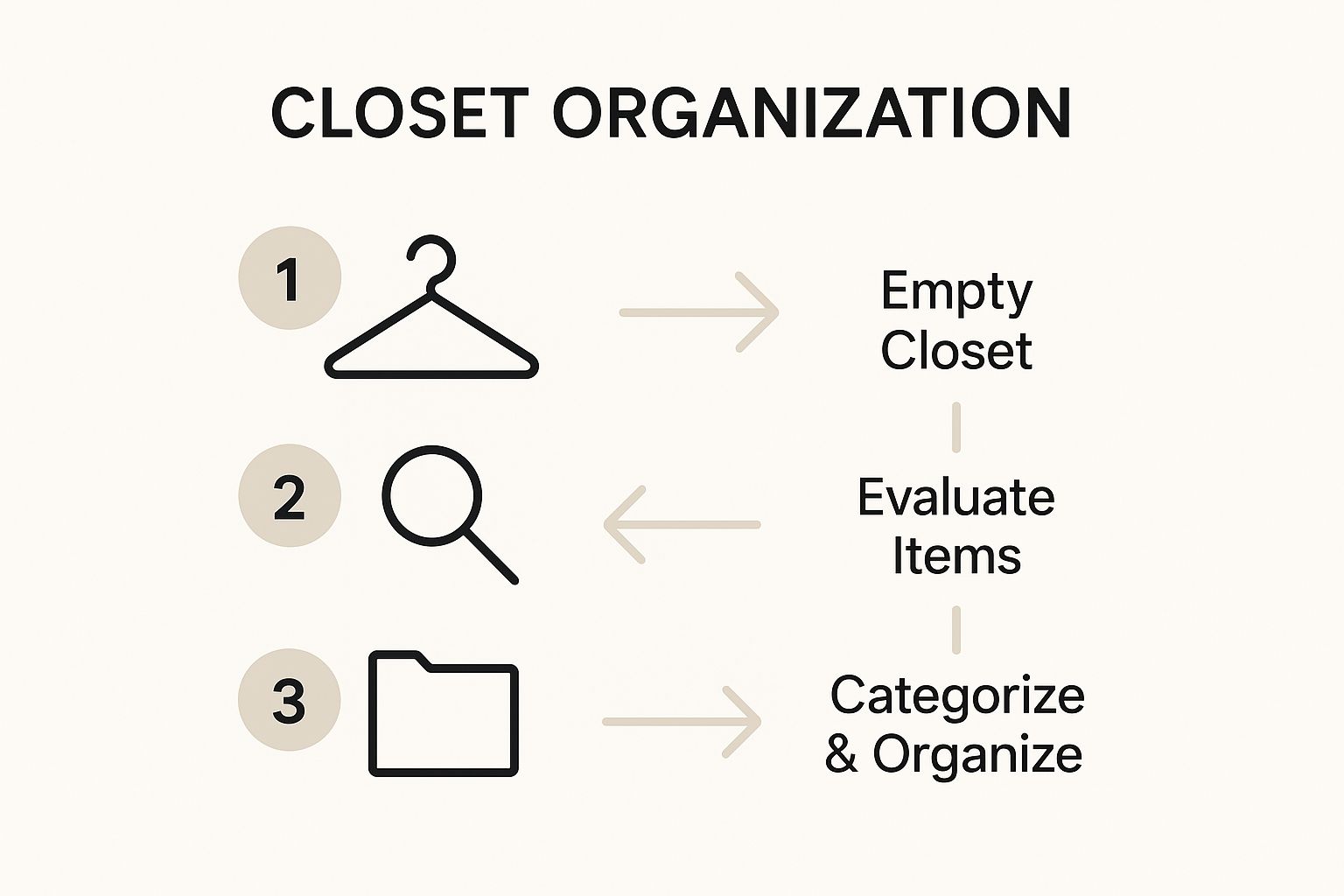
As the graphic shows, a successful outcome depends on a methodical approach, not just random tidying. We’ll break down each of these ideas in detail, starting with the most transformative (and sometimes intimidating) step of all: the great closet clean-out.
The Great Closet Cleanout: A Realistic Decluttering Method
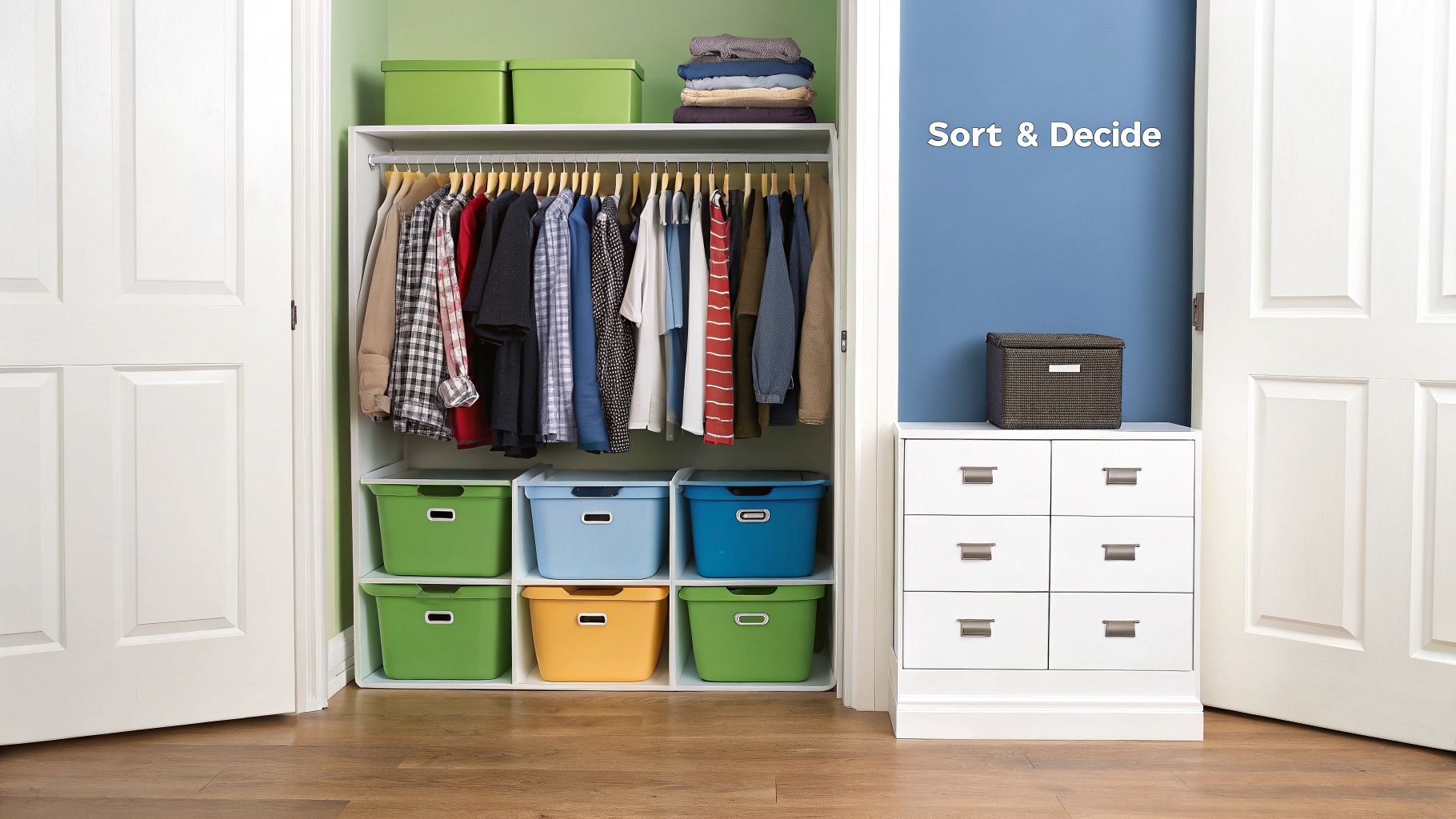
This is where the real magic happens. With your closet completely empty, you have a clean slate—a rare opportunity to be intentional about what goes back in. The goal is to evaluate every single item, but let's skip the vague advice.
Forget trying to decide if each sock "sparks joy." A much more practical approach is to get decisive. Grab four bins, boxes, or even just clear a corner for each pile. Label them: Keep, Donate/Sell, Repair, and Discard.
Making Guilt-Free Decisions
Think of yourself as the curator of your personal wardrobe. As you pick up each garment, your job is to make a quick, honest assessment. We're not just getting rid of stuff; we're consciously choosing what earns a spot in your life.
This process becomes surprisingly simple when you ask the right questions. For every piece, run through this mental checklist:
- When did I last wear this? Be honest. If it’s been over a year, that’s a pretty good sign it's time to let it go.
- How do I feel in this? Does it make you feel confident? Comfortable? Or do you spend the whole time tugging at it? If an item brings on a wave of self-consciousness, it has to go.
- Does this fit the person I am today? Our lives change. That suit from a previous job or the skinny jeans from a decade ago might not align with your current lifestyle, and that's okay.
- Is this a duplicate? I get it, we all have our favorites. But do you really need five nearly identical black t-shirts? Keep the one or two in the best condition and let the others go.
This kind of direct questioning cuts right through the indecision. You’re not just clearing space; you're actively refining your personal style.
Handling Sentimental Items
Okay, let's address the tough part: the sentimental stuff. That old concert t-shirt, the bridesmaid dress, the sweater a loved one gave you... these things feel heavy with memories, even if they're just collecting dust.
Here’s the secret: separate the memory from the item. An object can represent something special without needing to take up valuable real estate in your closet. If you truly can't part with it, create a memory box. This gives the item an honored place while freeing up your hanging space for the clothes you actually wear.
A common trap is holding onto clothes out of guilt—"It was a gift," or "I spent so much money on it." Give yourself permission to let it go. Your closet should serve your life now, not act as a storage unit for past obligations.
Once you’ve sorted through everything, you'll be left with your "Keep" pile. This is the hand-picked collection that will form the foundation of your new, streamlined closet. For an even deeper look at this process, our guide on how to declutter your closet has more great tips. With the hard part done, you're ready to start categorizing what's left.
Smart Categorization For Your Real-Life Wardrobe
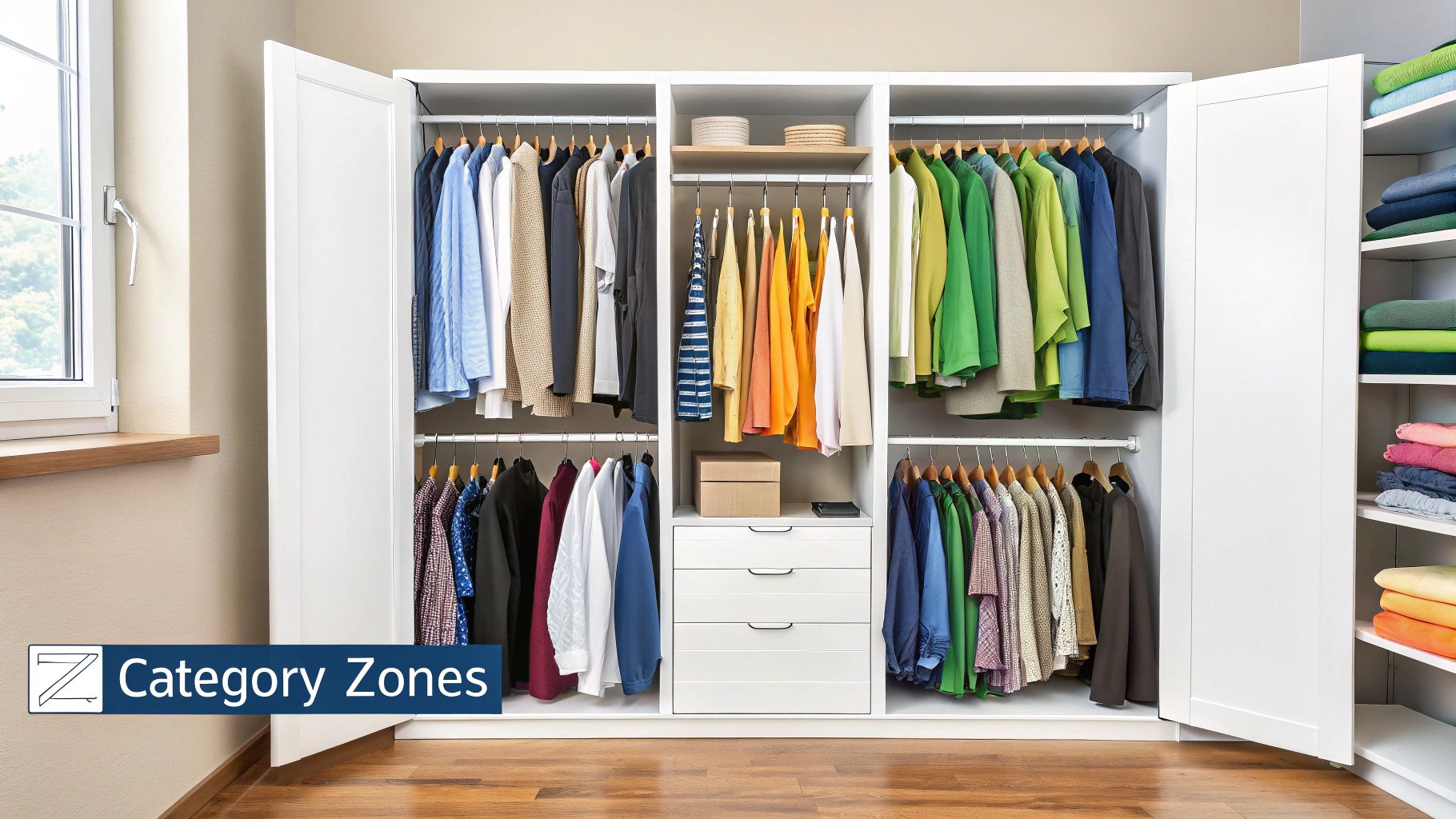
Alright, you've done the hard part and now have a pile of clothes you genuinely love and want to keep. The next step is where the magic really happens: sorting everything into groups that actually make sense for your day-to-day life.
Forget rigid, one-size-fits-all rules. The best way to organize your closet is to create a system that feels completely intuitive to you. This means moving beyond just putting all the shirts in one spot and all the pants in another. Instead, let's think about how you actually live.
A fantastic way to start is by categorizing your clothes by occasion. This naturally mirrors how you think when you get dressed in the morning, which makes finding what you need a whole lot faster. Your closet should reflect your life, not just be a random collection of fabric.
Ultimately, this is about making your closet work for you.
Grouping By How You Live
Think of your closet in terms of "zones" that map to your real-life activities. This simple mental shift can take the stress out of hectic mornings because you're no longer digging through everything you own just to find one work-appropriate top.
Take a moment to consider the main parts of your life and dedicate a section to each.
- Workwear: This is mission control for your professional life. Group all your blazers, office pants, blouses, and work dresses here. They’ll be ready to go when you are.
- Weekend & Casual: Here's where you'll find your favorite jeans, cozy sweaters, t-shirts, and everything else you reach for on your days off. Make this spot easy to access.
- Activewear & Loungewear: It’s a good idea to keep gym clothes and at-home loungewear separate. This way, you won't accidentally pull out your running shorts when you're just looking for something comfy to wear on the couch.
- Formal & Special Occasion: These are the items you wear less frequently. Storing them together keeps them in good condition and clears up prime real estate for your daily-use clothes.
The best closet systems I've ever seen are intensely personal. The goal isn't to create a picture-perfect closet, but a functional one. You want a setup that makes putting clothes away just as effortless as finding them.
This focus on smarter storage is a big reason why the closet organizer market is now valued at $7.64 billion and is expected to climb to $8.25 billion. With more people living in smaller urban spaces, maximizing every inch of storage has become a necessity. You can dive deeper into the rise of wardrobe organization trends to see how our habits are changing.
Create Smart Sub-Categories
Once your main zones are established, you can refine them even further. Inside your "Workwear" zone, for instance, you could group all your tops together, then all your pants, and then your skirts. This adds another layer of order that makes your search even quicker.
You can apply the same logic to your casual clothes. Maybe you want to separate short-sleeve tees from long-sleeve ones, or light-wash jeans from dark-wash pairs. These small tweaks are what take a closet from just "organized" to truly efficient. The trick is to find that sweet spot—a system with enough structure to be helpful but not so complicated that it's a pain to keep up with.
Choosing The Right Tools To Maximize Your Space
https://www.youtube.com/embed/7rm_FpffXlo
Now that your clothes are sorted, it's time for the fun part: equipping your closet with the right tools. This is where the real magic happens. Making smart choices here is the secret to unlocking every last inch of space and keeping your wardrobe from slipping back into chaos. This isn't about buying more stuff; it's about investing in the right stuff to solve specific storage headaches.
The biggest game-changer? Your hangers. I can't stress this enough. A random mix of bulky plastic, wire, and chunky wooden hangers creates visual noise and wastes a shocking amount of rod space. Switching to a single style of slim, space-saving hanger is probably the most satisfying and impactful upgrade you can make.
Select The Right Hangers For Your Clothes
Not all hangers are built the same, and using the wrong one can stretch out your favorite sweater or, at the very least, waste precious real estate. The key is to match the hanger to the garment to preserve its shape and make your whole wardrobe easier to browse. I've found that having a smart mix of a few different types works best for most people.
-
Velvet Hangers: These are the undisputed champions of space-saving. Their ultra-slim design lets you hang way more clothes, and the non-slip finish is a lifesaver for silky tops, tank tops, and anything with a wide neckline that loves to end up on the floor.
-
Wooden Hangers: Don't toss all your sturdy hangers! For heavy hitters like winter coats, suit jackets, and blazers, a solid wooden hanger is non-negotiable. It provides the structure needed to support the shoulders and prevent the fabric from distorting over time.
-
Padded Hangers: For your most delicate pieces—think silk dresses, lingerie, or treasured vintage finds—a soft, padded hanger is the way to go. It prevents the snags and shoulder bumps that other hangers can leave behind.
The single best thing you can do for a visually calm and spacious closet is to use uniform hangers. It instantly creates a cohesive, boutique-like feel and can free up as much as 50% more space on your clothing rod.
This drive for better organization is a huge trend. The global market for closet organizers is expected to more than double, growing from around $4.03 billion to an estimated $8.53 billion by 2035. It just goes to show how much people value smart, efficient storage in modern homes. You can dig into the closet organizer market trends at Future Market Insights if you're curious.
Hanger Type and Best Use Comparison
Choosing the right hanger can feel overwhelming, but it's really about matching the tool to the task. This quick table breaks down which hangers work best for different clothing items, helping you maximize your space and keep your clothes in great shape.
| Hanger Type | Best For | Key Benefit |
|---|---|---|
| Slim Velvet | Silky blouses, camisoles, dresses, lightweight tops | Non-slip grip and ultra-thin profile maximizes rod space. |
| Sturdy Wooden | Heavy coats, suit jackets, blazers, structured items | Provides essential shoulder support to prevent misshaping. |
| Padded/Satin | Delicate fabrics like silk, lace, lingerie, knits | Gentle, soft surface prevents snags, creases, and bumps. |
| Tiered/Cascading | Pants, skirts, or creating clothing "sets" | Hangs multiple items vertically to make the most of height. |
Ultimately, a combination of these types will give you the most functional and protective setup for your entire wardrobe.
Think Beyond The Hanging Rod
A truly organized closet uses every bit of available space—not just the rod. A few simple organizers can completely transform those messy corners and cluttered surfaces into tidy, functional zones.
Drawer dividers, for instance, are incredible for taming sock and underwear drawers. Instead of digging through a jumbled mess every morning, you can see every single pair at a glance. On your shelves, a few simple shelf dividers can work wonders for keeping stacks of sweaters or jeans from toppling over into each other.
And don't forget the floor! A slim shoe rack, whether it's a tiered one on the floor or a hanging organizer over the door, is essential for stopping that inevitable shoe pile-up. Each of these tools is designed to solve a common problem, turning wasted space into valuable storage. If you want to see more options, you might find our guide on the best space-saving hangers and their benefits helpful.
Arranging Your Closet For Effortless Daily Access
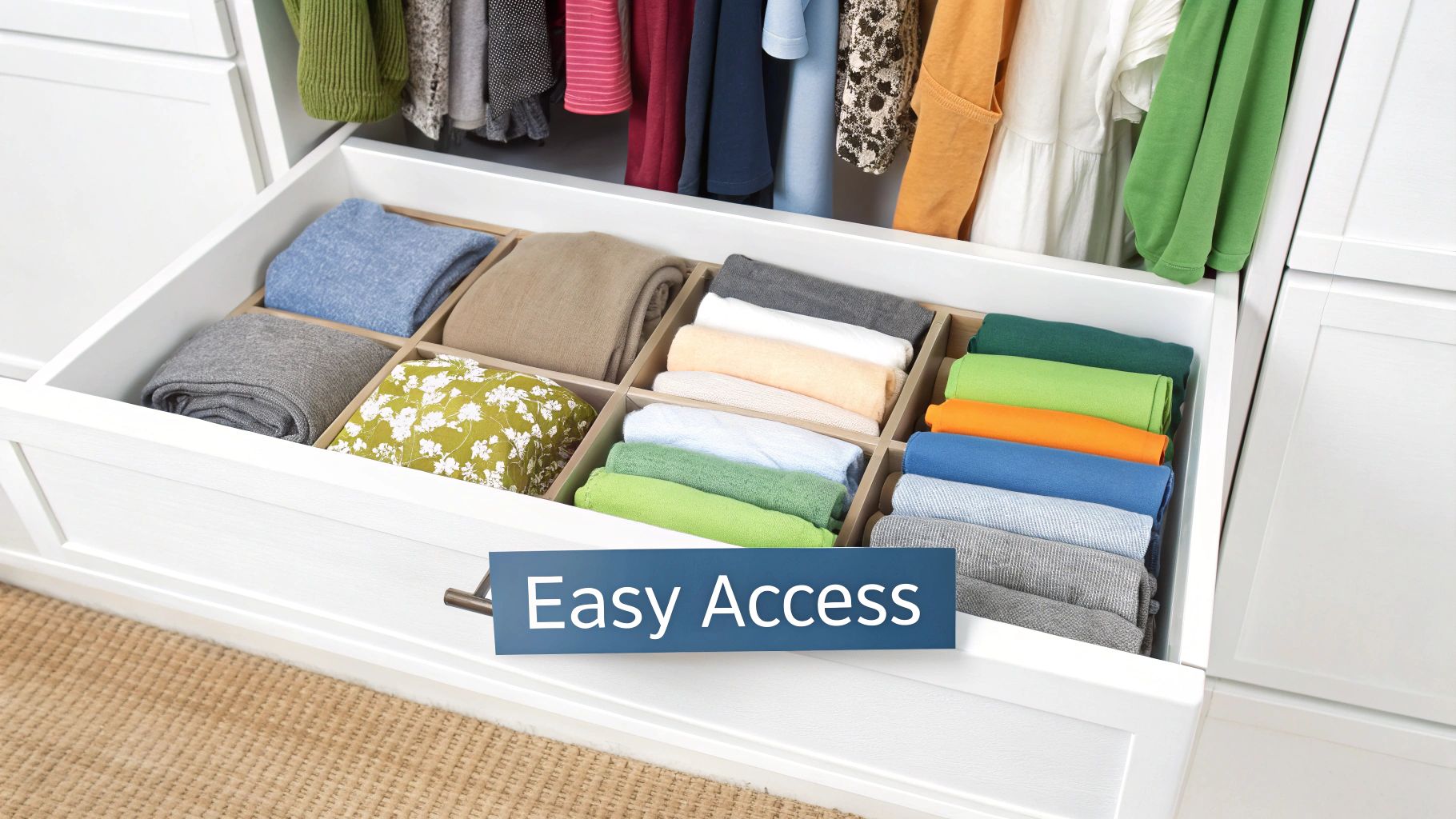
Okay, you’ve sorted your clothes and have your new hangers ready to go. Now for the fun part: putting everything back in a way that actually makes your life easier. For a system that sticks, you need to think a bit like a retail designer and create intuitive "closet zones."
The whole concept boils down to one simple rule: your most-worn clothes get the best spots. This is your closet’s prime real estate—the hanging rod space and shelves right at eye level, where you can grab things without a second thought. Your go-to jeans, favorite sweaters, and work blouses? They belong front and center.
Everything else—like formal wear or bulky winter coats you only touch a few times a year—can be moved to higher shelves, tucked in the back, or stored away. This one change stops you from fighting past a sequin dress just to get to your favorite hoodie.
Smart Placement and Folding Techniques
The way you physically place items on the rod or in a drawer can be a surprisingly big deal. If you have a closet with a double-hang rod, try this trick: organize your clothes the same way you’d wear them. Put tops, blouses, and jackets on the top rod, and hang your pants, shorts, and skirts on the bottom one.
It’s a small thing, but it creates a mental map that makes getting dressed feel almost automatic. And for your drawers, please, stop stacking your t-shirts! You only ever see the one on top.
The file-folding method is a total game-changer for drawers. By folding items like t-shirts and jeans into neat rectangles and arranging them vertically, you can see everything you own at a single glance. It's like flipping through a catalog of your own clothes.
This approach not only saves you time but also makes sure you don't forget about the awesome shirts buried at the bottom of the pile. It’s an easy habit to build and, honestly, makes putting laundry away way more satisfying. For those with more room to play with, you can find even more in-depth strategies for how to organize a walk-in closet and make the most of every inch.
Creating Visual Calm and Order
Last but not least, let's add the finishing touch that takes your closet from organized to beautifully organized. Once your clothes are grouped by type (all pants together, all dresses together), take a few extra minutes to arrange them by color within each category.
You wouldn’t believe the sense of harmony this creates. A popular method is to follow the colors of the rainbow (ROYGBIV), which looks something like this:
- Start with whites, creams, and other light neutrals.
- Flow into the warmer colors: reds, oranges, yellows.
- Transition to the cooler tones: greens, blues, purples.
- Finish with dark neutrals like gray, brown, and black.
This visual trick makes finding that one specific blue top a breeze. You’ll know exactly where to look, turning a daily chore into a moment of calm. Your closet will go from being a source of stress to a peaceful, functional space that helps you start your day on the right foot.
Common Closet Sticking Points
Even with the best intentions, you’re bound to hit a few snags when overhauling your closet. Let's tackle some of the most common questions that pop up, so you can keep your newly organized space looking great for the long haul.
Think of this as your personal troubleshooting guide. A tidy closet isn’t a one-and-done deal; it’s all about creating habits that stick.
How Often Should I Really Be Decluttering My Closet?
I usually recommend a big, deep cleanout once or twice a year—typically when you're swapping out your clothes for the new season. It's the perfect opportunity to get real about what you wore and what just collected dust.
But for day-to-day upkeep, the one-in, one-out rule is a game-changer. Seriously. Every time a new shirt or pair of jeans comes in, an old one has to leave. This simple little habit is the single best way to stop clutter from creeping back in. It keeps your closet filled only with things you genuinely love and wear.
What's The Best Way To Store My Bulky Sweaters?
Whatever you do, don't hang your heavy, bulky knit sweaters. It’s probably the most common mistake I see, and it's a surefire way to ruin them. The hanger puts all the weight on the shoulders, stretching the fabric and leaving those awful, pointy bumps. It can permanently wreck the shape of your coziest pieces.
The best way to store them is folded. If you have shelves, that's ideal—use some simple shelf dividers to stop your stacks from tipping over into a messy pile. If you're short on shelf space, folding them and lining them up vertically in a deep drawer or a storage bin works just as well. This keeps their shape intact and ready for when the temperature drops.
Keeping sentimental clothes in your daily closet is like reserving prime real estate for a museum that's never open to the public. Cherish the memory, but free up the space.
What Do I Do With Clothes I'm Keeping For Sentimental Reasons?
We all have them—the concert tee, the dress from a special occasion, maybe even a baby's first onesie. These pieces are important, but they don't belong in your active wardrobe. They’re taking up valuable real estate that your everyday clothes desperately need.
My solution is to create a dedicated memory box. You can even use a vacuum-sealed bag to keep them protected. Store this box somewhere safe, like under the bed or at the top of a guest room closet. This way, you get to honor the memories without sacrificing the space you need for the person you are today. It’s a key step in truly organizing your closet for your current life.
Ready to turn that chaotic closet into a calm, functional space? Having the right tools is half the battle. Check out the full collection of space-saving hangers from MORALVE and see how our clever designs can help you get the most out of every last inch. Start organizing today at moralve.com.
Leave a comment