
Best Way to Organize Clothes in Closet for Perfect Order

The secret to a closet that actually stays organized isn't some magic formula—it's a practical, three-part system: ruthlessly declutter, categorize everything intuitively, and finally, put smart storage solutions to work. This is how you create a sustainable system that gives you back time and makes getting dressed easier, not just a chaotic mess.
Your Blueprint for a Stress-Free Closet
That feeling of dread when you open your closet doors? It's a common problem, but it’s one you can solve for good. We're not talking about a temporary fix that falls apart by next weekend. The goal here is to build a simple, lasting closet organization system that’s designed around your clothes and your life.
Maybe you need to speed up your morning routine, or perhaps you just crave the visual calm of a tidy space. Whatever your reason, having a clear plan is the first, most important step to organizing your clothes effectively.
This infographic breaks down that initial decision-making process.
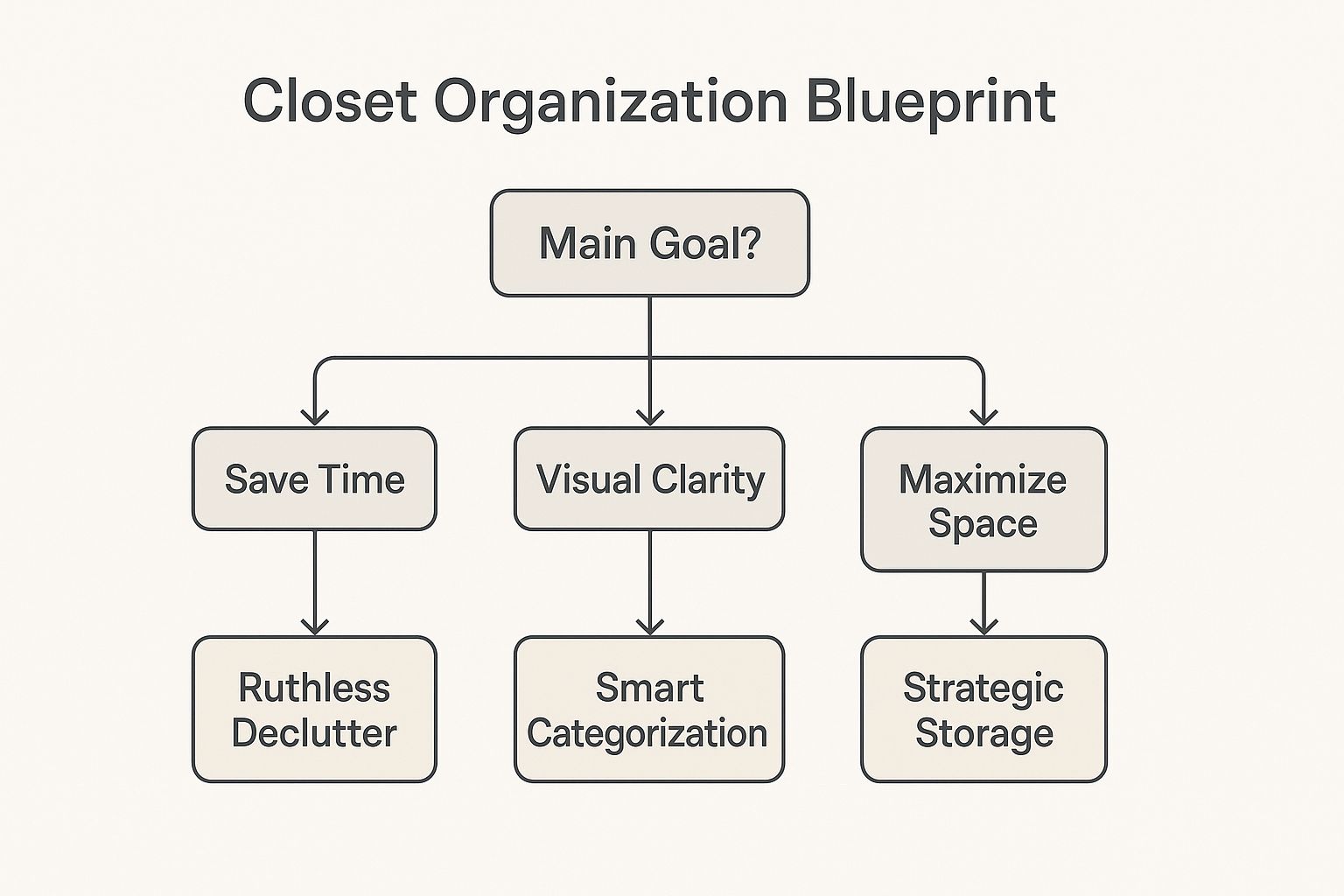
As you can see, defining your main goal—whether it's saving time, creating clarity, or just making the most of a tiny closet—points you directly to your first move.
Setting Achievable Goals
It's not just you. The demand for better closet organization is exploding. The closet organizer market is expected to jump from $7.64 billion to $8.25 billion in a single year—that's an 8% increase. It shows just how much people want systems that make life easier.
In fact, households that use closet organizers report spending 40% less time just looking for their clothes. Think about that. That's real time you get back every single day.
A well-organized closet isn’t about being perfect; it's about being practical. It should serve you. It should make it easier to find what you need, feel confident in what you wear, and start your day feeling in control.
This guide is your blueprint to get there. It will help you face the chaos and take those first critical steps. Of course, before you start hanging things, it helps to think about the space itself. For a deeper dive on optimizing your layout from the ground up, take a look at our complete guide on how to design a closet.
The Practical Purge That Ends Closet Clutter
Before you can organize clothes, you have to get real about what you own. This first pass—the big purge—is honestly the hardest part, but getting it right makes every other step of closet organization fall into place. It’s all about simplifying.
Let’s skip the complicated decision-making and get straight to it.
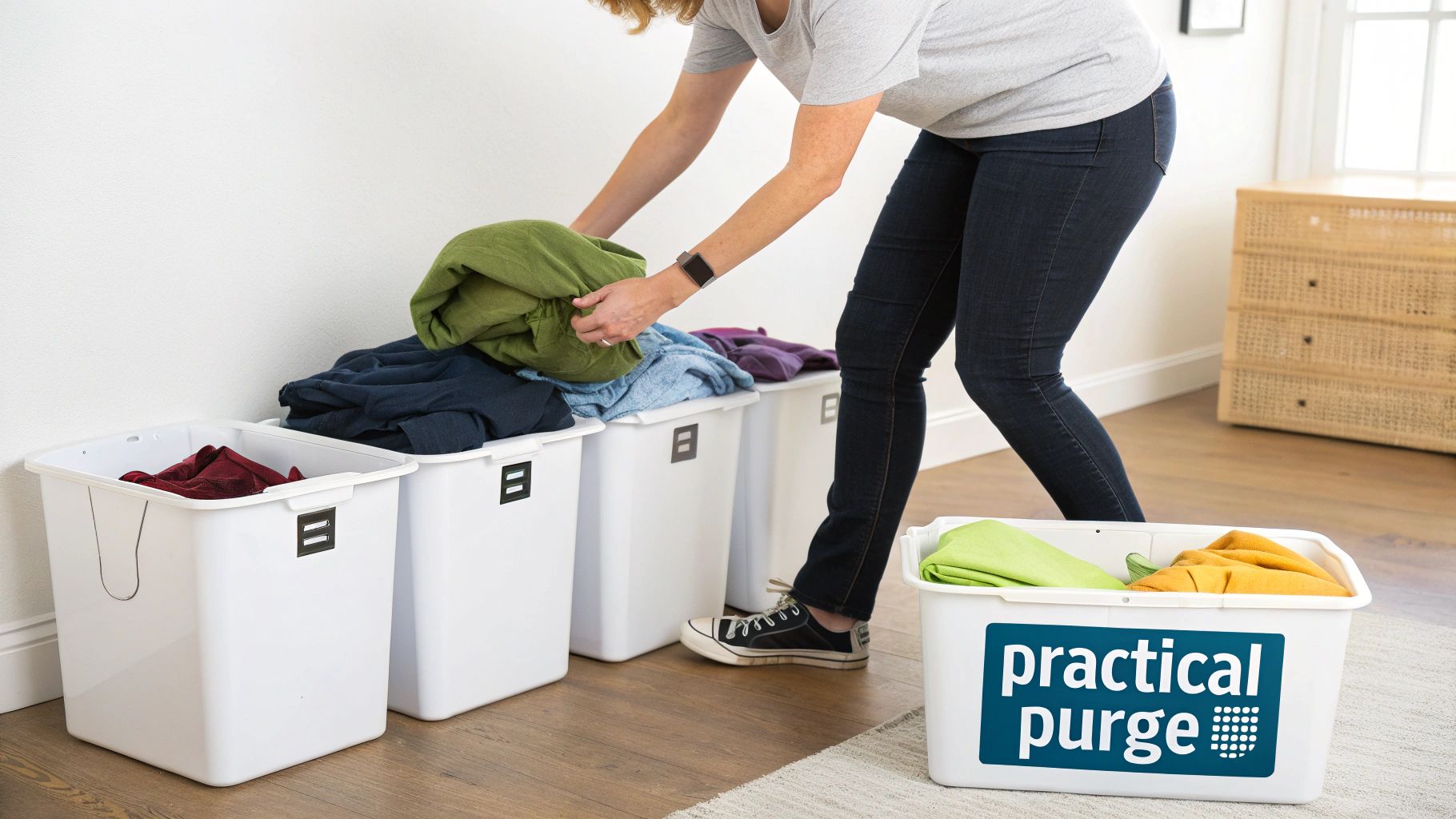
Grab four boxes, bins, or even just garbage bags. Label them: Keep, Donate/Sell, Repair, and Discard. From here on out, every single piece of clothing you touch must go into one of these four categories. No exceptions. No "maybe" pile.
The Four-Bin Decluttering Method
Use this simple framework to make quick, effective decisions about every item in your closet.
| Bin Label | Criteria for This Bin | Your Next Action |
|---|---|---|
| Keep | You love it, it fits well, and you've worn it in the last year. | Place it aside to be categorized and organized later. |
| Donate/Sell | It's in good condition but no longer fits your style or body. | Put it in a bag for donation or list it on a resale app. |
| Repair | It has a missing button, a small tear, or needs altering. | Set a deadline to get it fixed or do it yourself. |
| Discard | It's stained, stretched, or worn out beyond saving. | Time to say goodbye and recycle or toss it responsibly. |
This clear-cut approach stops you from second-guessing every decision and helps you build momentum.
Making Confident Choices
This isn't about getting rid of things just for the sake of it. The real goal is to build a wardrobe that actually works for you. As you pick up each item, run it through a quick mental checklist to cut through the emotional clutter and the "what if" excuses.
- Have I worn this in the last 12 months? Be honest. If not, it's a strong sign it's time for it to go.
- Does this fit my body and make me feel good right now? Don't keep clothes for a hypothetical future you. Your wardrobe should serve you today.
- If I saw this in a store today, would I buy it? This is a great gut check to see if your style has moved on.
- Is it damaged? If it is, decide immediately if you're actually going to fix it. If yes, it goes in the Repair bin. If not, it's time to let it go.
Moving quickly and decisively is key. If you're looking for more guidance on this crucial first step, we've put together some extra tips on how to declutter your closet.
The objective isn't to have an empty closet. The goal is to have a closet full of possibilities—items you feel excited to wear that make getting dressed an effortless and enjoyable part of your day.
Once you’ve whittled down your wardrobe to only the things that serve you, the real fun of organizing your closet can begin. You’re no longer just shuffling clutter; you're building a functional, inspiring space.
How to Categorize Your Clothes Like a Pro
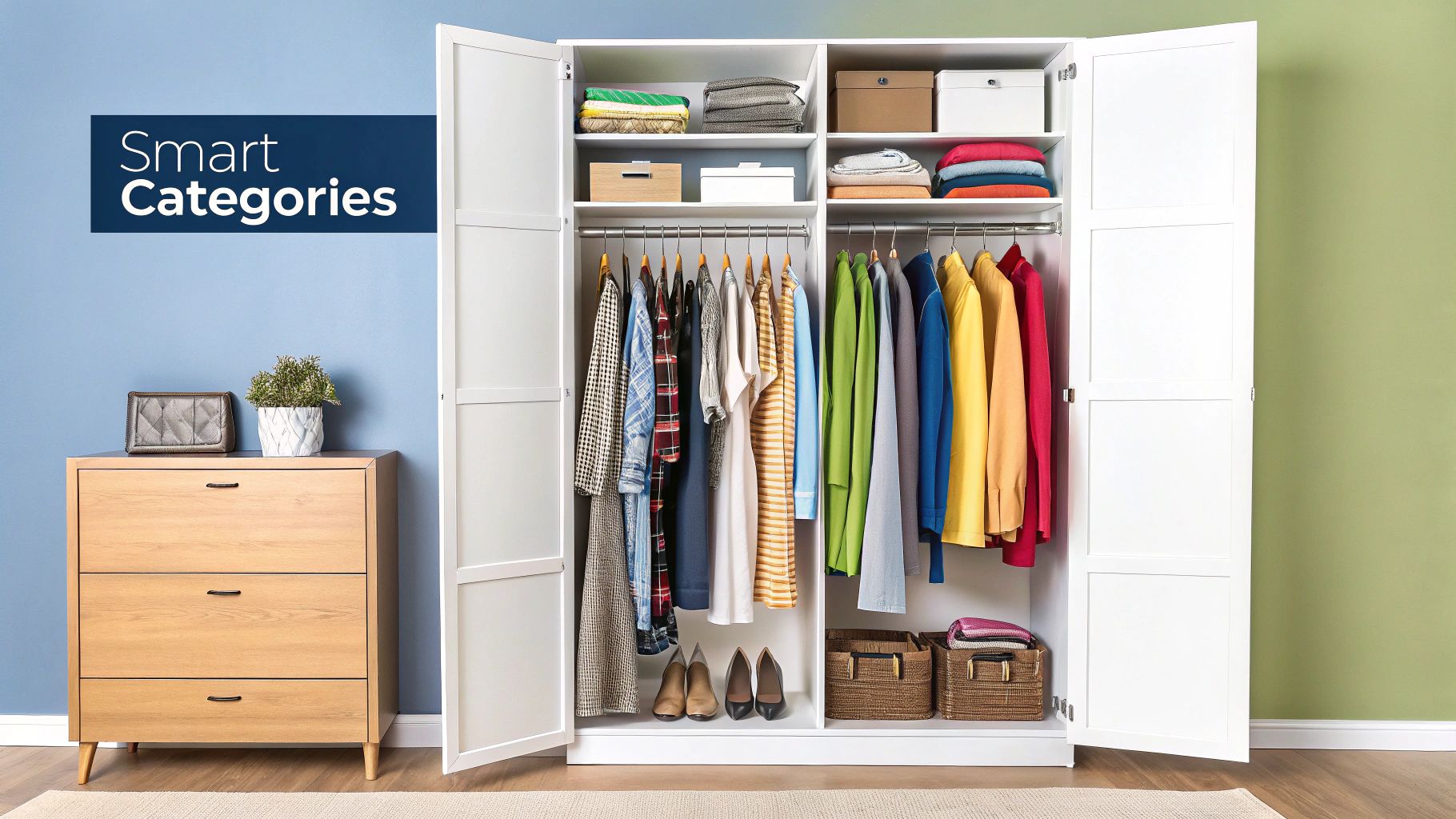
Alright, you’ve done the hard part and now you're left with only the clothes you truly love. The next step in closet organization is creating a system that lets you find anything you need in a blink. We're going to move beyond just lumping all your shirts in one spot and create intuitive zones in your closet.
Getting this right is more critical than ever, especially as our living spaces seem to be shrinking. It’s no surprise the global home organization market is projected to hit $13.27 billion. People everywhere, especially in cities, are realizing they need to make every single inch of space count.
Think about it: over 80% of new apartment buildings in North America now come with built-in closet systems. That tells you just how much we value smart, efficient storage. If you're curious, you can read more about these market trends on Woodworking Network.
Find Your Personal Sorting Style
Listen, there’s no single "correct" way to categorize your clothes. The best way to organize clothes in your closet is simply the one you'll actually use. How do you get dressed in the morning? Let's build your closet organization around that routine.
Here are a few effective methods for sorting clothes:
- By Occasion: This is a great system for busy people. You create distinct zones in your closet: a "work week" section with your blouses and slacks, a "weekend" area with casual tees and jeans, and maybe a spot for gym clothes or formal wear.
- By Clothing Type: The classic approach, and for good reason. Grouping all pants, all dresses, and all sweaters together gives you an instant, clear inventory of what you have in your closet.
- By Outfit Capsules: A real game-changer if you hate morning decision-making. You pre-plan and group items into ready-to-wear outfits, taking all the guesswork out of getting dressed.
- By Color: Organizing your closet in a rainbow or gradient is not only beautiful but also super practical. When you know you need a blue top, you know exactly where to look.
Don’t feel like you have to pick just one method! The real magic happens when you mix and match. You could organize by occasion first, and then color-code within each of those sections. The goal here is function, not some impossible standard of perfection.
For instance, your "work" section could have all your blazers hanging together, sorted from light to dark. Meanwhile, your "weekend" section might have your t-shirts folded and filed by color in a drawer. This kind of hybrid approach is often the most practical and sustainable way to keep your closet in order for the long haul.
Choosing the Right Tools to Maximize Your Space
Alright, you've done the hard part. The clothes are sorted, the donation bags are full, and you're left with only the things you truly love. Now comes the part where you make your closet work for you, not against you. This is where you see all that effort pay off. You don't need a massive, custom-built closet system to get that organized feel; a few strategic closet organization tools can make all the difference.
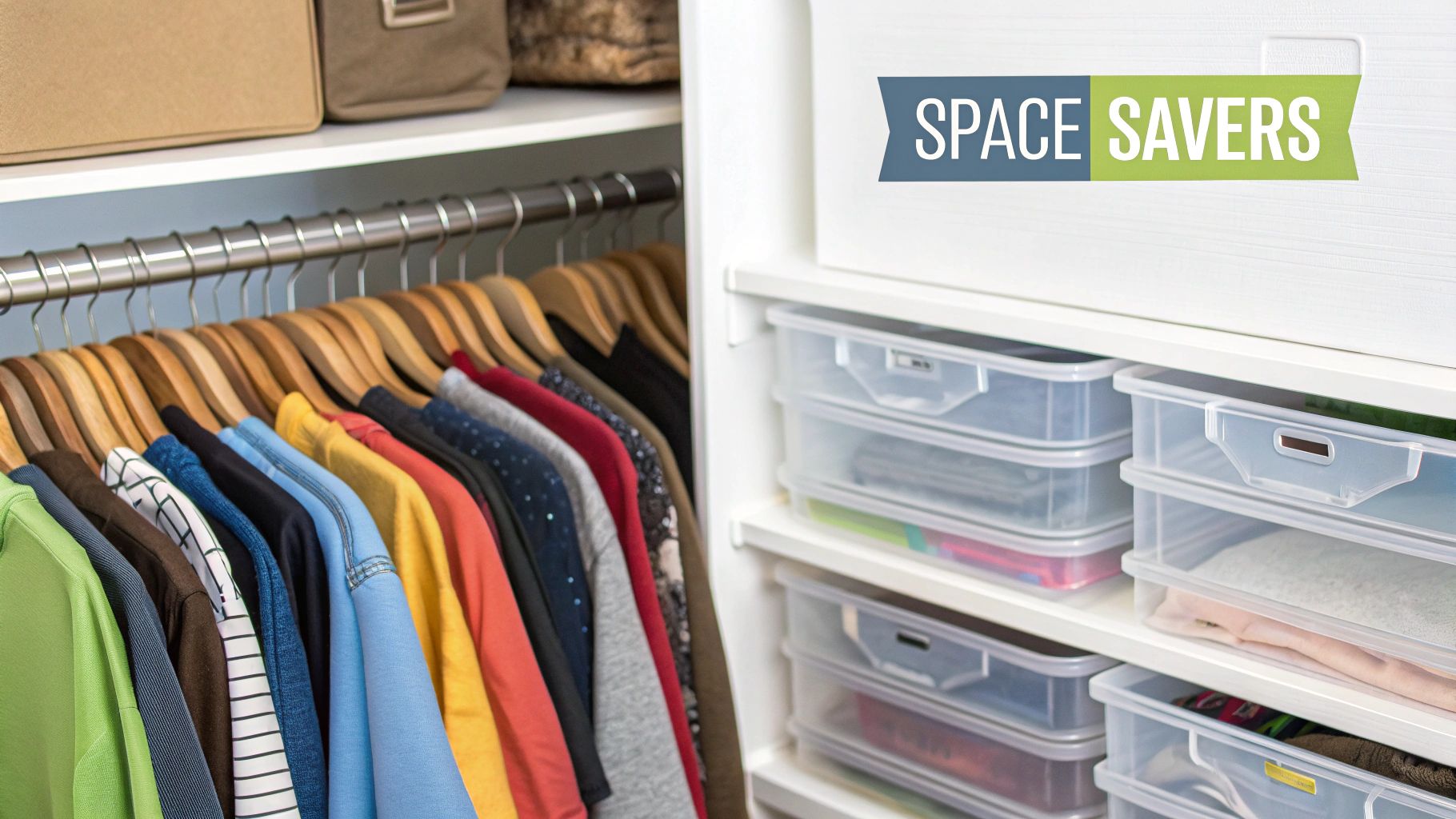
If I could recommend only one thing, it would be to upgrade your hangers. Seriously. Ditching those bulky, mismatched plastic hangers for a uniform set of slim ones, like MORALVE’s multi-garment hangers, is a total game-changer. I’ve seen it give people back up to 50% more rod space instantly. It’s a simple swap, but the impact on your closet organization—both visually and functionally—is huge.
Smart Storage for Every Nook
Once your hanging space is sorted, it's time to organize the areas where clutter loves to hide: your drawers and shelves. Without a good system, these spots can descend back into chaos in no time.
I always recommend a few key additions to clients:
- Drawer Dividers: These are a must-have for taming socks, underwear, and accessories. You go from a tangled mess to neat, orderly rows where you can actually see what you have. No more digging around for that one specific pair of socks.
- Shelf Dividers: You know how that perfect stack of sweaters or jeans always seems to fall over? Shelf dividers are the answer. These simple acrylic or wire dividers slide right onto your shelves, creating stable cubbies that keep your piles from toppling.
- Clear Storage Bins: For items you don't use every day, like off-season clothes or special occasion accessories, clear bins are perfect. You can see exactly what's inside at a glance, which saves you from pulling down a dozen boxes to find one thing.
There's a reason the closet organizer market is projected to grow from $12.5 billion to nearly $19.8 billion by 2032. People are realizing how much of an impact these tools can have, especially in smaller homes where every inch counts. In fact, the use of vertical storage options has jumped by 25% lately, largely thanks to social media showing us what’s possible. You can read more about these closet market insights if you're curious.
The best closet tools don't just store your things—they create a system that’s easy to maintain. The goal is to make putting things away just as simple as taking them out.
And for anything you’re folding—like those bulky knits or graphic tees—your technique matters just as much as the bin you put them in. Learning a few expert tricks for folding clothes to save space can easily double what you can fit in your drawers and on your shelves, making your new tools even more effective.
Keeping Your Closet Organized for Good
You’ve put in the work to declutter and organize, but let's be honest—the real challenge is keeping it that way. The secret to a permanently tidy closet isn't a massive, one-time overhaul. It's all about building small, consistent habits that stop the chaos from ever coming back.
Think of it like this: you wouldn't spend an entire weekend deep-cleaning your kitchen just to let dirty dishes pile up for a month. The same principle applies to your closet. A few simple routines are all you need to protect your hard work and keep your space feeling calm and functional.
Create Simple Maintenance Habits
The most powerful habit you can adopt for long-term closet organization is the ‘one in, one out’ rule. Seriously, make this non-negotiable. Every time you buy a new piece of clothing, an old one has to leave. This single trick prevents that slow, creeping accumulation of stuff that caused the clutter in the first place and forces you to be more intentional with your purchases.
Next, get into the rhythm of a 10-minute weekly reset. Pick a day—maybe Sunday evening before the week kicks off—and set a timer for just ten minutes. Use that time to put away the clothes that have ended up on "the chair," line up your shoes, and straighten any messy piles. It’s amazing how this quick tidy-up prevents small messes from turning into a weekend-long project.
Maintaining an organized closet is about progress, not perfection. It’s the small, consistent actions that make the biggest difference over time, not the massive, infrequent purges.
Finally, do a quick seasonal check-in. When you're pulling out your summer dresses or packing away your heavy coats, take an extra 30 minutes to evaluate what you actually wore last season. If a sweater or a pair of shorts never left the hanger, it’s a good sign it's time to let it go. This keeps your wardrobe feeling fresh and relevant to your current style.
Tackling Your Toughest Closet Questions
Even with a solid plan, a few tricky situations always pop up when you're trying to organize your closet for good. It's often these little details that make or break a system. Let's walk through some of the most common closet organization questions and get you some clear, practical answers.
How Often Should I Really Be Decluttering?
A big seasonal cleanout once or twice a year is great, but the real game-changer is what I call micro-decluttering. The trick is to keep a donation bag right in your closet.
When you try something on and it just doesn't feel right anymore, don't hang it back up. Toss it directly into the bag. This simple habit turns a massive, weekend-long project into a quick 30-minute refresh when the seasons change.
What’s the Right Way to Store Bulky Stuff?
Heavy knit sweaters and jeans are the usual suspects when it comes to closet chaos. If you don't handle them right, they'll eat up all your space. The golden rule here is to avoid hanging them if you can.
- Sweaters: Whatever you do, don't hang your heavy knits. Gravity is not their friend and will stretch them out of shape. Your best bet is to fold them neatly and stack them on a shelf. A few simple shelf dividers can work wonders to keep those stacks from tumbling over.
- Jeans: You've got a couple of great options here. You can fold them over specialized S-type hangers, which lets you see all your pairs at a glance. Or, you can "file fold" them vertically in a drawer—this method is fantastic because you can pull one pair out without messing up the whole stack.
Storing your clothes the right way does more than just save space—it actually makes them last longer. Taking that extra moment to fold a sweater can keep it looking brand new for years to come.
How Can I Make a Tiny Closet Feel Bigger?
When you're working with a small closet, you have to think vertically. Every inch from the floor to the ceiling is valuable real estate.
Start with the single most impactful change: swap out your bulky, old hangers for multi-level space-saving ones. This move alone can let you hang five shirts in the space you used to use for one. Next, look into a hanging shelf organizer for folded clothes like t-shirts and shorts. And don't forget the door! An over-the-door organizer is a lifesaver for shoes, belts, scarves, and other accessories.
Ready to conquer your closet and finally reclaim your space? The tools you choose can make all the difference. Discover how MORALVE’s innovative space-saving hangers can literally double your hanging space and bring effortless order to your wardrobe. Explore our collection and start organizing today!
Leave a comment