

The Best Way to Store T Shirts for an Organized Closet

Let's be honest, we've all faced that chaotic pile of t-shirts in a drawer or closet. It’s a common problem, but a well-organized closet is easier to achieve than you might think. The real secret to a calm, functional closet starts with one simple choice: folding versus hanging.
This decision is the bedrock of your entire closet organization system. It affects not just how tidy your space looks, but also how long your shirts last and how quickly you can find what you need on a busy morning. Your answer will come down to a few practical things: how much drawer space you have versus hanging space, the fabrics your tees are made of, and frankly, what closet system you'll actually stick with.
Finding Your Ideal T-Shirt Storage Method
For most of your everyday cotton tees, folding is king. I almost always recommend it for closet organization because it’s the best way to prevent the neckline and shoulders from getting stretched out over time—a classic, frustrating issue when they're left on hangers. Folding lets you pack shirts neatly into drawers or on shelves, making everything easy to see at a glance within your closet.
To Fold or To Hang Your Shirts
So, when does hanging make sense within your closet? I usually reserve hangers for tees made from more delicate or wrinkle-prone fabrics. Think linen, rayon, or that drapey slub cotton. For these, a good hanger can be a lifesaver, preventing the deep-set creases that folding can cause and keeping your closet looking pristine.
A quick pro-tip: if you do hang your tees, please ditch the flimsy wire and plastic hangers! They’re the number one cause of those dreaded shoulder bumps. Instead, invest in some velvet or padded hangers; they'll grip the fabric gently and maintain the shirt's shape as part of an effective closet system.
Here’s a simple table to help you decide at a glance.
Hanging vs Folding At a Glance
This quick comparison will help you decide the best storage method for your t-shirts based on common factors like closet space, fabric type, and accessibility.
| Factor | Hanging T-Shirts | Folding T-Shirts |
|---|---|---|
| Best For | Wrinkle-prone fabrics (linen, rayon), graphic tees | Standard cotton & blends, saving drawer space |
| Pros | Good visibility in the closet, prevents folding creases, better airflow | Protects neckline & shoulders, maximizes drawer/shelf space |
| Cons | Can stretch fabric, creates shoulder bumps, takes more rod space | Can create creases, shirts can be hidden at bottom of a pile |
| Space Use | Uses vertical rod space, good for closets with less drawer area | Excellent for drawers & shelves, very space-efficient for closets |
Ultimately, this isn't just about being tidy.
The right storage method is about preserving the fit and feel of your favorite shirts for years to come. A well-organized closet saves you time and clears away the mental clutter that comes from a messy space.
Building a closet system that truly works for you is what matters most. Take a moment to think about how you want your closet to function day-to-day. For more in-depth strategies on planning your perfect space, check out our complete guide on how to design a closet.
Mastering T-Shirt Folds for Maximum Drawer Space
So, you’ve decided folding is the way to go for your closet organization. Great choice. But let's ditch the old method of just stacking them one on top of the other. We all know how that ends: a messy, rummaged-through pile where you can never find the one shirt you're actually looking for.
The goal isn't just neatness; it's about making every single shirt visible and easy to grab without causing a clothing avalanche. Think of it like creating a library for your tees inside your closet. When you get the fold right, you can pull one out, and the rest stay perfectly in place. This one small change can completely transform a chaotic drawer into a beautifully organized space.
This simple workflow shows how that initial choice between folding and hanging really sets the stage for everything else in your closet.
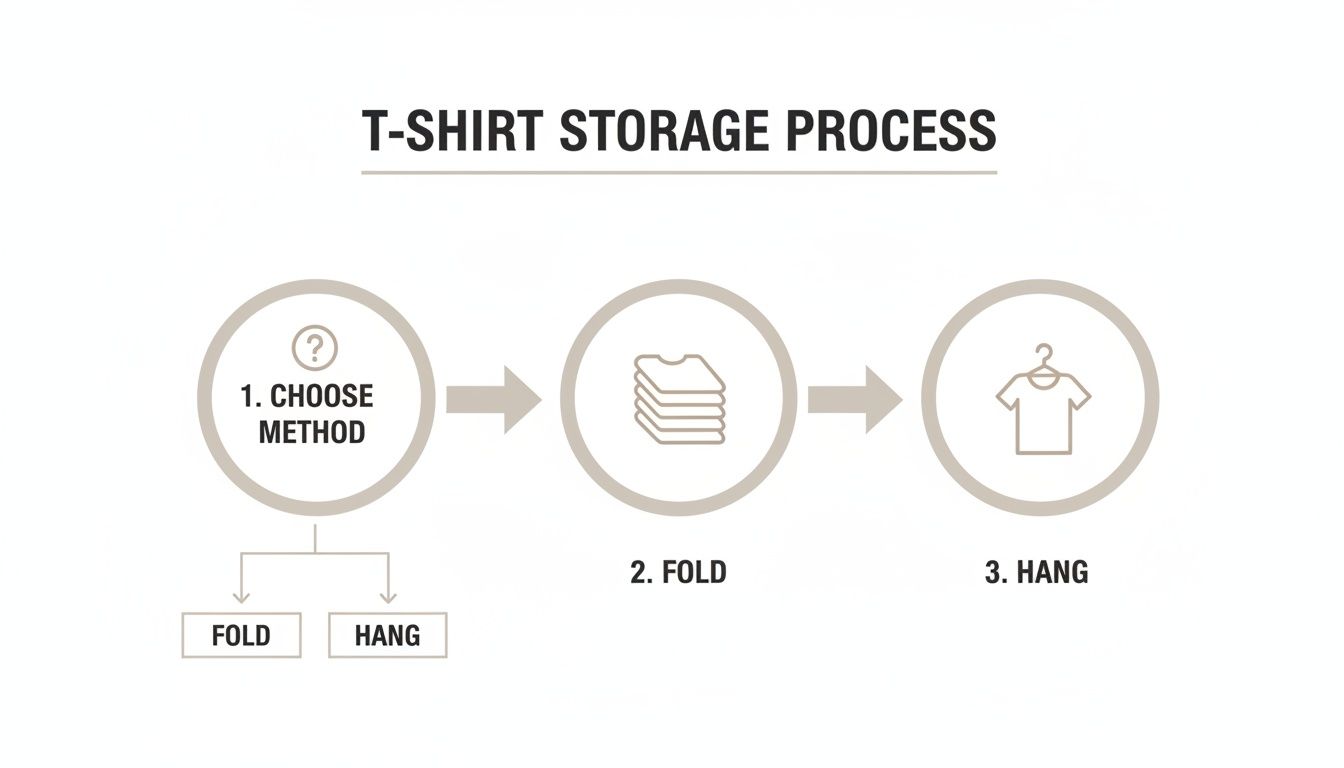
As you can see, once you commit to a method, the right technique is what makes it all work.
The File Fold Technique
Made famous by Marie Kondo, the file fold is, in my opinion, the absolute best method for storing tees in a drawer. Instead of stacking, you stand them up vertically, just like files in a filing cabinet. This simple trick lets you see your entire collection in a single glance, maximizing closet organization.
To do it, just lay your shirt flat, fold both sides toward the middle to make a long rectangle, and then fold that rectangle into thirds. The trick is to create a small, sturdy package that can stand up on its own.
By allowing shirts to stand upright, the file fold maximizes vertical drawer space and completely eliminates the problem of forgotten shirts buried at the bottom of a stack.
Getting your folds precise and uniform is a huge space-saver. In Europe, where the T-shirt market is expected to grab 21.10% of the global share by 2025, organization is key. KonMari-style folding can cut down on drawer chaos by as much as 40%. I've seen it firsthand—it slashes the time it takes to find a shirt by 25% and helps prevent 30% of overbuying because you can actually see everything you own. You can dive deeper into these trends over at Cognitive Market Research.
The Ranger Roll for Ultimate Compression
For maximum compression, nothing beats the ranger roll (also called the army roll). This technique creates a super tight, compact cylinder that's a lifesaver when you're packing a suitcase or trying to cram extra shirts into small storage bins within your closet.
Here’s the breakdown:
- Lay the shirt flat and fold the bottom hem up a few inches. This creates a little "pocket."
- Fold the left and right sides in toward the center.
- Start at the collar and roll the shirt down as tightly as you possibly can.
- When you get to the bottom, use that pocket you made to tuck the whole roll into itself. It secures it perfectly.
This method is brilliant for keeping shirts from wrinkling in a travel bag and is the best way to store T-shirts in awkward closet spaces where traditional folding just won't work.
The Classic Retail Fold
If you're storing T-shirts on open shelves in your closet instead of in drawers, the classic retail fold gives you that clean, uniform look you see in stores. It's designed specifically for creating neat, stable stacks because the fold is wider and flatter than a file fold.
It definitely looks sharp, but keep in mind that you're back to stacking, which can make it a pain to get to the shirts on the bottom. Still, for a guest room closet or for displaying a smaller collection on shelves, you can't beat its aesthetic appeal.
We've got more detailed walkthroughs on these methods in our guide to folding clothes to save space. Ultimately, each fold has its place, so pick the one that makes the most sense for your closet setup and your lifestyle.
Knowing When to Hang T-Shirts to Avoid Wrinkles
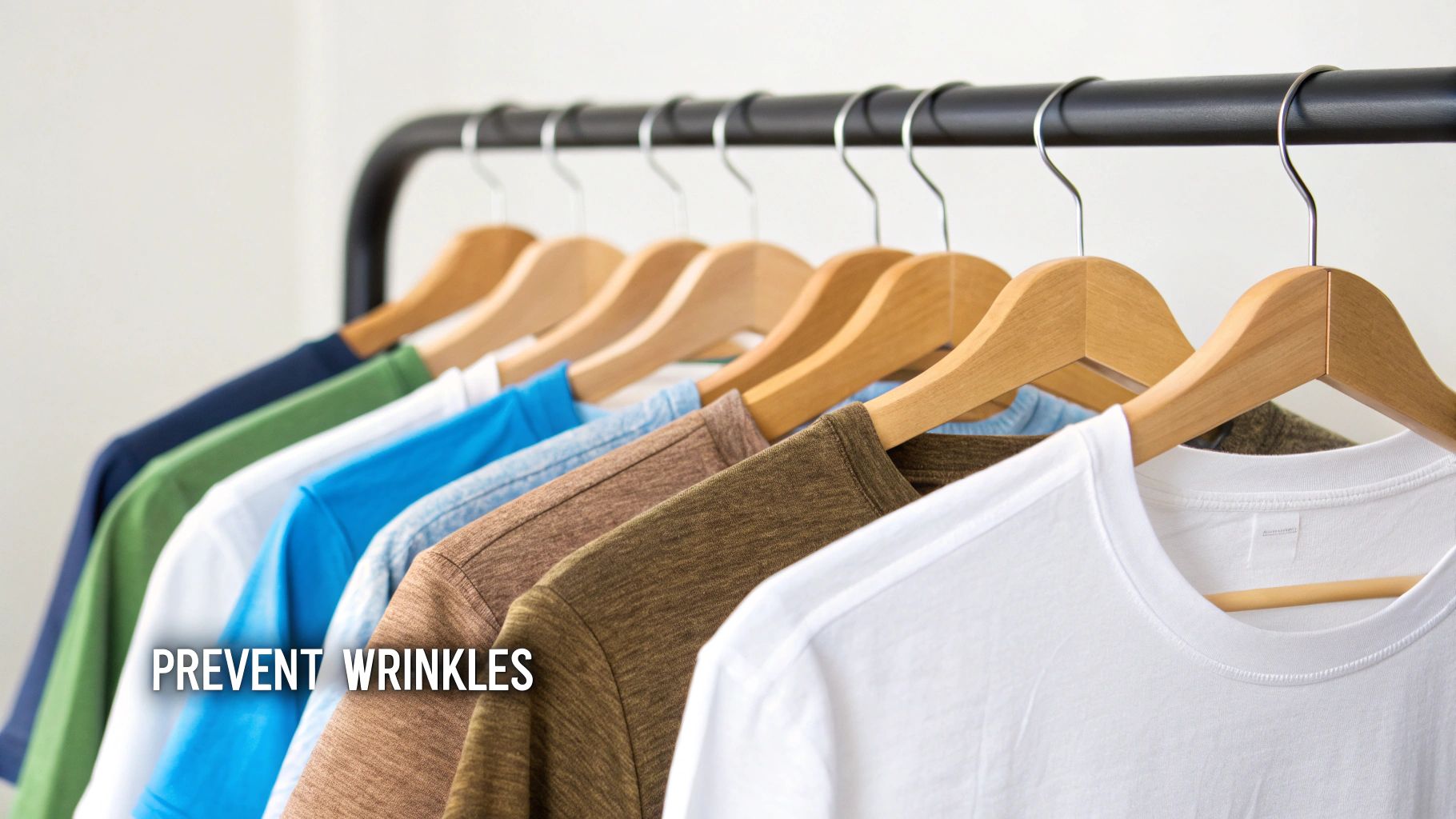
While perfectly folded tees are a drawer's best friend, some situations—and some fabrics—call for a hanger. There isn't a single "best" way to store every T-shirt; it really comes down to the material and your closet setup. Hanging is the clear winner for preventing stubborn creases in more delicate shirts and for keeping your entire collection visible in your closet at a glance.
For a lot of people, especially those short on drawer space, hanging T-shirts is just the most practical solution for closet organization. In fact, the global market for clothes racks is expected to top 350 million units by 2033, and this is exactly why. A well-organized rack doesn't just look good; it improves air circulation, which can cut down on how often you need to do laundry by 15-20%. Plus, it helps you actually wear the 23.10% of T-shirts that tend to get lost in a crumpled drawer pile. If you're curious about these trends, you can dig into the data from Data Vibe.
This visual access is a huge perk of an organized closet. When you can see every shirt you own, you're far more likely to rotate through your wardrobe instead of just grabbing the same few tops from a folded stack.
Identifying Hanger-Friendly Fabrics
The deciding factor in the hang-versus-fold debate is almost always the fabric. Your heavy, sturdy cotton tees are usually better off folded to prevent stretching. Hanging them can cause the shoulders and neckline to stretch out over time from their own weight.
But some materials practically beg to be hung.
- Linen and Linen Blends: Famously prone to wrinkling, these shirts stay much smoother on a hanger.
- Rayon, Modal, and Tencel: These silky, drapey fabrics will develop deep creases when folded that are a real pain to iron out.
- Slub Cotton: This textured, lighter-weight cotton wrinkles easily and can lose its unique look if it's squashed in a drawer.
- Performance Fabrics: Most athletic shirts are made from synthetics designed to be wrinkle-resistant, so they are perfectly safe to hang.
A good rule of thumb I always follow: if the fabric feels delicate, lightweight, or is notorious for wrinkling, a hanger is its best friend. This one small step preserves the shirt’s intended shape and saves you a ton of time with the iron.
Choosing the Right Hangers to Prevent Damage
Not all hangers are created equal. I've seen so many great shirts ruined by the wrong hanger, leaving behind those awful shoulder bumps or a stretched-out neck.
Let's get one thing straight: wire hangers are the enemy of good closet organization. Avoid them at all costs. Instead, you'll want to choose hangers that actually support your clothes.
- Velvet Hangers: These are my personal favorite. The non-slip surface keeps shirts from sliding off, and their ultra-slim profile is a lifesaver for maximizing closet space.
- Padded Hangers: A great choice for extremely delicate fabrics. The soft padding distributes the garment's weight evenly, preventing any stress on the seams.
- Wooden Hangers: While they take up more room, their wide, curved shape is perfect for maintaining the natural contour of a T-shirt’s shoulders.
The right hanger is a small investment that makes a big difference in how long your clothes last. If you find yourself battling wrinkles no matter what, our guide on how to prevent wrinkled clothes has some extra tips you might find helpful.
Maximizing Your Vertical Closet Space
Hanging your tees doesn't have to eat up all your closet real estate. With a few smart tools and techniques, you can hang everything efficiently, even in the smallest closets.
One of the best tricks for closet organization is using tiered or cascading hangers. For example, a single MORALVE space-saving hanger can hold several shirts vertically, which instantly multiplies your usable rod space. This is an absolute game-changer if you're in an apartment or just dealing with a cramped closet.
Another easy win is to organize your hung shirts with a system. Grouping them by color creates a clean, calming look and makes finding what you want in the morning so much faster. You could also organize by sleeve length—tanks, short sleeves, long sleeves. A little bit of order turns your closet from a messy storage zone into a functional, easy-to-use part of your home.
Designing Your Perfect T-Shirt Organization System
Knowing a few good folding techniques is great, but the real game-changer is building a closet organization system that you'll actually stick with. We're aiming for a personalized setup so simple and intuitive that it becomes second nature—no more wrestling with a messy drawer every morning.
Think of it as creating a personal library for your t-shirts, where everything has its place and is easy to find, wear, and put away. This is where we move from just knowing how to fold to knowing where to put everything to make your life easier. A good system is flexible and just works, ending that frantic "I have nothing to wear" search once and for all.
Creating Categories That Actually Work for You
First things first, you need to sort your tees into logical groups for your closet. I’ve seen people try to organize only by color, but that system usually falls apart because our lives are more complicated than a rainbow. The trick is to create categories based on how you actually use your clothes.
A layered approach almost always works best. Try combining a few of these methods:
- By Occasion: This is my personal favorite for pure practicality. Carve out distinct zones in your closet for your workout tees, casual weekend shirts, basic undershirts, and maybe even those nicer t-shirts you can get away with at work.
- By Frequency of Use: Be honest about what you wear all the time. Your go-to shirts deserve the prime real estate in your closet—front and center in a drawer or at eye-level on a shelf. The shirts you wear less often can go in the back or on a higher shelf.
- By Color: Once you've sorted by occasion, arranging the shirts within each category by color is a fantastic finishing touch. It's visually calming and makes grabbing that specific gray V-neck a breeze.
Getting this initial sort right is the bedrock of a closet that truly works for you, not against you.
Essential Tools for a Tidy Closet
With your categories set, a few simple tools can take your closet organization from pretty good to practically perfect. Don't worry, we're not talking about expensive gadgets—just some basic items that help maintain the order you've created.
For folded t-shirts, drawer dividers are a must-have. Seriously. They create neat little channels for your file-folded tees, stopping them from slumping into one big, messy pile after a week. If you're using shelves, shelf dividers do the exact same job, keeping your stacks from toppling over.
The most successful closet organization systems rely on simple structures to maintain order. Dividers act like guardrails, making it almost impossible for your t-shirts to become disorganized again.
If you’re hanging your shirts, create some visual separation on the closet rod. Grouping them by sleeve length (tanks, short sleeves, long sleeves) and then by color within those groups makes your closet look incredibly curated. For an even more versatile setup, you can introduce elements like wardrobe hanging shelves for stylish closet organization to mix and match folded and hung items.
Ultimately, the best way to store your t-shirts is whatever system removes friction from your daily routine. Putting away a clean shirt should take seconds, not a minute of strategic refolding and restacking. A little time spent planning your closet now pays off with a little more calm every single day.
Long-Term Storage Solutions to Protect Your T-Shirts
When you’re packing away seasonal or sentimental t-shirts, you want them to come out of storage looking just as good as they did going in. That means creating a safe environment that shields them from light, moisture, and pests. Getting this right starts with ditching one of the most common storage mistakes: the plastic bin.
I know they're convenient, but those airtight plastic containers can be a death sentence for fabric. They trap any moisture that's in the air, which can eventually lead to mildew and that awful yellowing, especially on your favorite white tees.

Choose Breathable Storage Containers
The single most important factor for long-term closet storage is breathability. You need containers that let air circulate just enough to prevent moisture buildup while still keeping dust and critters out.
- Cotton Storage Bags: These are a fantastic choice. The natural fibers let air pass through freely, making them perfect for storing a handful of special shirts.
- Archival Boxes: If you're storing valuable vintage tees, acid-free archival boxes offer rigid protection from light and environmental damage.
- Fabric Bins: For bigger collections of off-season shirts, canvas or linen bins strike a great balance between structure and breathability and fit neatly on closet shelves.
Prepare Your T-Shirts Correctly
Before a single shirt goes into a box, a little prep work makes all the difference. Never, ever store dirty or even slightly damp clothing. Stains can set permanently over time, and any food residue or body oils are basically an open invitation for pests like moths.
Make sure every shirt is freshly laundered and—this is critical—completely dry. Even a tiny bit of moisture can cause huge problems down the line. If you're looking for more general guidance, there are some great tips for storing clothes effectively that expand on these principles for your whole wardrobe.
The most crucial step in long-term storage is preparation. A clean, dry shirt stored in a breathable container is a shirt that will last for years without deteriorating.
Finally, throw in a layer of natural protection. Chemical mothballs leave a harsh, stubborn odor and can even damage fabrics. It's much better to use natural deterrents that keep pests away and leave a subtle, pleasant scent.
- Cedar Blocks or Balls: A classic for a reason. Cedar is a natural repellent for moths and other insects.
- Lavender Sachets: This is my personal favorite. It keeps everything smelling fresh and helps deter pests at the same time.
Just tuck one or two inside your storage containers—making sure they don’t sit directly on the fabric—and your favorite tees will be fresh and ready to wear next season.
Your T-Shirt Storage Questions Answered
Even with the best closet organization system, a few tricky situations always seem to pop up. Let's tackle some of the most common questions I get asked when it comes to getting T-shirt storage just right.
How Should I Store Graphic Tees?
When it comes to your favorite graphic tees, folding is definitely the way to go. Hanging them can stretch the fabric over time, which often leads to the printed design cracking and fading—a tragedy for a beloved band shirt.
The secret is to fold the shirt with the graphic facing inward. This protects it from rubbing against other clothes in the drawer. The file fold is my go-to method here because it keeps the tee standing upright, so the design is safe from friction while still being easy to spot in your organized closet.
Protecting your graphic tees comes down to one simple rule: minimize friction and folding stress on the print. Always fold with the graphic facing inward to keep it looking great for years.
What About Wrinkle-Prone Fabrics?
Are you constantly fighting with wrinkled T-shirts? The culprit is probably the fabric itself. Materials like linen, rayon, and even some very thin cottons are notorious for creasing the moment you look at them.
For these specific items, hanging is the clear winner for your closet. Just be sure to use the right kind of hanger—something wide, padded, or covered in velvet will support the shirt's natural shape and prevent those annoying shoulder bumps. A small change in hangers can save you a ton of time with the iron or steamer.
Can I Store T-Shirts in Vacuum Seal Bags?
Vacuum seal bags are amazing space-savers, but you have to use them carefully for closet storage. They’re really only suitable for short-term or seasonal storage. If you leave natural fibers like cotton compressed in an airless bag for too long, you risk damaging the fabric and setting in wrinkles that are nearly impossible to remove.
If you decide to use them, stick to these guidelines:
- Perfect for Seasonal Swaps: They're a fantastic solution for stashing away off-season shirts for a few months on a high closet shelf.
- Don't Go Overboard: Avoid sucking every last bit of air out. Leaving a little loft helps protect the fabric.
- Unpack Promptly: As soon as you're ready to bring the shirts back into rotation, take them out, give them a good shake, and let them air out for a bit.
Ready to build a closet system that finally puts an end to the clutter? Having the right tools is half the battle. Explore the collection of innovative, space-saving solutions at MORALVE and see how simple it can be to create a wardrobe you love. Check out our hangers and organizers to get started on your closet transformation.
Leave a comment