

A Practical Guide to Closet Organization for Apartments

Effective closet organization for apartments comes down to two things: an honest look at your wardrobe and a realistic assessment of your space. This is the foundation of any successful closet makeover, especially in a small apartment. It's not the most glamorous part, but skipping it is the fastest way to end up with a bunch of organizers that don't fit and the same old mess.
Your Guide to Reclaiming Closet Space
Apartment living teaches you that every square foot is prime real estate, and that goes double for the closet. Before you get excited about new hangers or clever shelf dividers, we have to start with the basics: figuring out exactly what you have and the physical space you’re working with. This isn't about tidying up just yet; it's about gathering intelligence.
Many people jump straight to buying bins and containers, only to realize they’ve wasted money on solutions that don’t solve their specific problem. Taking a few minutes to measure your closet and confront your clothing collection head-on will save you a ton of frustration later.
Assess Your Space and Your Stuff
First things first, grab a tape measure. You need to know the exact dimensions you're dealing with—the height from the hanging rod to the floor, the width of any existing shelves, and the depth from the door to the back wall. These numbers are your new best friend; they’ll guide every decision you make from here on out.
Next, it's time to pull everything out. And I mean everything. Find a clear patch of floor and get a real, unfiltered look at your entire wardrobe. It might feel a little overwhelming, but you can't organize what you can't see.
The point of this first step isn't to achieve instant perfection. It's all about gaining clarity. Knowing your closet’s true size and exactly what needs to go back inside is the only way to build a system that actually works for apartment life.
A significant number of city dwellers, particularly in apartments under 1,000 sq ft, say closet clutter is their biggest organizational headache. The demand for smart, space-saving solutions is real because the problem is universal.
The 4-Step Closet Assessment Checklist
To get started with a clear plan, here's a quick reference guide covering everything from measuring your space to sorting your wardrobe effectively.
| Step | Action Item | Why It Matters |
|---|---|---|
| 1. Empty the Closet | Take everything out. | Creates a blank slate and reveals the true volume of your belongings. |
| 2. Measure Everything | Record the closet's height, width, and depth. | Ensures any new organizers or storage solutions will actually fit. |
| 3. Sort Your Items | Use the four-box method: Keep, Donate, Store, Discard. | Makes sure only the items you truly need and love take up valuable space. |
| 4. Group "Keep" Items | Organize your "keep" pile by category (e.g., shirts, pants, dresses). | Helps you understand how much space each category requires. |
This checklist turns a daunting task into a manageable process, setting you up for long-term success.
The Four-Box Sorting Method
With your floor covered in clothes, it’s time to make some decisions. Get four boxes or create four distinct piles: Keep, Donate, Store, and Discard. This method forces you to decide the fate of every single item, getting rid of that "maybe" pile that just turns back into clutter.
- Keep: These are the items you genuinely love, wear often, and that fit you right now. No exceptions.
- Donate: Anything in good condition that you no longer wear. Let someone else enjoy it!
- Store: Think seasonal items (heavy winter coats in July) or sentimental pieces you can't part with but don't need access to every day.
- Discard: Be ruthless. Anything stained, torn beyond repair, or just worn out has to go.
This sorting phase is often the toughest part, but it’s also the most liberating. For a deeper dive into smart strategies, check out these best ways to organize a small closet. Ultimately, if you want to know how to create more closet space, you first have to decide what’s actually worthy of being in there.
This simple workflow is a great visual reminder of the essential first steps for any apartment closet project.
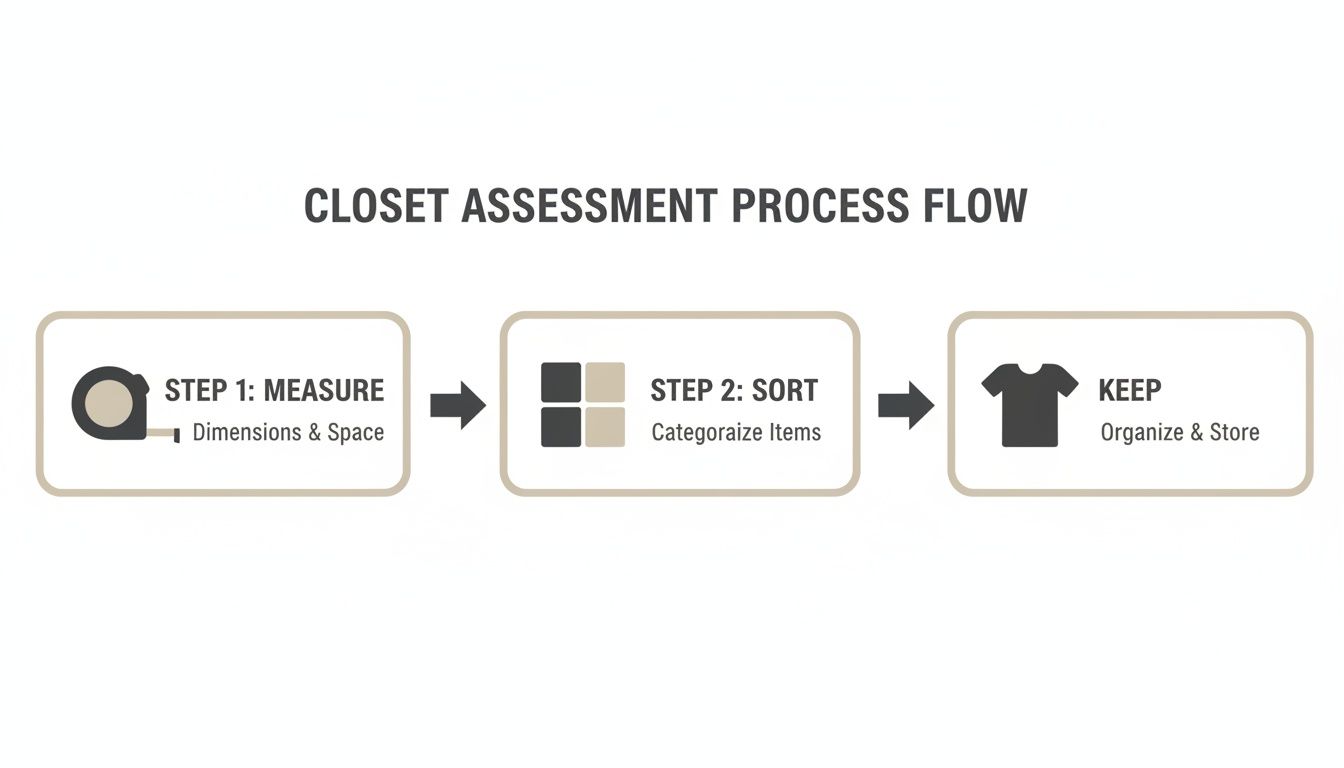
It really drives home the point: a successful organization project always starts with measuring your space and thoughtfully decluttering before you bring a single new thing into the mix.
Thinking Vertically: Unlocking Your Closet’s True Potential
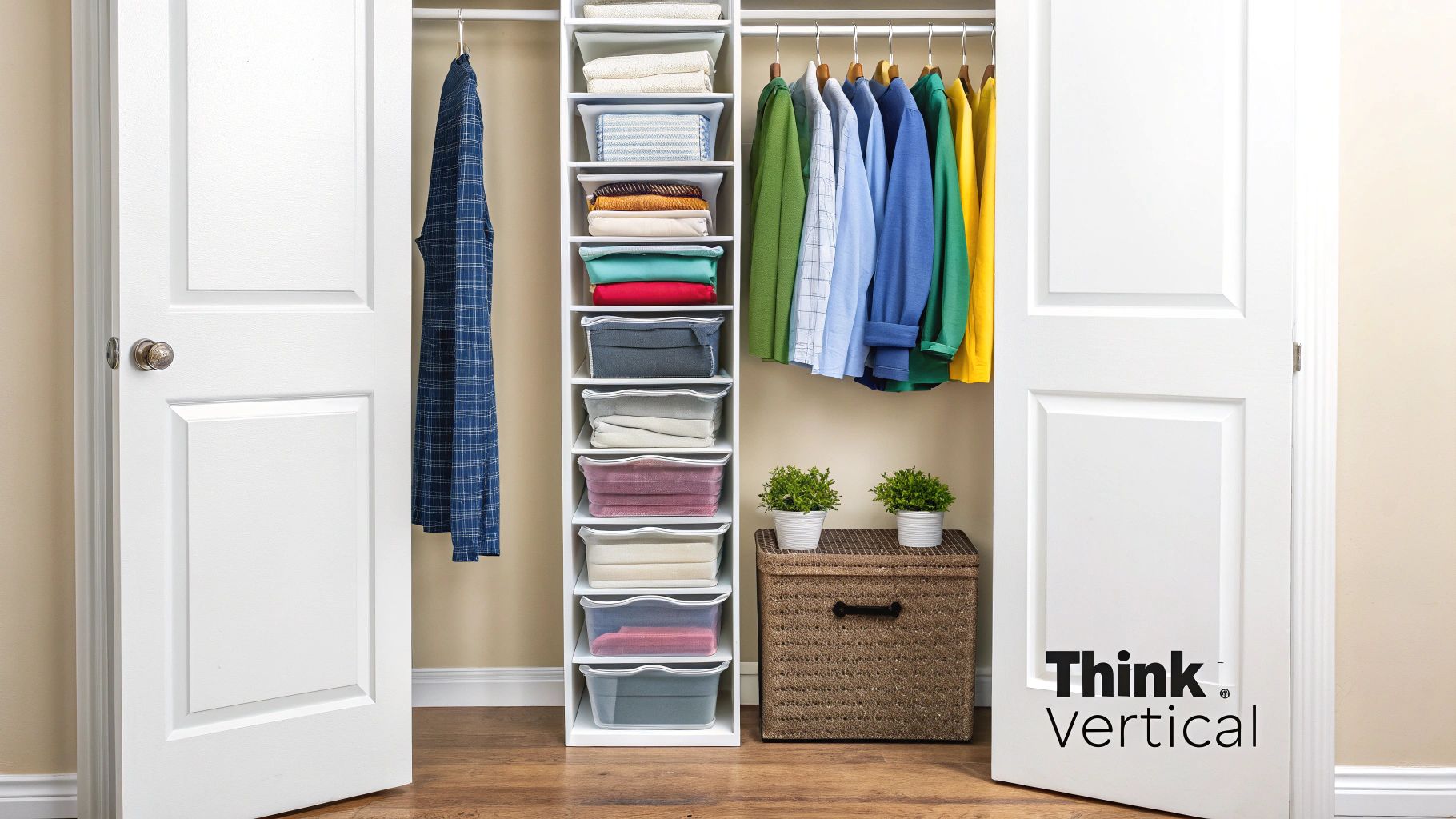
Let's be honest, most apartment closets have a terrible design flaw. You get one rod and maybe a high shelf, leaving a huge, empty chasm below your hanging clothes. This isn't just wasted space; it's a massive missed opportunity. The real secret to effective closet organization for apartments isn't about wishing for a walk-in. It's about learning to think vertically.
Once you start looking up and down instead of just side-to-side, you’ll find so much untapped storage potential. It’s all about turning that dead air into a functional, accessible home for everything from folded jeans to your shoe collection.
Build Up with Shelving
One of the fastest ways to reclaim that vertical real estate is with shelving. You don't need to install a custom built-in system to see a huge difference.
Try sliding a narrow, freestanding shelving unit right into your closet. It’s the perfect spot for bulky items like sweaters and denim that otherwise eat up drawer space. This simple move gets things off the floor and makes them so much easier to find.
Another great trick is a hanging shelf organizer. It hooks right onto your existing rod, instantly creating cubbies for t-shirts, workout clothes, or small bags. If you’re hunting for more ideas, there are tons of smart shelving ideas for closets that are perfect for tight spaces.
Don't Forget the Door and Floor
Beyond traditional shelves, you need to get creative with stackable solutions and overlooked surfaces. The back of your closet door is probably the most underused piece of real estate in your entire apartment.
- Over-the-Door Organizers: These are lifesavers for shoes, scarves, belts, and even toiletries. They add a ton of storage without taking up an inch of floor or rod space.
- Stackable Bins: Use clear, stackable bins on the floor or that top shelf. They’re fantastic for off-season clothes, keeping them dust-free while letting you see exactly what's inside.
This strategy is more important than ever. Making smart upgrades like these can boost a closet's efficiency by up to 50%—a game-changer when you feel like the walls are closing in.
The goal is to create layers of storage. Your closet shouldn't be a single-level system. By using tiered shelving, door organizers, and stackable bins, you can easily double or even triple your storage capacity.
Cascade Your Hangers
Finally, even the way you hang your clothes can be a vertical strategy. Instead of giving every single garment its own horizontal space on the rod, look for hangers that let you cascade items downwards.
Multi-garment hangers for pants, skirts, or even tank tops let you hang several pieces in the same vertical space as a single old-school hanger. This one simple swap can free up inches—sometimes even feet—of precious rod space. It’s a tiny change that delivers a massive payoff, turning a jam-packed rod into a tidy, organized column of clothes.
Mastering The Art Of Strategic Hanging
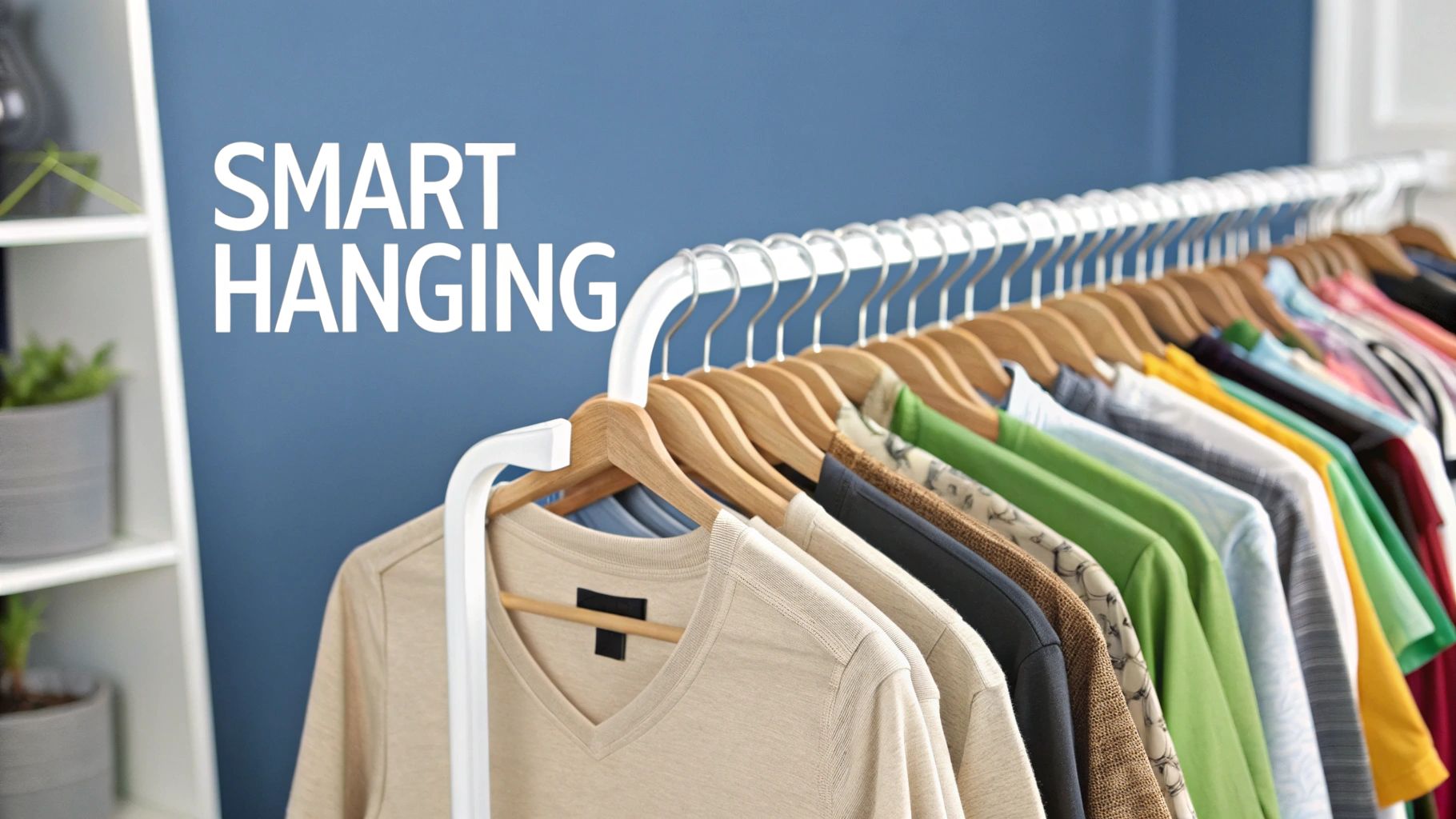
The way you hang your clothes can make or break your closet organization. It’s not just about getting things off the floor; it’s a strategic move that can either magically create space or gobble it up. One of the single most effective changes you can make, with surprisingly little effort, is upgrading your hangers.
Those bulky plastic hangers or the tangle of wire hangers from the dry cleaner are notorious space hogs. Making the switch to a uniform set of slim, non-slip velvet hangers is a fantastic starting point. This simple swap instantly gives your closet a clean, streamlined look and can reclaim inches of precious rod space. But that's just the beginning.
Specialized Hangers: The Real Secret Weapon
To truly conquer a cramped closet, you need to think beyond the standard hanger. You need tools designed specifically for the job—hangers engineered to multiply your storage capacity.
Consider a common clutter culprit: a dozen tank tops can quickly crowd a rod. This is where a dedicated tank top hanger comes in. It can consolidate up to eight tops into the vertical footprint of just one hanger, immediately freeing up a huge chunk of room.
Then you have cascading hangers, which are an absolute must-have for small spaces. These clever designs let you hook hangers onto one another, layering your clothes vertically instead of horizontally. This is perfect for creating grab-and-go outfits—hang a blazer, the shirt that goes under it, and the matching pants all in one neat column. This technique alone can easily double or even triple your usable rod space. If you're looking for more ideas, check out our guide to powerful space saving hangers for clothes that work wonders in apartments.
Smart hanging isn't just about cramming more stuff in. It’s about protecting your clothes and making your daily routine smoother. When every item has a proper place, you prevent wrinkles, find what you need in seconds, and take the stress out of getting dressed.
Match The Hanger To The Garment
Using the right tool for the job is a rule that definitely applies to your wardrobe. Not all clothes have the same needs, and using the right kind of hanger prevents annoying problems like stretched-out necklines, shoulder bumps, and constant slipping.
- Pants and Skirts: Look for multi-tiered hangers that hold several pairs vertically. These usually have clips or non-slip bars to keep everything secure without leaving creases.
- Blouses and Camisoles: For delicate items with thin straps, choose velvet hangers with those little built-in divots or find specific camisole organizers. No more finding your favorite tops in a heap on the closet floor.
- Suits and Outfits: Cascading hangers or dedicated suit hangers with multiple bars are perfect for keeping matched sets together. This is a real time-saver on busy mornings.
To help you decide, here’s a quick rundown of some of the best space-saving options out there.
Choosing The Right Hanger For Your Apartment Closet
| Hanger Type | Ideal For | Key Benefit |
|---|---|---|
| Slim Velvet Hangers | Everyday shirts, blouses, dresses | Maximizes rod space with a thin profile and prevents clothes from slipping off. |
| Cascading Hangers | Coordinated outfits, shirts, pants | Doubles or triples vertical space by allowing you to hang items in a tiered fashion. |
| Multi-Pant Hangers | Trousers, jeans, slacks, skirts | Consolidates 5+ pairs of pants into the space of a single hanger. |
| Tank Top/Camisole Hangers | Camis, tank tops, bras, slips | Organizes up to 8 strappy items vertically, clearing significant rod clutter. |
| Padded Hangers | Delicate fabrics like silk, satin, lace | Prevents snags and stretching on fragile garments while maintaining their shape. |
Once you’ve got the right hangers, take five minutes to arrange your clothes by category (all shirts together, all pants together) and then by color within each category. This little trick makes your closet look like a curated boutique and makes finding exactly what you need a breeze. Your closet will go from a source of stress to a functional, peaceful space.
Taming Shoe And Accessory Clutter
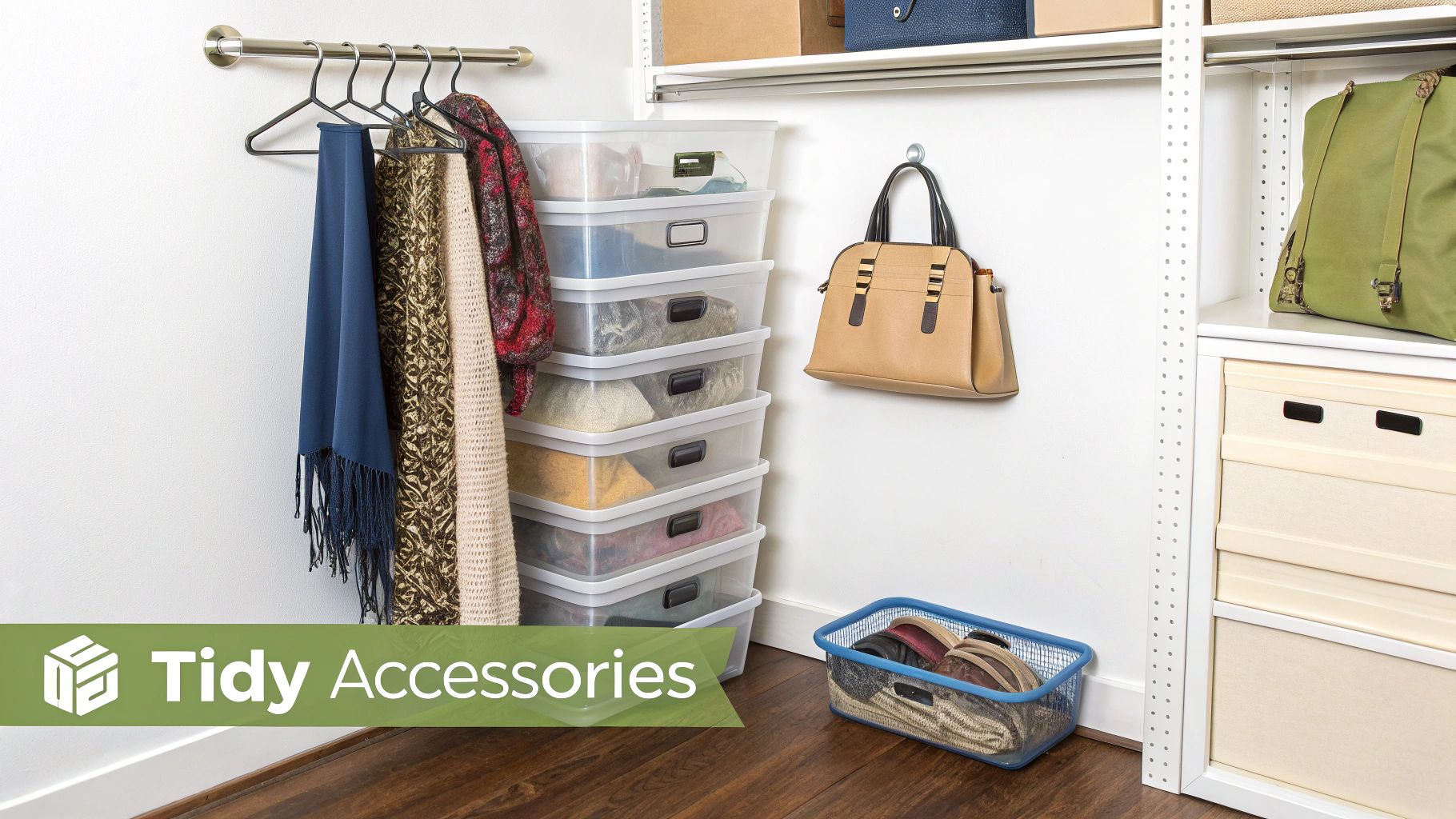
So, your clothes are perfectly hung and folded. Fantastic. But what about the real culprits behind most closet chaos? I'm talking about the shoes, bags, belts, and scarves that seem to multiply in dark corners and create messy piles on the floor.
To get your closet organization for apartments truly under control, every single one of these items needs a proper home. This is where you can get really clever, because you’re dealing with all sorts of odd shapes in a tight space. It's time to graduate from the "floor pile" method and embrace solutions that let you see and grab what you need.
Give Every Item A Home
The biggest mistake people make is treating their accessories like an afterthought. They deserve just as much organizational attention as your clothes do.
That jumble of shoes on the closet floor? It’s not just messy—it's a waste of prime real estate and it's bad for your shoes. You can find some great in-depth tips on how to store shoes efficiently for small spaces. My personal favorite for apartment closets is using clear, stackable shoe boxes. They keep everything dust-free and you can instantly spot the pair you’re looking for.
For everything else, think about targeted solutions:
- Handbags: Simple S-hooks are perfect for hanging purses from the main closet rod. If you have door space, a hanging organizer with clear pockets is a game-changer.
- Belts and Scarves: Ditch the drawer-stuffing. A basic wall-mounted rack or a purpose-built hanger with lots of loops will keep your collection neat and accessible.
- Jewelry: Find a bit of empty wall space and stick on a few small, clear adhesive hooks. They’re perfect for keeping necklaces and bracelets from becoming a tangled mess.
Creative Solutions For Small Spaces
When you can't fit a standard organizer, you have to think outside the box. A few simple, non-permanent additions can create a surprising amount of storage.
The best accessory storage happens in places people usually ignore. Look at the inside of your closet door, the small vertical gaps next to shelves, and the empty wall above your hanging clothes. Every blank surface is an opportunity waiting to be used.
For example, you can wedge a small tension rod below a shelf to create a new spot for hanging scarves or even hooking high heels. Another one of my go-to tricks is a pegboard. Mount a small one on a free wall, and you can customize it with hooks and tiny baskets for everything from sunglasses to clutches.
This isn't just about making things look nice. An organized closet can save you a significant amount of time each week—time you get back just by knowing where everything is.
Keeping Your Organized Closet That Way
You’ve put in the work—the sorting, the installing, the perfect folding. Now comes the real challenge: keeping it that way. The final, and arguably most crucial, piece of the closet organization for apartments puzzle is maintenance. An organized closet is fantastic, but only if it doesn't immediately fall back into chaos. The good news? Preventing that slow creep of clutter is easier than you might think.
The trick is to stop thinking of organization as a massive, one-and-done project. Instead, it’s all about building a few small, nearly effortless habits into your daily life. You don’t need to block out another whole weekend. A couple of simple routines will keep your space functional and serene for the long haul.
Adopt Sustainable Daily Habits
Long-term organization really comes down to small, consistent actions. One of the most powerful habits you can adopt is the "one in, one out" rule. It’s brilliantly simple: for every new piece of clothing you bring home, an old one has to go. This single habit is a fortress against the slow accumulation of stuff that inevitably leads to overflowing drawers and a jammed closet rod.
Another game-changer is the 10-minute weekly tidy-up. Seriously, that's all it takes. Just set aside ten minutes every weekend to put things back where they belong. Hang up the clothes that have migrated to "the chair," refold that one messy stack of sweaters, and straighten your shoe rack. It's a tiny investment of time that stops a little bit of disarray from turning into a full-blown disaster.
Think of closet maintenance like any other routine. You wouldn't skip brushing your teeth for a month and then spend hours catching up. Consistent, small efforts are far more effective than occasional, overwhelming purges.
Use a Seasonal Checklist for Easy Upkeep
A seasonal check-in is the perfect way to make sure your closet system is still working for you. As the weather changes, so does your wardrobe. This natural transition point is the ideal time to reassess, rotate, and refresh your space.
A simple checklist can keep you on track without feeling like a huge chore:
- Rotate Your Wardrobe: Move out-of-season items to less accessible spots, like the top shelf or under-bed bins. Bring the current season's clothes front and center. This not only makes getting dressed easier but also protects your off-season garments.
- Reassess Your Needs: Is your setup still practical? Maybe you realized you need more dedicated space for bulky sweaters in the winter or for sundresses in the summer. Don't be afraid to tweak your layout and organizers.
- A Quick Declutter: Do a mini-purge while you’re at it. Did you actually wear that chunky scarf at all last winter? If the answer is no, it might be time to donate it and reclaim that valuable space.
By embedding these small habits and seasonal checks into your routine, you transform closet organization from a dreaded chore into an easy, ongoing practice. It’s how you guarantee you’ll keep enjoying all the benefits of your hard work.
Answering Your Most Common Apartment Closet Questions
Even with a solid plan, every closet has its own quirks. What works wonders in one apartment might fall flat in another. Let's tackle some of the most frequent questions and real-world problems that pop up when you're trying to get organized.
These are the kinds of issues that can stop a project dead in its tracks, but thankfully, they usually have simple, targeted solutions.
"How Can I Organize My Closet With Absolutely No Money?"
It's totally possible—it just calls for some creativity. The single most powerful thing you can do, which costs absolutely nothing, is a thorough decluttering session. Just letting go of what you don't need instantly creates breathing room.
Next, look around for things you can repurpose. Old shoeboxes make surprisingly good drawer dividers for socks, underwear, or accessories. Got soda cans? The tabs can be used to double your hanging space. Just loop one over a hanger's hook and slip another hanger through the bottom hole. It’s a classic trick that works.
Your apartment's real estate is valuable. Make sure you're only storing things you truly need or that genuinely make you happy. Don't be shy about MacGyvering a solution that makes your space work for you.
To clean up the floor, try arranging your shoes heel-to-toe. It's a small adjustment that saves more space than you'd think. And for bulky items like sweaters and jeans, "file fold" them and stack them vertically on your shelf instead of hanging them. You'll be amazed at how much rod space you free up.
"What's the Best Way to Organize My Hanging Clothes?"
Getting your hanging clothes under control really comes down to three things: the right hangers, a smart system, and using your vertical space.
First, ditch the mismatched hangers. Switching to a uniform set of slim, non-slip hangers is a game-changer. This one simple move can free up a shocking amount of rod space while giving your closet a clean, calming look. Plus, no more shirts puddled on the floor.
Then, categorize everything logically. Group like with like—all your shirts together, all your pants together, and so on. If you want to take it a step further, arrange each category by color. It looks fantastic, but more importantly, it makes grabbing what you need on a busy morning completely effortless.
"How Do You Store Seasonal Clothing in a Small Apartment?"
When you live in a small space, seasonal storage is all about thinking outside the closet. Your primary closet space is prime real estate for what you wear day-to-day, so off-season stuff needs a different home.
The hands-down best solution here is vacuum-sealed bags. They are miracle workers for bulky winter coats and chunky sweaters, shrinking them down by up to 75%. Once compressed, they're flat enough to slide right under your bed or get stashed on that high, out-of-the-way shelf.
For those transitional pieces—a light jacket or a few cardigans you might need on a cool evening—fabric under-bed storage containers are perfect, especially ones with clear lids. Just make sure everything is clean before you pack it away to prevent stains from setting in and to keep pests away. And always, always label the containers. You'll thank yourself later.
"My Closet Is Just a Single Rod and a High Shelf. What Do I Do?"
Ah, the classic (and endlessly frustrating) apartment closet. The good news is you can absolutely turn this setup into a powerhouse of organization.
Your first move? Get a hanging closet organizer. The kind with fabric shelves that hangs right from the rod is perfect. This instantly gives you cubbies for folded items like T-shirts and jeans, breaking up that long, awkward drop.
Use that high shelf for things you don't need often. Think extra bedding, luggage, or your vacuum-sealed seasonal clothes. Put them in clearly labeled bins so you know what's what at a glance. For the hanging space you have left, a few space-saving cascading hangers will work wonders to group outfits or types of clothing vertically.
Finally, don't write off the door and the floor. An over-the-door rack is a lifesaver for shoes, belts, and scarves. A simple two-tiered shoe rack on the floor can round out your system, guaranteeing that every single inch of that small closet is pulling its weight.
Ready to turn your cramped apartment closet into a model of efficiency? The right tools make all the difference. Explore MORALVE's collection of space-saving hangers and smart organization solutions designed specifically for modern living. Start reclaiming your space today by visiting the MORALVE online store.
Leave a comment