

Easy Closet Organization Tips for a Clutter-Free Space

If you want an organized closet that stays that way, the first step is always the most dramatic: a complete clear-out. Seriously, take everything out. The fastest way to get this done is by sorting every single item into one of three piles: ‘Keep,’ ‘Donate,’ or ‘Discard.’ This initial purge is the foundation for a sustainable system and a permanently tidy space.
Your First Step to a Permanently Organized Closet
The thought of tackling a stuffed, messy closet can feel completely paralyzing. But the path to a genuinely organized space is simpler than it seems, and it doesn't start with buying a single bin or hanger.
Before anything else, you have to do a full closet reset. The goal isn't just to get rid of stuff; it's about understanding what you actually own versus what’s just taking up valuable real estate. Seeing everything laid out provides a powerful dose of reality and sets the stage for a new, efficient system.
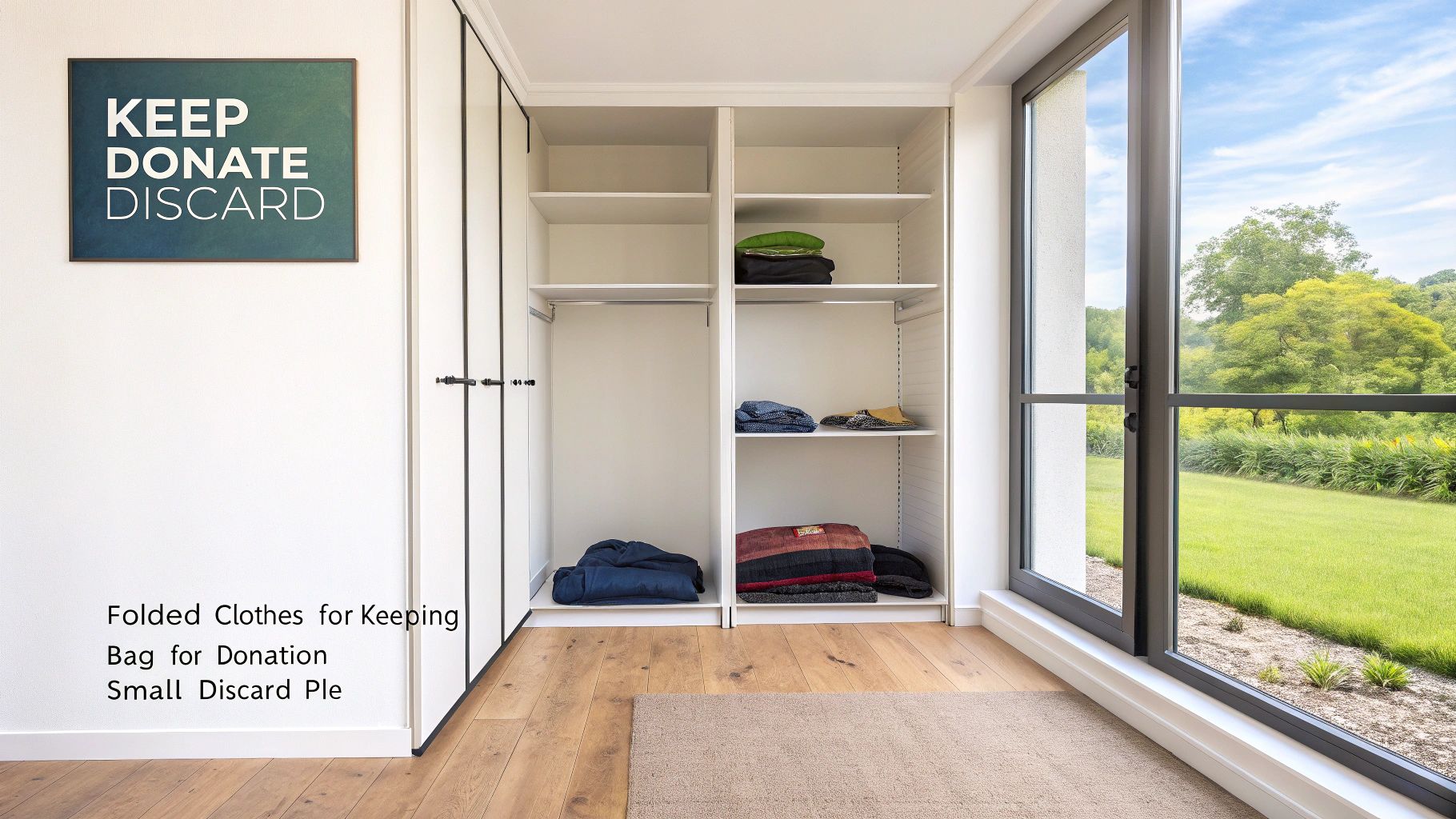
The Four-Box Decluttering Method
To make this process as efficient as possible, grab four boxes or create four distinct zones on your floor or bed. Pull every single item out of the closet. Yes, everything. Seeing the sheer volume is a huge motivator. Then, sort each piece into a category.
This simple framework helps you make quick, effective decisions during your closet clean-out.
| Category | Decision Criteria | Example Item | Action |
|---|---|---|---|
| Keep | I love it, it fits me now, and I wear it regularly. | Your go-to pair of jeans. | Place back in the closet later. |
| Donate | It's in great condition, but it's not my style or size anymore. | That bridesmaid dress you'll never wear again. | Put in a bag for your local charity. |
| Store | It's sentimental or seasonal and in good shape, but I don't need it daily. | Heavy winter coats in the middle of summer. | Box up for storage elsewhere. |
| Discard | It’s stained, ripped, stretched out, or too worn to donate. | A t-shirt with permanent pit stains. | Bag for textile recycling or trash. |
This structured approach takes a lot of the emotion out of the decision-making. Instead of asking, "Will I ever wear this again?" you can ask a more direct question: "Do I love and use this now?" If the whole idea still feels overwhelming, there are some great tips on how to make cleaning out your closet less daunting.
By adding a "Store" pile, you create a home for items you're not ready to part with but that don't belong in your prime closet real estate.
Preparing Your Blank Canvas
Once the sorting is done, you’re left with an empty closet—a true blank canvas. Don't rush to put things back in just yet! Take this golden opportunity to give the space a deep clean.
Wipe down all the shelves, dust the hanging rods, and give the floor a good vacuum. Starting with a fresh, clean environment makes the organizing process feel much more rewarding and signals a genuine new beginning for the space. Now, with a clean slate and only the items you truly want, you’re ready to design a closet that actually works for you.
Designing a Closet That Works for You
A truly organized closet doesn’t happen by accident; it’s a product of smart, intentional design. Now that your space is completely empty, you have a golden opportunity to be the architect of your own wardrobe. This planning stage is the secret sauce for creating a system that feels natural and is incredibly easy to maintain.
Before you even think about putting anything back, grab a tape measure. Seriously. Knowing the exact dimensions—the height between shelves, the width of your hanging space, the depth of the floor—is the first step to unlocking its full potential. These aren't just numbers; they represent possibilities. Sometimes, a functional redesign means rethinking the closet's purpose entirely. For example, some people even learn how to turn a closet into a mudroom to better manage household clutter.
Map Out Your Closet Zones
The heart of any functional closet is zoning. It's a simple concept: you assign a specific purpose to each area based on what you actually wear and how you live. Think of it like a mini-map of your wardrobe.
Start by sketching a quick layout. The most accessible, eye-level space is your prime real estate. This is where the stuff you wear all the time needs to live.
- Prime Zone (Eye-Level): This is for your daily drivers—the shirts, pants, and shoes you reach for without even thinking. Make them ridiculously easy to grab and put away.
- Secondary Zone (High Shelves): Use these harder-to-reach spots for out-of-season clothes, sentimental keepers, or luggage. Think bulky winter coats in the middle of summer or that formal dress you pull out once a year.
- Tertiary Zone (Floor/Low Shelves): Perfect for shoes, handbags, or storage bins filled with accessories. Keeping these items low and contained prevents them from visually cluttering up your main space.
By dedicating prime closet real estate to your top 20% most-worn items, you eliminate 80% of the daily friction that leads to clutter. It's an easy closet organization tip that pays off every single morning.
Plan for Your Lifestyle
Your closet map should be a direct reflection of your life. A corporate lawyer’s closet is going to look completely different from that of a freelance artist who works from home. This kind of personalization is why the home organization market is booming. In fact, the growth of the closet organizer market shows people are hungry for solutions that fit them, not a generic mold.
Think about your daily routines. Do you lay out your outfit the night before? Set up a small, dedicated hook as a "staging area." Are you a fitness fanatic? Your workout gear should be grouped together for a quick grab-and-go. We dive deeper into this in our guide on how to design a closet that truly fits your day-to-day. This kind of thoughtful planning is what makes a system stick for the long haul.
Squeezing Every Last Inch Out of Your Closet
Alright, with the hard part of decluttering and cleaning done, you're looking at a clean slate. This is the fun part—rebuilding your closet into a seriously functional space. The biggest mistake people make is only thinking horizontally, focusing on that single hanging rod. The real secret, especially for small closets, is to go vertical.
Think about it. Most of us only use the middle third of our closet, leaving all that prime real estate above the rod and on the floor completely wasted. A simple shift in perspective can literally double your storage without a single power tool.
This visual breaks down the simple but effective workflow for rethinking your closet's layout. It's all about assessing what you have, grouping it logically, and then putting it back in a way that makes sense for your daily routine.
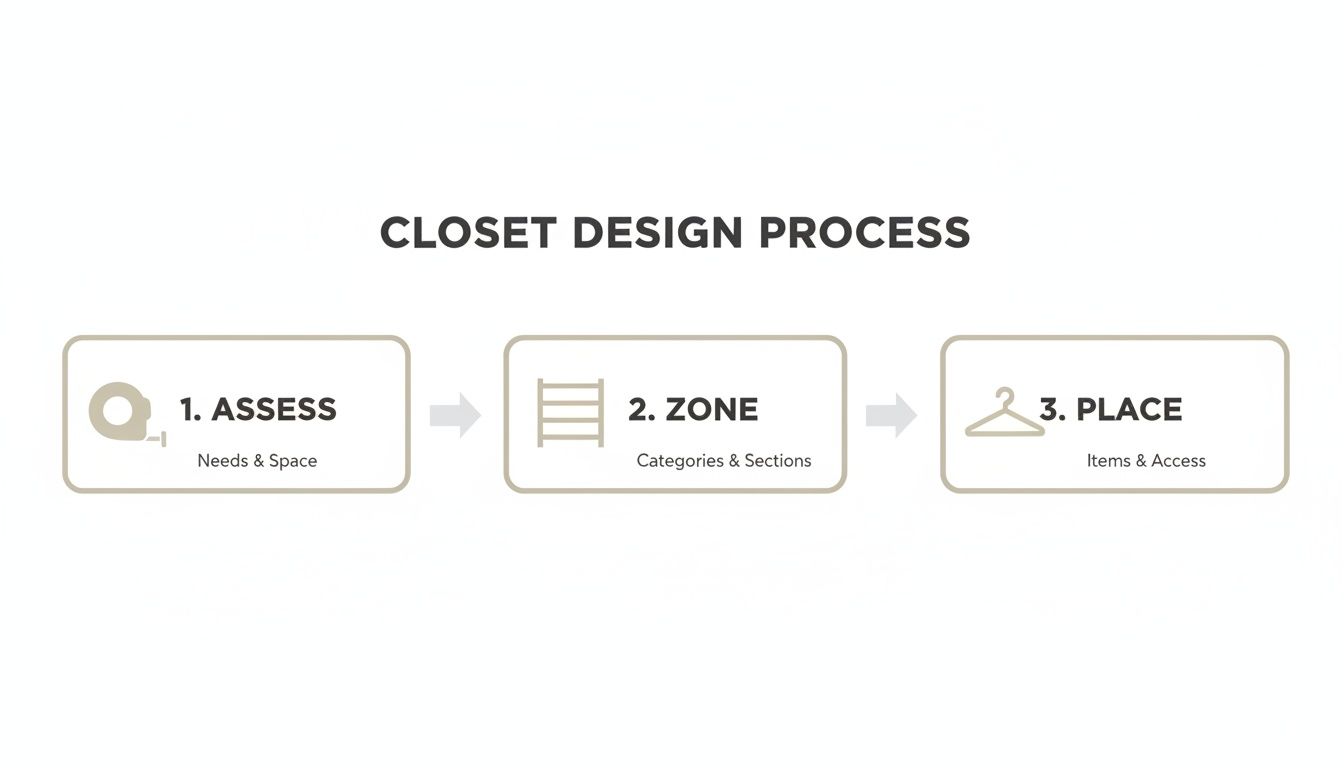
Stick to this Assess, Zone, and Place method, and you'll end up with a closet that’s not just organized, but actually intuitive to use.
The Power of Going Vertical with Smart Hangers
If you want the single fastest, most impactful change you can make, it's this: upgrade your hangers. Those chunky plastic or wooden hangers are secretly eating up a massive amount of your rod space. Making the switch to slim, specialized hangers is a game-changer.
Tiered, space-saving hangers are where the real magic happens. Imagine hanging five pairs of jeans on five separate, bulky hangers. Now, picture hanging all five on a single MORALVE space-saving pant hanger that cascades them neatly downward. It's not a small difference—this one swap can free up as much as 80% of the rod space your pants were hogging.
This same idea works wonders for the rest of your wardrobe:
- Tiered Clothing Hangers: These are brilliant for outfit-prepping. You can hang a complete look—blouse, blazer, and pants—all on one hanger, which is a lifesaver on busy mornings.
- Specialized Skirt Hangers: These let you hang multiple skirts vertically using clips, keeping them wrinkle-free and easy to flip through.
- Tank Top Hangers: Finally, a solution for the tangled mess of camisoles! One of these can hold a whole collection, so they stop slipping off regular hangers and disappearing into a drawer.
Condensing your clothes vertically does more than just save space. It creates a visual catalog of your wardrobe, letting you see everything you own at a glance. When you can see it, you're far more likely to wear it.
Claim Those Forgotten Spaces
Beyond the hanging rod, your closet is probably full of little nooks and crannies that are going completely unused. These are goldmines for storing accessories, shoes, and out-of-season items.
The back of your closet door is the perfect example. It's a blank canvas! An over-the-door organizer with clear pockets is fantastic for stashing scarves, belts, flats, or clutches. You get a ton of storage without sacrificing an inch of shelf or floor space.
Inside drawers, slim dividers can instantly tame the chaos, creating a neat grid for socks, underwear, or rolled-up tees. The goal is to make every single part of your closet work for you. If you need more inspiration, we dive into even more creative tactics for how to maximize small closet space in another guide. It’s all about making your space work smarter, not harder.
Time to Put It All Back Together
Okay, the hard work of planning and decluttering is done. Now for the fun part: putting your clothes back into their new, beautifully organized home. This is where your vision comes to life. The goal isn't just to jam everything back in, but to create a system that actually makes you feel good every time you open the closet doors.
As you start hanging items, be intentional. This is where those good habits start to kick in. Think about what you reach for most often—those pieces should be front and center, right at eye level. The fancy dress you wear once a year? It can go on a higher shelf or in the back.
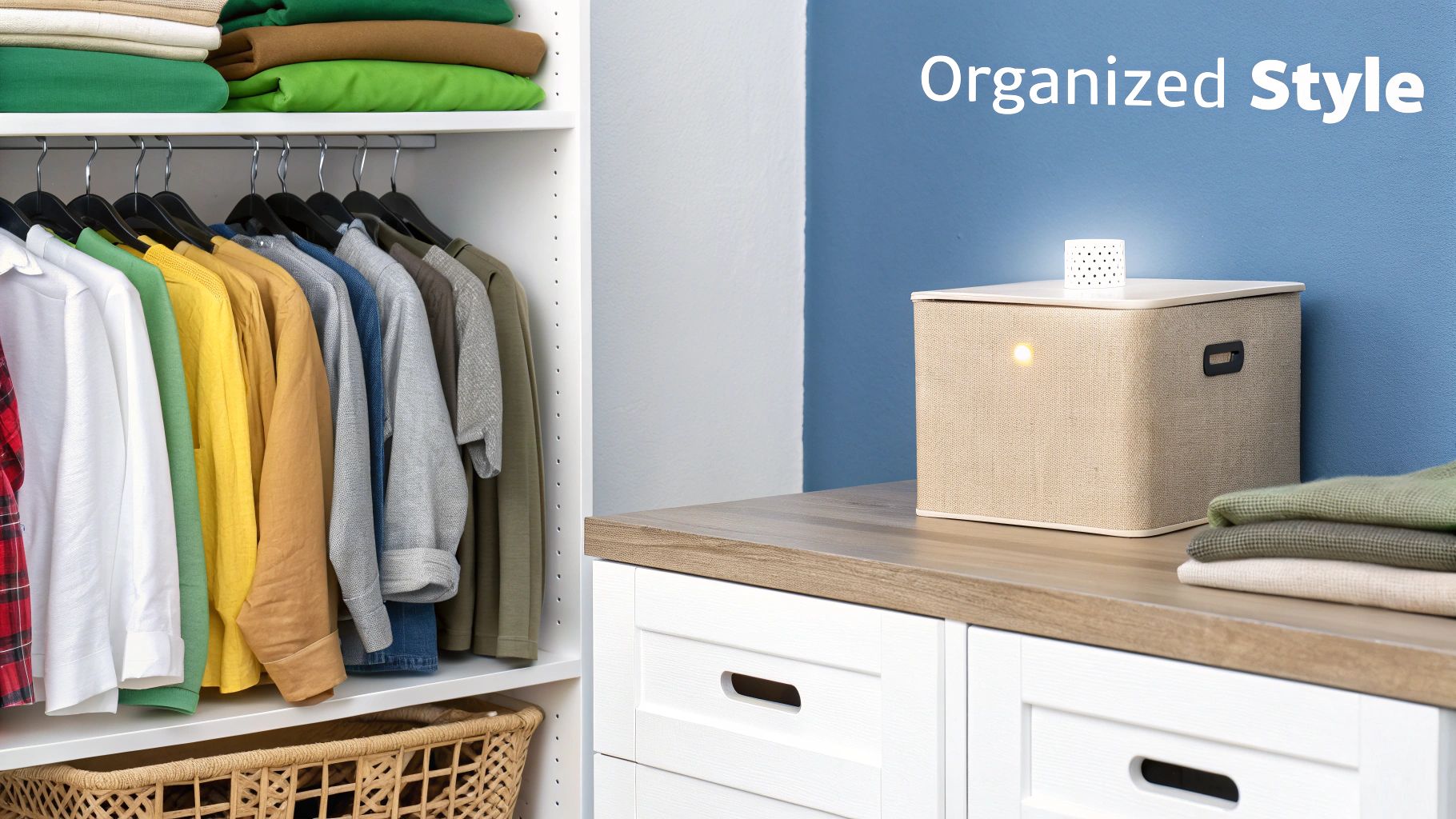
Find Your Sorting Style
How you arrange your clothes on the rack can make or break your whole system. Honestly, there's no single "right" way to do it. The best method is whatever clicks with your brain and makes finding an outfit feel effortless. Just pick one and be consistent.
Here are a few popular approaches that work well:
- By Type: This is the classic for a reason. All your t-shirts live together, all your pants are in one spot, all your sweaters in another. It’s intuitive and probably the easiest place to start.
- By Color: After grouping by type, arrange everything in rainbow order (think ROYGBIV, then add in your neutrals like black, white, and gray). It looks incredible and makes grabbing that specific green top a breeze.
- By Occasion: This is a game-changer if your life has very distinct "modes." Create zones for your work clothes, your comfy weekend outfits, and your dressy evening wear. Getting ready for a specific event suddenly becomes much faster.
The magic often lies in a hybrid approach. Start by sorting everything by type, and then color-code within each section. You get the logical separation of categories with the visual ease of a color-coordinated system.
Don't Forget the Finishing Touches
Now it's time to add the little details that take your closet from functional to fantastic. These are the small, thoughtful additions that make the space feel truly polished and complete—the final punctuation on all your hard work.
This is when you bring in stylish bins for odds and ends or drawer dividers for your socks and accessories. It's no surprise that people are investing more in these solutions; the home organization market continues to grow as we all crave functional living spaces. You can discover more insights about the home organization market and how the industry is booming.
Consider adding a few of these final elements:
- Let There Be Light: A small, battery-operated LED light can be a total game-changer. Good lighting helps you see colors properly and find things hiding in dark corners.
- Keep It Fresh: Tuck a few cedar blocks or scented sachets onto shelves or in drawers. It's a simple trick to keep moths away and make sure everything smells wonderful.
- Contain the Clutter: Use nice-looking baskets or bins for items that don't hang well, like clutches, belts, or scarves. A quick label on the front means you’ll always know what’s inside without having to pull it down.
By arranging your clothes thoughtfully and adding these final details, you’re not just organizing for today—you're creating a system that’s genuinely easy to stick with for the long haul.
Simple Habits to Keep Your Closet Organized for Good
You’ve put in the work—the sorting, the designing, the organizing. Your closet finally looks amazing. So, what’s the biggest challenge now? It isn't getting organized; it's staying that way.
The secret lies in building simple habits that feel so effortless they just become part of your routine. These aren't huge time-sucks. They're small, consistent actions that stop the chaos from creeping back in and make sure all your hard work pays off.
Adopt Daily Maintenance Routines
The best way to keep your closet in check is with a few micro-habits that only take a couple of minutes each day. These tiny actions prevent clutter from ever getting a foothold, making those massive weekend clean-outs a distant memory.
One of the most effective habits is the ‘one-in, one-out’ rule. Every time you buy a new item of clothing, a similar old one has to leave. This simple exchange maintains a perfect balance in your closet and makes you think twice about impulse buys.
Another game-changer is the ‘five-minute tidy’. Right before bed, just take five minutes to put things back where they belong. Hang up the coat you threw on the chair. Put away the shoes you kicked off by the door. It’s a tiny time investment with a massive return.
Master the Seasonal Swap
For anyone trying to keep a closet organized—especially if you're short on space—a seasonal rotation is non-negotiable. Getting off-season clothes out of the way frees up precious real estate for what you’re actually wearing now. It makes getting dressed so much easier.
And it doesn’t have to be a dreaded, all-day affair. Just follow a few simple steps twice a year.
- Review Before You Store: As you're packing away last season's clothes, give everything a quick once-over. Did you wear that sweater at all? If not, now’s the time to donate it instead of letting it take up space for another year.
- Store Properly: We recommend using breathable garment bags for delicate pieces and vacuum-sealed bags for bulky items like sweaters and puffer jackets. Always label your containers so you know exactly what’s inside without having to tear everything apart.
- Refresh Your Current Wardrobe: Before moving your current season's clothes to the front, give them a quick look. Does anything need to be mended or dry-cleaned? Get it done now.
A well-executed seasonal swap isn’t just about storage; it's an opportunity to re-edit your wardrobe twice a year, ensuring your closet only contains items you truly love and wear.
If these maintenance tips were helpful, you’ll probably love our complete guide on how to declutter your closet from start to finish. By making these easy habits part of your life, organizing stops feeling like a chore and becomes a natural, rewarding routine.
Common Questions We Get About Closet Organization
Even the most detailed plan can leave you with a few lingering questions. When you're standing in front of a mountain of clothes, it's natural for things to come up. Let's tackle some of the most common hurdles people face when organizing their closets.
Think of this as a quick-reference guide for those "what do I do now?" moments.
How Often Should I Really Declutter My Closet?
For a full, deep-dive declutter, aiming for once or twice a year is the sweet spot. The best time is often when you're swapping clothes for the changing seasons. When you're already pulling out your sweaters for fall or your sundresses for spring, it’s the perfect, built-in reminder to take stock of what you actually wear.
But don't wait for those big sessions to keep things in check. A quick 15-minute sweep once a month works wonders. This isn't about overhauling everything; it's about catching the clutter before it builds up again. A little consistent effort makes the big seasonal purges feel way less overwhelming.
What's the Best Way to Store Seasonal Clothes?
Getting your out-of-season clothes out of the way is a game-changer, but doing it right protects your wardrobe and frees up precious space. There's no single best way; it depends on what you're storing.
- For delicate items: Think wool coats, silk blouses, or special occasion dresses. Breathable garment bags are your best friend. They keep dust off while letting the fabric breathe.
- For bulky stuff: Sweaters, ski gear, and heavy jackets can be compressed with vacuum-sealed bags. It’s genuinely surprising how much closet real estate you get back.
- For everything else: Folded items like t-shirts, jeans, and shorts do great in clear, labeled bins. You can see what's inside at a glance, and they stack neatly.
Tuck them away somewhere cool, dry, and dark. Under the bed or a high shelf in a guest room are perfect spots to prevent moisture and sun-fading.
Here's a pro tip: Always, always wash everything before you pack it away. Even faint perfumes or tiny, unnoticed food spots can attract pests or set into permanent stains over a few months. Your future self will thank you when you pull out fresh, ready-to-wear clothes.
I Have a Tiny Closet. Will These Tips Actually Work for Me?
Absolutely! In fact, these closet organization tips are more important when you're working with a small space. When every inch is prime real estate, you simply can't afford to have clutter or inefficient systems.
For a tiny closet, your two most powerful weapons are ruthless decluttering and maximizing every bit of vertical space. The ‘one-in, one-out’ rule isn't just a trendy suggestion—it's a survival tactic. You have to be brutally honest about what deserves a spot.
Focus on tools built for compact areas. Tiered hangers that let you hang multiple pairs of pants in the space of one, and over-the-door organizers for shoes or accessories are non-negotiable. In a small closet, every item has to pull its weight.
Ready to finally win the war against closet chaos? MORALVE builds the smart, space-saving hangers that can instantly multiply your storage capacity. From cascading pant hangers to clever solutions for skirts and tank tops, our tools are the secret to a closet that stays organized for good. Explore our innovative organization tools today.
Leave a comment