

How to Color Coordinate Your Closet for Ultimate Organization

Learning how to color coordinate your closet is about more than just aesthetics—it’s a powerful closet organization strategy that saves you time and reduces stress. When your clothes are grouped by color, your morning routine becomes significantly simpler. You can instantly find what you're looking for, assess your inventory, and pull together outfits in seconds, making it a cornerstone of an organized wardrobe.
The Organizational Benefits of a Color-Coordinated Closet
Imagine opening your closet to a space that feels calm, functional, and perfectly organized. This isn't just a Pinterest fantasy; it's a practical change that streamlines your daily routine. Color-coordinating is one of the most effective closet organization methods because its impact goes far beyond just looking tidy.
The primary benefit is efficiency. By setting up your clothes in a clear, visual order, you dramatically cut down on decision fatigue. Instead of digging through a jumble of patterns and colors, your brain can quickly locate items, leaving you feeling more focused and less frazzled before your day has even begun.
A Smarter, More Functional Wardrobe
This system promotes a more mindful approach to managing your clothes. When you can see everything you own at a glance, you're better equipped to maintain a curated and functional wardrobe.
A visually organized closet helps you:
- Spot Duplicates: It becomes glaringly obvious when you own five nearly identical black t-shirts, helping you curb redundant purchases.
- Maximize What You Own: Seeing all your blue tops together might inspire you to pair an old favorite with a skirt you haven't worn in ages, making better use of your existing clothes.
- Identify Wardrobe Gaps: You can easily see what's missing, making shopping trips more strategic and purposeful.
A well-organized closet isn't just about managing clothes; it's about managing your time, money, and mental energy. The clarity it provides empowers you to make better daily decisions, starting with what you wear.
Creating an Organized and Functional Home
Ultimately, the goal is to create a space that is both visually pleasing and highly functional. The principles of good organization extend beyond the closet. In fact, learning about effective home organization strategies for other areas, like the kitchen, can provide a holistic approach to maintaining an orderly life.
Figuring out how to color coordinate your closet is often the first step toward a more streamlined home, setting the stage for a complete organizational refresh.
Step 1: Declutter and Prep Your Space for Organization
Before you can implement a color-coordinated system, you must first assess what you own. A truly organized closet isn’t about cramming things in more neatly; it's about curating a wardrobe filled only with pieces you love and wear. This decluttering phase is the most critical part of the entire closet organization process.

Start by taking everything out. While it sounds daunting, this step is non-negotiable for effective organization. Piling every piece of clothing on your bed forces you to handle each item and decide if it deserves precious closet space.
Skipping this step just means you’ll be rearranging clutter. By clearing everything out, you create a blank slate for a system that's not just pretty but practical. This drive for beautiful, functional spaces is a major trend. The global wardrobe market is expected to hit $108 billion by 2032, with organizers growing at an 8% clip. People crave this level of order, and for good reason: 45% report feeling less stressed after organizing their closets.
The Art of the Purge
With your clothes out of the closet, it's time to sort. Set up boxes or bags labeled: Keep, Donate/Sell, and Toss. To streamline decisions, ask these direct questions for every garment:
- Does this fit me right now? Be honest. Don't save it for a hypothetical future.
- Have I worn this in the last 12 months? If an item sat through all four seasons untouched, its time is likely up.
- Does this align with my current style? Styles change. It's okay to let go of clothes that no longer represent you.
- Is it in good condition? Items that are stained, stretched, or damaged beyond repair should be discarded.
This process can feel ruthless, but it's the only way to ensure your organized closet contains items you’ll actually wear. For a more detailed guide, our post on how to declutter your closet offers additional tips.
Creating a Clean Foundation
With the decluttering done, you’re left with an empty closet. This is the perfect time for a deep clean before you start organizing.
A clean, empty closet is more than just a blank canvas. It's a mental reset that reinforces your commitment to maintaining a more organized and intentional space.
Wipe down the shelves, dust the hanging rods, and vacuum the floor. Getting rid of lingering dust makes the space feel fresh. Now, you’re ready to build your color-coded system in a pristine environment where your newly organized wardrobe can shine.
Step 2: Choose Your Color Organization Method
Now that you’ve edited your wardrobe down to the essentials, it's time for the fun part: arranging it for optimal organization. Choosing how to color-coordinate your closet isn't about rigid rules. It’s about finding a system that aligns with how you think about your clothes and what makes getting dressed feel effortless.
Let's explore the three most common organizational approaches.
The Classic Rainbow Method
This is the most popular method for a reason—it’s visually intuitive. Organizing your clothes by the colors of the rainbow (think ROYGBIV) creates a stunning flow that can make your closet feel like a personal boutique.
You’d start with whites and creams, then transition to reds, oranges, yellows, greens, blues, and purples, finishing with neutrals like brown, gray, and black. If your wardrobe contains a vibrant mix of hues, this system is a lifesaver for quickly spotting that specific coral top or emerald green skirt.
Organizing By Color Value (Light to Dark)
If your wardrobe is more monochromatic, with many shades of the same color, arranging by color value is your best organizational strategy.
With this technique, you first group all items of the same color. Then, within that color family, you arrange them from the lightest shade to the darkest. All your blue pieces would hang together, flowing seamlessly from pale, icy blue to deep, inky navy. This creates a sophisticated ombré effect that is incredibly practical when you’re trying to find the perfect shade of taupe.
The best closet organization systems are the ones that feel intuitive. Don't force a system that doesn’t match how you naturally look for clothes. The goal is to make your life easier, not more complicated.
A Warm-to-Cool Approach
Here’s another highly effective organizational take: sorting by color temperature. This involves splitting your wardrobe into two main categories.
- Warm Tones: These are your sun-kissed colors like reds, oranges, yellows, and earthy browns.
- Cool Tones: This side of the closet holds blues, greens, purples, and sharp grays.
Once you have these two sections, you can organize each by value (light-to-dark) or in a mini-rainbow order. This approach is excellent for people who want to build cohesive outfits quickly. Pair this strategy with some of the best closet organization systems available, and you’ll have a seriously efficient and beautiful space.
Comparing Color Organization Methods
Still undecided? This table breaks down the three systems to help you choose the perfect fit for your wardrobe and your organizational goals.
| Method | Best For | Pros | Cons |
|---|---|---|---|
| Rainbow | Colorful, diverse wardrobes. | Visually stunning; easy to find specific colors quickly. | Can be chaotic if you have many shades of one color. |
| Color Value | Neutral or monochromatic wardrobes. | Creates a sophisticated, gradient look; great for shade-specific searches. | Less visually dramatic; can be time-consuming to set up initially. |
| Warm-to-Cool | People who build outfits based on color stories or seasons. | Simplifies outfit creation; makes seasonal transitions easy. | Requires an understanding of color theory; might feel too broad. |
Ultimately, the right method is the one you’ll maintain. Look at your clothes, think about how you get dressed, and pick the system that feels the most natural and organized to you.
Step 3: Implement a Clean and Cohesive Closet Layout
You've chosen a color system—now it's time to physically arrange your clothes and bring your vision of an organized closet to life. The goal is to create a visual and functional flow that makes finding what you need feel second nature.
A critical organizational trick is to group items by type first. Before thinking about color, put all your shirts together, then all your pants, followed by dresses, skirts, and so on. This simple step is the foundation of a closet that’s not just beautiful, but genuinely functional.
Layering Your Organization System
With your garments sorted into categories, you can now apply your color system within each group. For example, your shirt section will now follow your chosen color palette, whether that's a bright ROYGBIV setup or a calming light-to-dark gradient. This "category first, color second" approach is the secret to a closet that’s both practical and visually stunning.
To achieve an even higher level of organization, arrange items by sleeve length inside each color block. All your white sleeveless tops would hang together, followed by white short-sleeved shirts, and finally, white long-sleeved ones. This small detail makes a huge difference in your daily routine.
This visual guide breaks down popular methods to help you picture what might work best for your space.
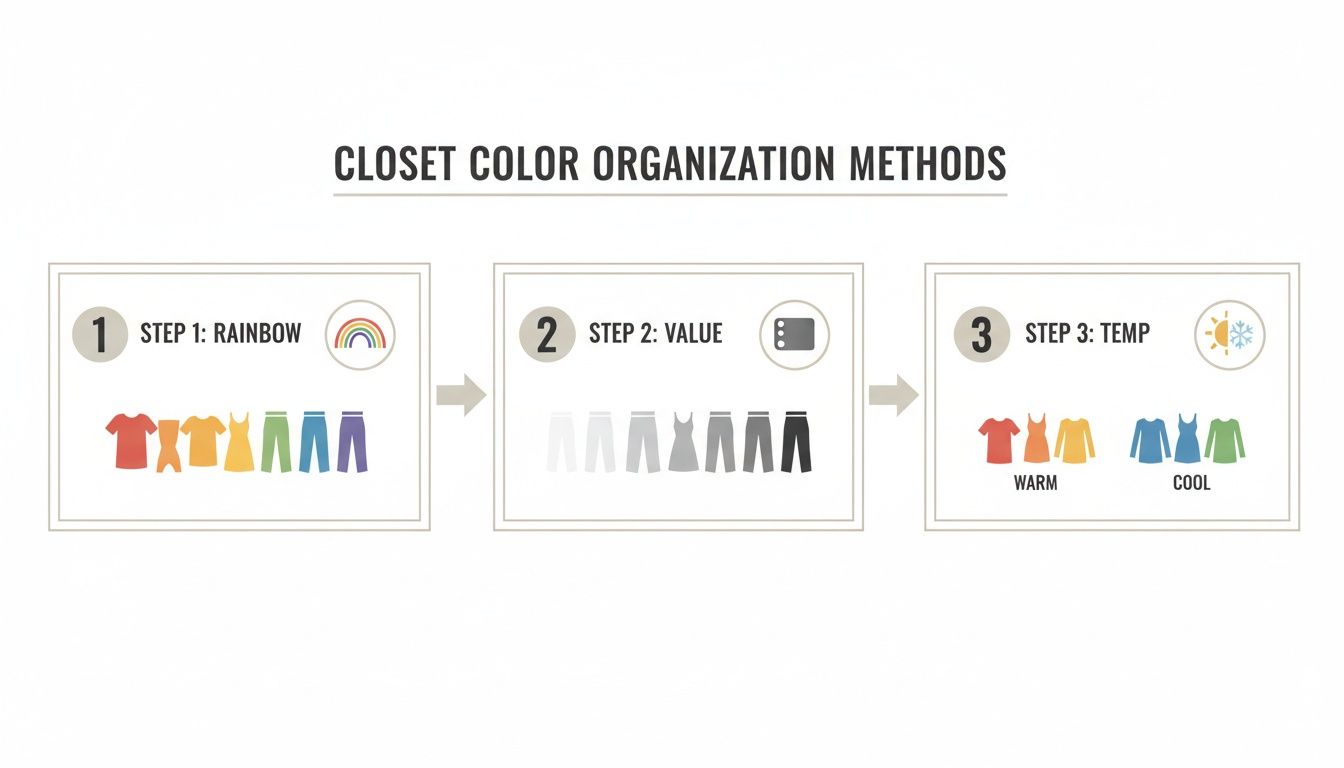
Seeing the rainbow, value, and temperature methods laid out like this really shows how each one creates a completely different look and feel for your closet organization.
How to Organize Patterns and Prints
Patterns often feel like the rebels of an organized closet, but they’re easy to integrate. You have two excellent options.
- Create a Dedicated Pattern Section: Group all your patterned items together at the end of a garment category (e.g., after all solid-colored blouses). This keeps your solid color blocks looking clean and uninterrupted.
- File by Dominant Color: Identify the main color of the patterned item and place it in that corresponding color section. A blue-and-white striped shirt, for instance, goes with the blues. This is my preferred method, as it integrates patterns seamlessly.
At the end of the day, the best system is whatever feels most logical to you. It should make getting dressed easier by putting things where your brain already expects to find them.
The demand for organized closets is booming. The closet organizers market is expected to more than double to $8.53 billion by 2035, as more people seek optimized, functional spaces. Simple tricks, like splitting clothes into warm and cool tones, can speed up outfit planning by 30-40%. The principles of smart organization found in everything from retail displays to baby clothing storage solutions can be applied to create your perfect closet.
Step 4: Use Tools and Habits to Maintain Organization
You’ve done it. Your closet is a color-coordinated, beautifully arranged space. But the real victory isn't just getting it organized; it's keeping it that way. The secret lies in building a few smart, simple habits and using the right tools to make maintenance feel automatic.
One of the quickest and most impactful upgrades is to switch to one style of hanger. Using matching hangers, especially slim velvet ones, instantly creates a polished, organized look. More importantly, their non-slip surface keeps clothes in place, and their slender design can free up a surprising amount of rod space. This uniformity creates visual calm, making it easier to see what you own and inspiring you to put things back properly.
Lock in Lasting Order with Simple Routines
To prevent your organized closet from slowly devolving into chaos, incorporate a few key routines that stop clutter before it starts.
- The One-In, One-Out Rule: This classic organization rule works. For every new item you bring home, an old one must go. This discipline prevents wardrobe bloat and forces more intentional purchases.
- A "Home" for Empty Hangers: Don't let empty hangers get mixed in with your clothes. Designate a specific spot for them, such as at the very front of the closet rod. This makes putting laundry away faster and keeps your closet looking tidy.
- The 10-Minute Tidy: Set aside ten minutes once a week for a quick reset. This isn't a deep clean. It's simply about re-folding a few sweaters, straightening hangers, and putting away items that have been left out.
Maintaining your system is about small, consistent actions—not perfection. The goal is to create a space that serves you well, and these simple habits ensure it continues to do so with minimal effort.
Don't forget proper spacing. Cramming clothes together ruins the visual flow, causes wrinkles, and makes it hard to see what you have. Leave a small gap, about a finger's width, between each hanger. This gives every piece room to breathe and makes pulling items out (and putting them back) much easier.
Why This All Matters
These organizational habits have a real impact. The global closet organizers market is projected to swell to over $11 billion by 2029, showing how many people are realizing the benefits of intentional living spaces.
And the methods work. Strategies like grouping monochromes and arranging them by gradient can create closets that are up to 50% neater. This clarity can also lead to 15% fewer impulse buys. You can find more wardrobe organization statistics on sites like BestColorfulSocks.com. By putting these strategies into practice, you’re not just organizing clothes—you’re building a smarter, more mindful wardrobe.
Step 5: Troubleshoot Common Organization Challenges
Even with a solid plan, you might encounter a few organizational challenges. Let's tackle some of the most common questions to ensure your color-coordinated system remains effective long-term.
What Should I Do with Multi-Colored or Patterned Clothes?
This is easily the most-asked question. The simplest solution is to create a dedicated section for patterned items at the end of your solid colors. This way, the clean flow of your color blocks isn't interrupted.
Another great approach is to file the patterned piece under its most dominant color. Have a floral blouse that's mostly pink with hints of green? Hang it with your other pink tops. A quick trick to find the dominant shade is to hold the item at arm's length and squint; the color that stands out most is your answer.
How Often Will I Need to Reorganize Everything?
A full-blown reorganization should only be necessary once or twice a year, perhaps with seasonal change-outs. The secret to a closet that stays organized isn't the big overhaul; it's the small, daily habits.
The most crucial habit is putting laundry away immediately and in its proper spot. Beyond that, a quick 15-minute touch-up once a month to straighten hangers, refold items, and reset the space is all you'll need to maintain order.
The goal is progress, not perfection. A well-maintained closet isn't one that's never messy; it's one where tidying up is quick and intuitive because everything has a designated home.
Is the Rainbow Method Better Than a Light-to-Dark System?
Neither method is inherently "better." The right choice depends entirely on your wardrobe and what feels most logical for your organizational style.
-
The Rainbow Method (ROYGBIV): Ideal for closets full of distinct, vibrant colors. It makes finding specific colorful items incredibly easy.
-
The Light-to-Dark Method: Shines for neutral or monochromatic wardrobes. If your closet has many shades of black, gray, and beige, arranging them in a gradient creates a chic look and helps you distinguish between similar hues.
If you're still not sure, try a quick test. Pull out a group of similar items, like your T-shirts, and arrange them on your bed first in a rainbow order, then in a light-to-dark gradient. Whichever layout feels more organized and intuitive to you is the right choice.
Ready to create a closet that simplifies your life? At MORALVE, we design innovative hangers and organizers that help you maximize every inch of space. Explore our collection of space-saving solutions and build the organized wardrobe you've always wanted. Discover your perfect closet system on moralve.com.
Leave a comment