

How to Organize Your Closet for Maximum Space and Sanity

Learning how to organize your closet is about creating a smart, sustainable system, not just a one-time tidying spree. It boils down to four core ideas: assessing what you own, decluttering what you don't need, choosing the right organization tools, and maintaining the order. Once you nail these, you can turn a chaotic closet into a genuinely functional, even peaceful, part of your daily routine.
Your Blueprint for a Perfectly Organized Closet
We've all been there—staring into a messy closet, feeling that familiar wave of frustration. It can turn the simple act of getting dressed into a daily chore. But here’s the thing: creating an organized closet is totally doable with the right plan. It’s not about needing a huge walk-in; it’s about making the space you already have work harder for you through smart organization.
This guide is your blueprint for moving past those quick, temporary fixes that never seem to last. An organized closet doesn't just look good, it makes a real difference in your life.
- You'll save time. When you know exactly where everything is, those frantic morning searches become a thing of the past.
- You'll feel less stressed. A calm, orderly space can genuinely set a more positive tone for your entire day.
- You'll protect your clothes. Proper storage and organization mean fewer wrinkles, snags, and damage, which helps your favorite pieces last longer.
The trick is to start seeing your closet not as a problem, but as an organization puzzle you can solve. With the right approach, you can build a system that truly works for you.
To get started, it helps to think in terms of four foundational concepts. I call them the Four Pillars of Closet Organization. They're the principles that guide every successful closet makeover.
The Four Pillars of Closet Organization
| Pillar | Key Action | Expected Outcome |
|---|---|---|
| Assessment | Honestly evaluate your wardrobe and the physical space you have. | A clear inventory of what you own and a precise understanding of your closet's dimensions and limitations. |
| Decluttering | Thoughtfully sort through items and decide what to keep, donate, or discard. | A curated wardrobe filled only with items you love and use, freeing up significant space for organization. |
| Strategic Organization | Choose and implement organization systems that fit your space and your stuff. | An efficient system where every item has a logical home, maximizing every inch of available space. |
| Maintenance | Establish simple, repeatable habits to keep the closet organized long-term. | A closet that stays tidy with minimal effort, preventing clutter from creeping back in. |
Nailing these four areas is what separates a temporarily tidy closet from one that stays organized for good.
Why Closet Organization Matters More Than Ever
Getting smart about storage isn't just a "nice-to-have" anymore; for many of us, it’s a necessity. With more people living in cities, our living spaces are getting smaller. A staggering 55% of the world's population now lives in urban areas, and that's projected to climb to 68% by 2050. Every square foot counts.
This trend has turned closet organization from a weekend project into a critical home management skill. In fact, over 64% of households in major urban markets are now opting for customized storage solutions to deal with limited space. You can read more about the rising demand for custom closets to see just how common this is becoming.
This is why a real organization strategy is so important. It’s all about creating flow and function so your closet supports your lifestyle instead of being a source of daily friction. The next sections will walk you through exactly how to do it, step by step, so you can turn that chaos into calm.
Get Ready to Declutter and Organize Your Wardrobe
Alright, this is where the real transformation begins. To organize a closet that truly works for you, first, you have to see what you're actually working with. That means pulling everything out—every last shirt, forgotten scarf, and single sock.
I know it sounds overwhelming, and yes, your room will look like a clothing store exploded for a little while. But creating this clean slate is the only way to build a truly functional organization system from the ground up. You need to see the bare bones of your closet to understand its potential before you can decide what deserves to go back in.
The Four-Pile Tactic for Stress-Free Sorting
As you start going through everything, don't just make vague piles. You'll get lost in the indecision. Instead, use a structured approach for sorting and organizing your thoughts—I call it the Four-Pile Tactic. It's a simple framework that forces a clear, honest decision for every single item you own.
Grab some boxes, laundry baskets, or just designate four clear spots on your floor for:
- Keep: These are your non-negotiables. The clothes you love, wear all the time, and feel fantastic in. If it’s an immediate "yes," it goes here. No hesitation.
- Donate/Sell: This pile is for anything in good shape that just isn't you anymore. Maybe the fit is off, your style has evolved, or you just never reach for it. Let someone else give it a new life.
- Store: Think off-season gear like bulky winter parkas or that formal dress you only wear to weddings. This is also a safe spot for sentimental pieces you can’t bear to part with but don't need cluttering up your daily-use space.
- Toss: This is for the truly worn-out. Be ruthless. If it's stained, ripped beyond repair, or faded to oblivion, it's time to say goodbye.
This method turns a mountain of chaos into four manageable categories. Suddenly, the whole process feels much more in control and way less emotional.
Asking the Hard Questions
The easy part is sorting your absolute favorites and the obviously worn-out items. But what about everything in between? That "just in case" outfit, the jeans that might fit again someday, the sweater from your aunt that you feel guilty about never wearing.
For those tough calls, you need to get organized. Before anything lands in the 'Keep' pile, ask yourself:
- Have I worn this in the last year? Be honest. If the answer is no, why not?
- Does this make me feel good right now? Not five pounds from now or five years ago. Today.
- If I saw this in a store today, would I buy it? This is a great trick for cutting through sentimental clutter and focusing on your current style.
- Is it a hassle to care for? If you avoid wearing it because it’s "dry clean only" or needs constant ironing, it's probably just taking up valuable real estate.
Asking direct questions helps you break free from the "what-ifs" and focus on building a wardrobe that actually serves the life you're living. If you want to dive deeper, our complete guide on decluttering your wardrobe has even more great strategies. It's also worth noting how professional organizers think; understanding effective staging strategies for decluttering can give you a fresh perspective on making your space visually appealing and functional.
Here's an organization tip I always share with clients: if you have to talk yourself into keeping something, it’s probably a no. Your closet should be a curated collection of your best pieces, not a storage unit for your past.
Group Your 'Keepers' for an Intuitive Layout
Once you’ve finalized your 'Keep' pile, don't just start hanging things back up. The last step in this phase is to group everything logically. Think of it as creating an organizational map of your wardrobe.
Start sorting your keepers into sensible categories. Most people find a hybrid approach works best:
- By Type: Group all your pants, all your sweaters, all your dresses, etc.
- By Occasion: Create separate zones for work clothes, workout gear, weekend casual, and formal wear.
- By Season: If you live somewhere with distinct seasons, separating your summer and winter clothes is a game-changer.
For example, you might have a section for "Work Blouses" that's completely separate from your "Casual T-Shirts." This simple organizational step makes designing your new closet layout so much easier because you'll know exactly how much space each category needs.
This pre-planning is what the pros do. A well-organized closet often follows a ratio of 40% hanging space, 30% shelves, 20% drawers, and 10% for bins, which can boost your daily efficiency by 25-50%. People are catching on, too—the custom closet market is projected to hit $60.42 billion by 2034. It just goes to show that investing a little time upfront to declutter and categorize pays off big time in reducing daily stress.
Choosing the Right Closet Organization Systems
With the clutter gone, you’re now looking at a blank canvas. This is where the real fun begins—choosing the right tools to build a closet organization system that actually works for you long-term. We're not just putting things back; we're creating a smart, organized environment where everything has its own logical, easy-to-find spot.
The right organization tools can literally double your closet's capacity without a single renovation. A comprehensive guide to closet organization systems can be a huge help here, showing you options to make the most of every last inch. It’s all about matching the solution to your stuff and your space.
Instantly Create More Space by Organizing Your Hangers
If you do only one thing, do this: switch to uniform hangers. That mismatched collection of bulky plastic and wire hangers is secretly stealing a shocking amount of rod space and ruining the shape of your clothes. Switching to a uniform set of slim hangers is an absolute game-changer for organization.
- Slim Velvet Hangers: These are the unsung heroes of closet organization. Their ultra-thin design can give you up to 50% more hanging space almost overnight. Plus, the non-slip velvet grip means no more silky tops slithering onto the floor.
- Tiered Hangers: For things like pants, skirts, or even camisoles, these are brilliant. A single MORALVE tiered hanger, for instance, holds multiple pairs of pants vertically, taking up the same tiny bit of rod space as one old-school hanger. It's one of the simplest ways to use vertical space effectively.
- Sturdy Wooden Hangers: While they aren't as slim, wooden hangers are non-negotiable for heavy coats, blazers, and suits. They offer the critical shoulder support needed to keep these investment pieces from sagging and losing their shape.
Start thinking of your hangers as the foundation of your entire closet organization system. A small investment here pays off big time in both extra space and better care for your clothes.
Go Beyond the Rod with Modular Organizers
Your closet rod is only one piece of the puzzle. To truly organize the space, you have to think vertically and use every available surface. This is where modular storage becomes your best friend, letting you build a custom setup that perfectly fits your wardrobe and the closet's dimensions.
Modular shelving units or cube organizers are perfect for sliding under hanging clothes or lining a bare wall. They create tidy, designated homes for folded items like sweaters and jeans, stopping them from turning into those messy, toppling piles we all know too well. Try to find units with adjustable shelves so you can change things up as your wardrobe evolves.
And please, don't forget drawer dividers. They’re cheap but incredibly powerful tools for bringing order to the chaos inside your dressers. Use them to create neat little corrals for socks, underwear, scarves, and belts. You'll never have to dig through a tangled mess to find what you need again.
The secret to a truly organized closet is giving each category of clothing its own type of storage. Clear bins are fantastic for clutches you want to see at a glance, while fabric bins can neatly hide away things like workout gear or PJs. The goal is to cut down on visual noise while keeping everything within reach.
Homeowners everywhere are catching on, and the market shows it. The demand for closet organizers is expected to skyrocket from USD 4,033.3 million in 2025 to an incredible USD 8,529.7 million by 2035. This boom is driven by people in smaller living spaces looking for smart, adaptable organization.
The Best Hangers for Organizing Your Wardrobe
Choosing the right hanger can feel overwhelming, but it's one of the highest-impact organizational decisions you'll make for your closet. Each type serves a different purpose, and a mix-and-match approach is often the most effective.
This quick comparison will help you figure out what you need.
Hanger Comparison for Closet Organization
| Hanger Type | Best For | Space Saved (Approx.) | Pro Tip |
|---|---|---|---|
| Slim Velvet | Everyday tops, blouses, dresses, slippery fabrics | Up to 50% | Buy them in one color to create a serene, boutique-like feel in your closet. |
| Tiered (Pants) | Trousers, jeans, slacks, leggings | Up to 75% | Look for hangers with swing-out arms for easier access to individual pairs. |
| Tiered (Skirts) | Skirts, shorts, pants with belt loops | Up to 75% | The adjustable clips are key—make sure they have soft padding to avoid marks. |
| Multi-Hanger (Cascading) | Uniform items like shirts, tanks, or camis | Up to 80% | Hook multiple hangers vertically to compress a whole section of your wardrobe. |
| Sturdy Wood | Heavy coats, suits, blazers, formalwear | Minimal | Essential for preserving the shape of structured garments. Not for space-saving. |
By strategically using a combination of these, you can customize your hanging space to fit exactly what you own, rather than letting bulky hangers dictate how you organize.
Find Hidden Storage on Your Door and Floor
Some of the most valuable real estate in any closet is hiding in plain sight: the back of the door and the empty space on the floor. With a few smart organizers, these dead zones can become storage goldmines.
Over-the-door organizers are a classic for a reason. A pocket-style organizer can neatly store a dozen pairs of shoes, while hook-based racks are fantastic for handbags, belts, and scarves. This one simple trick gets bulky items off your shelves and floor, freeing up that prime space instantly.
The chart below shows a great way to think about zoning your closet space. By assigning percentages to different storage methods, you can create a balanced and highly efficient organizational system.
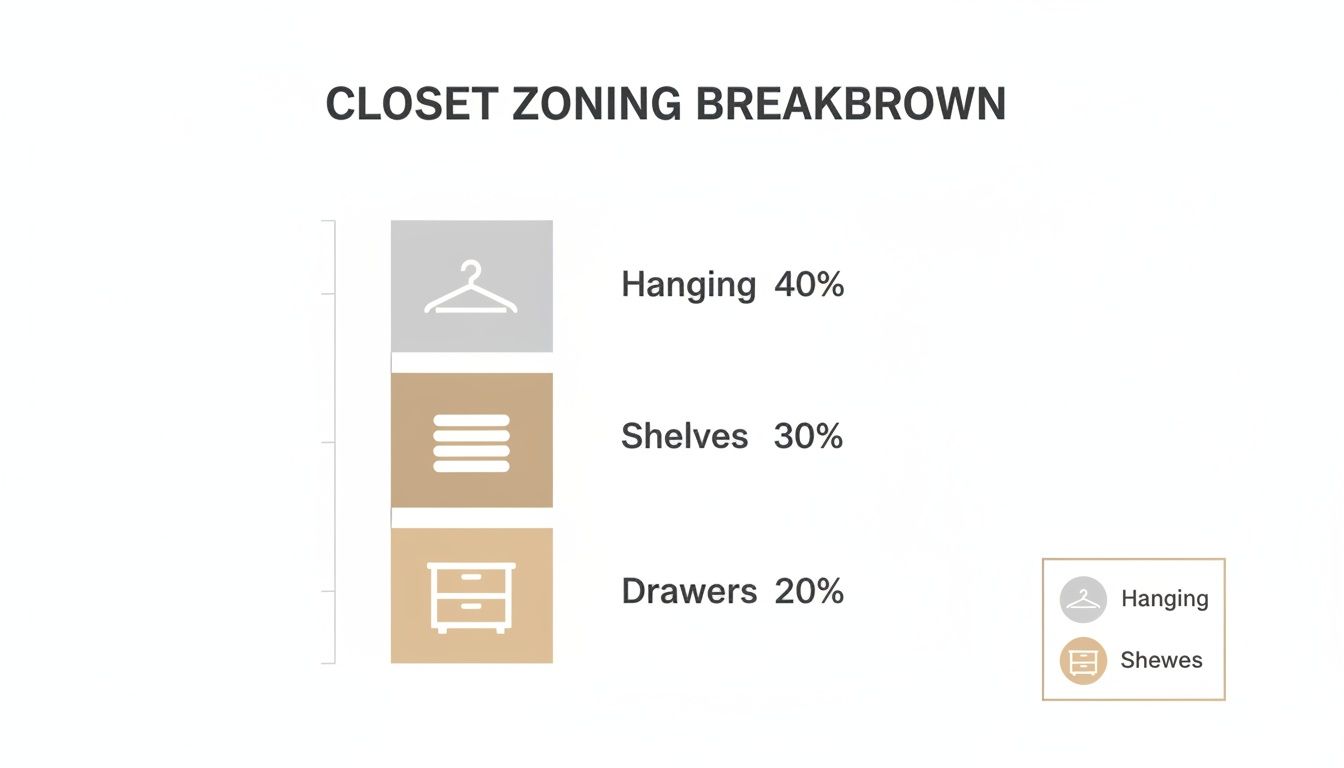
This kind of planning shows how a good mix of organization methods leads to a closet that just works. Dedicating about 40% to hanging keeps your main wardrobe visible and accessible, while shelves and drawers efficiently handle the rest.
Of course, the perfect mix depends entirely on what you wear. If you live in dresses and blazers, you’ll need more hanging space. If you’re a sweater-and-jeans person, shelves will be your saving grace. For a deeper dive into designing a full system, check out our guide on the best closet organizer systems, where we break down options for every kind of closet.
Designing Your Closet Layout for Daily Use
Alright, your wardrobe is decluttered and you’ve got the right organization tools. Now for the fun part: creating a closet layout that actually works for you. This is where we create a system that feels so intuitive, it practically maintains itself.
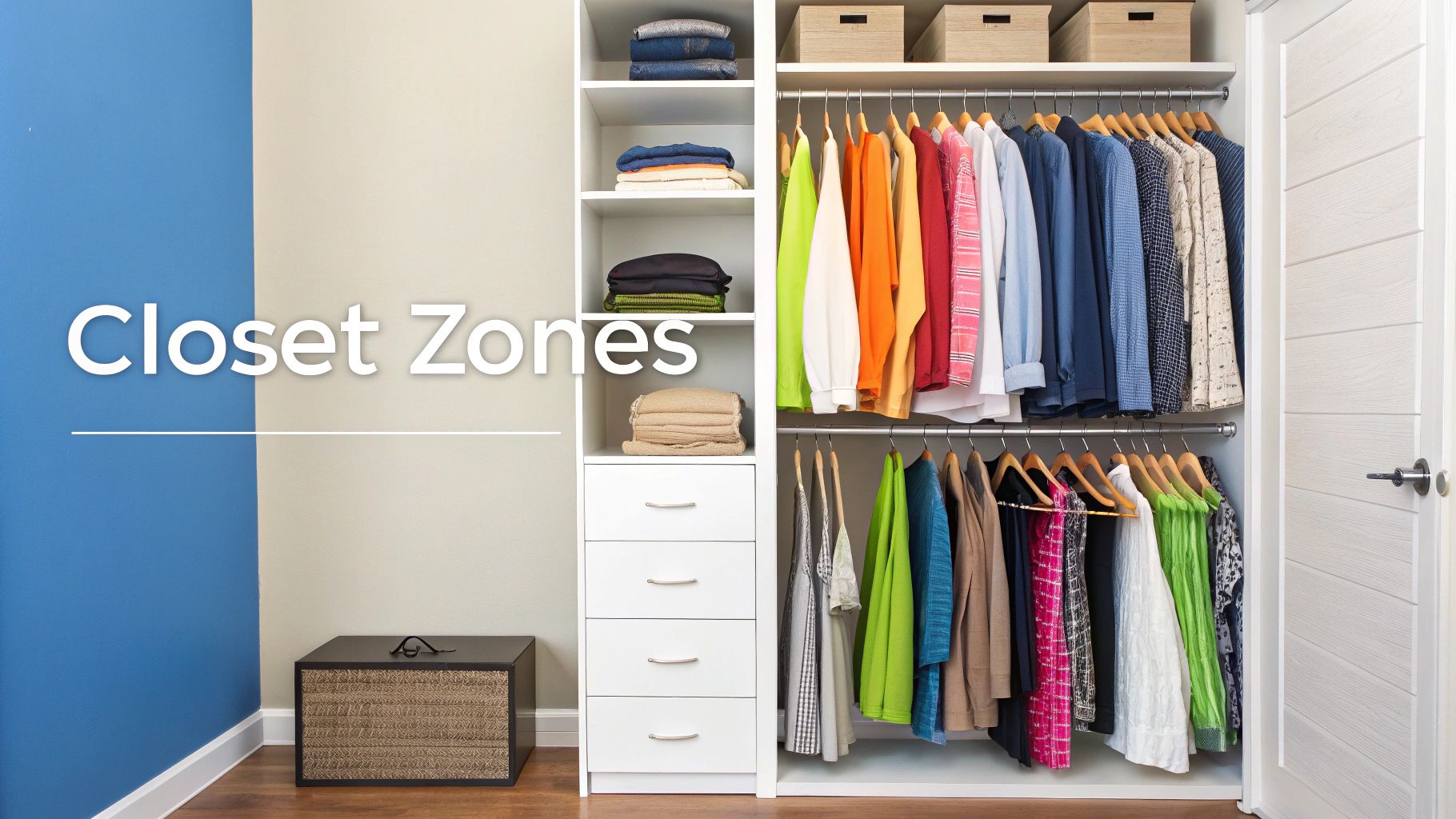
The secret is something we call closet zoning. Think about how you organize your kitchen—utensils near the stove, glasses near the fridge. We're going to apply that same logic to your closet. By creating dedicated "zones" for different types of clothing and accessories, everything gets a permanent home.
This one strategy is the key to stopping clutter before it even starts. When putting things away is just as easy as taking them out, keeping your closet organized becomes second nature.
Prioritize Your Prime Real Estate
Let's be honest, not all closet space is created equal. The most valuable spot for organization is what I call "prime real estate"—everything right at eye level, from about your shoulders to your waist. This is the space you can see and reach without stretching or bending, and it should be reserved for the things you wear all the time.
This means your favorite work shirts, go-to jeans, and everyday sweaters get front-and-center placement. Imagine how much smoother your mornings will be when you aren't digging past bridesmaid dresses and winter coats to find your favorite t-shirt.
Here’s a simple way to map out your prime organizational zone:
- Top Hanging Rod: This is for your most-worn shirts, blouses, and light jackets.
- Eye-Level Shelves: Perfect for folded items you grab daily, like pullovers or workout gear.
Everything else—seasonal stuff, formalwear, sentimental pieces—can be stored in the less accessible spots, like the high top shelf or in drawers down low. This simple organizational hierarchy makes all the difference.
Unlock Your Closet's Vertical Potential
Most closets have an incredible amount of wasted vertical space. You know what I’m talking about: that giant, empty gap below your hanging shirts. It's time to organize that territory.
The quickest win here is to install a double-hanging rod. This simple addition can literally double your hanging capacity for shirts, skirts, and folded trousers overnight. Just hang the top rod high enough for your longest shirts, then add a second one below it.
It's not just about aesthetics. A study on home organization found that a staggering 84% of people feel their stress levels rise when their home is disorganized. Doubling your usable space is one of the fastest ways to create visual calm and cut down on that clutter-induced anxiety.
Shelf risers are another game-changer. These little freestanding shelves create a second tier on your existing shelves, giving you the perfect spot to stack sweaters or line up handbags without everything toppling over. For a deeper dive into creating the perfect layout, check out our guide on how to design a closet.
Master the Overlooked Spaces
The final piece of the organization puzzle is to harness the power of those often-forgotten nooks and crannies. I'm looking at you, back of the door and closet floor.
The Back of the Door
This is a goldmine of storage potential. An over-the-door organizer is non-negotiable for a truly optimized closet.
- Shoe Organizers: Those clear pocket organizers are brilliant for flats, sandals, and even accessories like belts and scarves.
- Hook Racks: A sturdy rack is great for hanging your robe, go-to handbag, or even planning tomorrow's outfit.
Just by moving these items to the door, you free up a ton of shelf and floor space.
The Closet Floor
The floor is not an organization shelf! It’s so easy for it to become a dumping ground for shoes and bags. Tidy it up with low-profile shoe racks to keep your footwear neat and visible. If you have enough clearance, a two-tier rack doubles your storage without taking up more floor space.
If your closet is deep, consider using rolling bins on the floor. They're fantastic for bulkier items like off-season sweaters or extra blankets, and you can just pull them out when you need something. The goal is simple: get everything off the floor and into a proper home.
Keeping Your Closet Organized for Good
So, you’ve done it. You’ve decluttered, sorted, and strategically organized every last shirt and shoe. Your closet is finally a calm, functional space. But the real challenge isn't the big overhaul; it's keeping it that way.
Think of your closet organization as a living system, not a one-and-done project. Without a little upkeep, even the most perfectly organized space can slip back into chaos. The good news is that maintaining it doesn't take hours. It's all about building a few simple habits that stop clutter before it even starts.
These aren't intense chores. They're quick organizational routines, just a few minutes here and there, that prove consistency beats a massive clean-out every time.
Master the Seasonal Swap
One of the easiest ways to keep your closet organized and spacious is to embrace the seasonal wardrobe swap. Let's be honest, trying to cram your entire wardrobe into one space year-round just doesn't work. It makes finding anything a nightmare.
By rotating your clothes with the seasons, you instantly give your closet more breathing room.
Set aside an hour twice a year to do a quick switch. Pack away the off-season stuff and bring the current season's wardrobe front and center.
- Store It Right: Don't just stuff your winter sweaters into a dusty box. Use weathertight bins or vacuum-sealed bags to protect your clothes from moisture, pests, and getting musty. That way, they’re fresh and ready to go when you need them again.
- Organize Prime Real Estate: Your most accessible spots—the main hanging rod and shelves right at eye level—should be reserved for what you're actually wearing now.
This little ritual also doubles as a mini-declutter session. Before you pack anything away, ask yourself if you actually wore it last season. If not, maybe it's time to let it go.
Live by the 'One-In, One-Out' Rule
If you’re prone to impulse buys or feel like your wardrobe is constantly expanding, this organization rule is a game-changer. It’s incredibly simple: for every new thing you bring home, something you already own has to go.
This isn’t about punishment; it’s about being intentional. It makes you stop and think, "Do I love this new thing more than something I already have?"
The 'one-in, one-out' rule turns you from a collector into a curator. It’s the single best habit for stopping that slow creep of clutter that can completely undo all your organizational work.
Following this principle keeps your closet at a steady, manageable size. More importantly, it ensures your wardrobe is filled only with pieces you truly love and feel great in.
The Five-Minute Weekly Reset
This is where consistency really pays off. You can avoid another marathon organizing session by just spending five minutes a week putting things back in order. I like to do this on Sunday evening to start the week fresh.
Just run through a quick organizational checklist:
- Hang up the chair-drobe (we all have one).
- Quickly refold any messy stacks on the shelves.
- Put shoes back in their organizer and clear the floor.
That’s it. This tiny slice of your time prevents little messes from becoming a huge, overwhelming project. It keeps your system working, your mornings stress-free, and reminds you how good it feels to have a closet that actually works for you.
Answering Your Toughest Closet Organization Questions
Even the most meticulously planned closet makeover can hit a few snags. It’s totally normal. Questions always come up, whether you're wrestling with what to do with sentimental pieces or just trying to figure out the best way to fold that chunky knit sweater.
Let's tackle some of the most common organizational hurdles people face. Think of this as your personal troubleshooting guide from someone who's seen it all.
What Do I Do With Sentimental Items I Don't Actually Wear?
This is a big one, and it trips up so many people. We all have those items: a wedding dress, that vintage band t-shirt, maybe a piece of clothing inherited from a loved one. You'll never wear them, but you can't imagine letting them go.
Here's the secret: separate storage from sentiment. Your everyday closet is prime organizational real estate, and it should only hold the clothes you actually wear.
For those treasured pieces, create a dedicated "memory box" or a special garment bag.
- First, make sure to properly clean everything before packing it away to prevent hidden stains from setting over time.
- Wrap delicate fabrics in acid-free tissue paper. This is a pro tip to stop them from yellowing.
- Find a safe, dry spot for your memory box, like under the bed or on the top shelf of a guest room closet.
This way, you get to keep the items that mean so much to you without them hogging the valuable space you need for daily organization.
Is It Better To Fold or Hang Sweaters?
Please, fold your sweaters. Always. Hanging them, especially the heavier ones, is a surefire way to end up with stretched-out, sad-looking garments with those dreaded shoulder bumps. Gravity is the enemy of knitwear.
The ideal spot for sweaters is neatly folded on a shelf. If you're tight on shelf space, though, there's a clever hanging trick I recommend:
- Fold the sweater in half vertically (sleeve to sleeve).
- Place the hanger hook in the sweater's "armpit."
- Simply drape the body and the sleeves over the arms of the hanger.
This little maneuver avoids the stretching issue while still letting you hang sweaters if you absolutely have to.
A huge organizing mistake is treating every piece of clothing the same way. A study from the National Association of Productivity and Organizing Professionals found that a whopping 80% of what we keep, we never actually use. Learning the right organization methods for the 20% you do wear ensures your favorite pieces stay in perfect shape.
How Can I Organize Shoes Without a Giant Shoe Rack?
Ah, shoes. They're often the trickiest part of any closet organization project because they're bulky and awkward. But you don't need a massive floor rack to get them under control. The key is to think vertically and use overlooked spaces.
Here are a few of my favorite shoe organization hacks:
- Over-the-Door Organizers: A clear pocket shoe organizer is a game-changer. It gets every pair off the floor, protects them from scuffs, and lets you see your entire collection at a glance.
- Under-Bed Storage: Don't forget about the space under your bed! Low-profile fabric containers, especially ones with dividers, are perfect for stashing off-season shoes like sandals or formal heels.
- Clear Shoe Boxes: These are fantastic because they're stackable and you can see exactly what's inside. You can build a neat "shoe wall" along a closet floor or shelf, keeping everything dust-free and easy to find.
Each of these methods helps you reclaim precious floor space and turn unused nooks and crannies into functional, organized storage.
Ready to conquer the clutter for good? Having the right organization tools makes all the difference. At MORALVE, we design innovative space-saving hangers that can instantly create more room and bring a sense of calm to your closet. See how you can transform your space and simplify your life by exploring our collection.
Leave a comment