
How to Organize Clothes for a Perfectly Tidy Closet

Any truly effective closet organization project starts with one crucial, non-negotiable step: a complete closet reset. I've learned from years of doing this that the most lasting transformations don't begin with rearranging hangers. They start by ruthlessly decluttering every single item you own. This first phase is the bedrock for building a closet that actually works for you—one that's functional, easy to manage, and genuinely reflects your style.
Your Blueprint For A Clutter-Free Closet
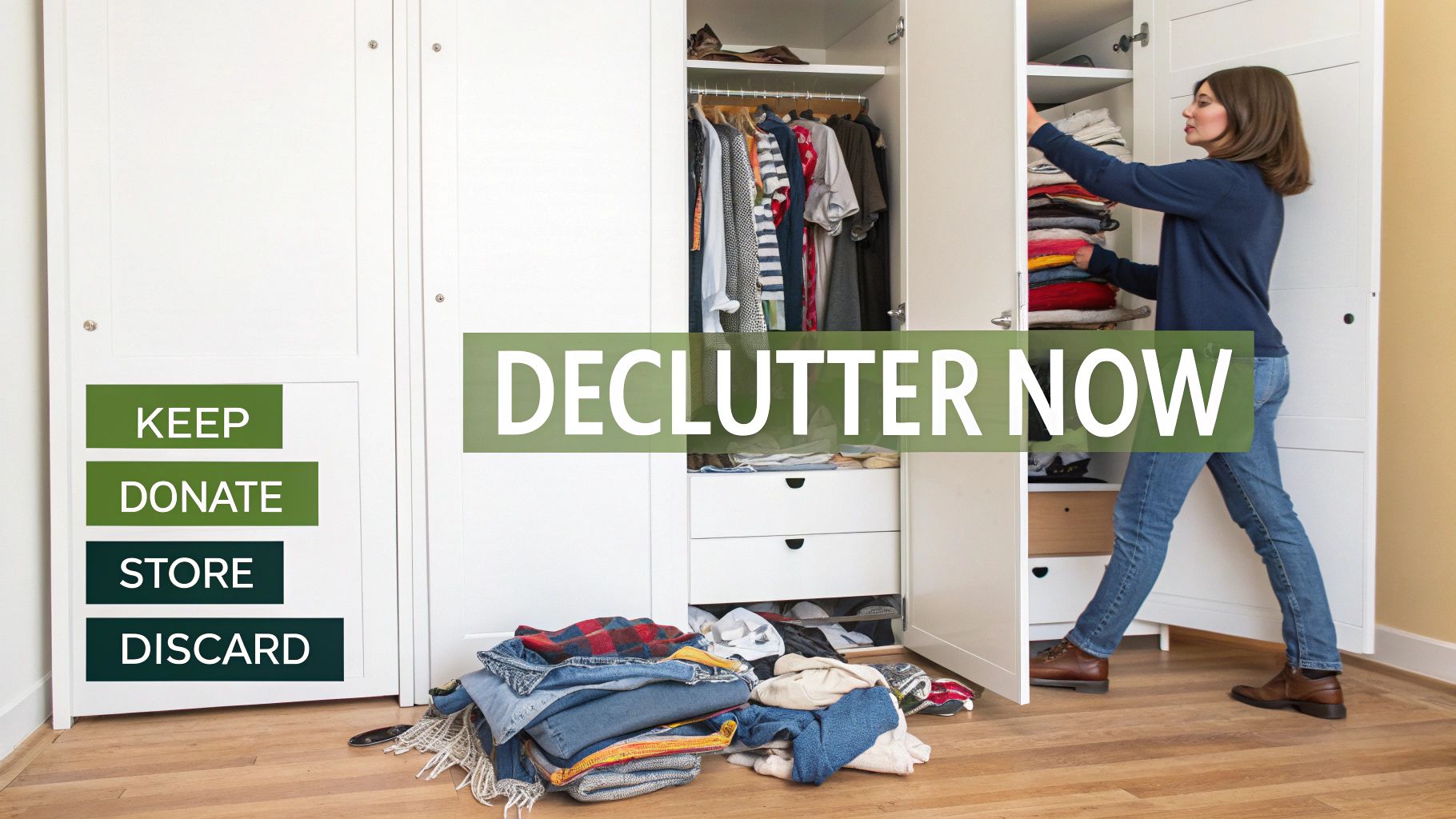
Let's be honest, staring into a closet that’s packed to the gills is overwhelming. The real secret to learning how to organize clothes isn't about mastering a new folding technique right away. It's about being decisive about what even deserves to be in there. Think of it less as what you're getting rid of and more about what you're intentionally choosing to keep in your closet.
The most powerful way to kick things off is to take everything out. And I mean everything. Pile it all on your bed. This physical act forces you to see the true volume of what you own and touch each item, making a conscious choice about its fate.
The Four-Pile Decluttering Method
To keep yourself from getting stuck in "what-if" mode, sort every single piece into one of four distinct piles. This straightforward system keeps you moving and prevents decision fatigue.
I've found this four-category sort to be the most effective way to tackle the mountain of clothes. Here's a quick breakdown:
| The Four-Pile Decluttering Method | ||
|---|---|---|
| Category | Criteria for This Pile | Your Next Action |
| Keep | Items you truly love, wear often, and that fit your current lifestyle. The "feel good" clothes. | These go back into the closet... eventually. For now, set them aside. |
| Donate | Clothes in good condition that you no longer wear, don't fit well, or don't match your style. | Bag them up immediately and put them by the door or in your car. |
| Store | Off-season items or sentimental pieces you can't part with but don't need access to right now. | Place in vacuum-sealed bags or storage bins for later. |
| Discard | Anything stained, stretched, or damaged beyond repair. If you wouldn't donate it, it goes here. | Bag it for the trash or textile recycling. |
Once you have your piles sorted, you can see how much progress you've made. It's a satisfying feeling!
This whole process isn't just a personal victory; it taps into a much larger trend. The closet organizer market is on track to grow from $7.64 billion in 2024 to $8.25 billion in 2025. People everywhere are trying to get smarter about their space, which you can read more about in this market analysis from The Business Research Company.
Here's a little trick to make the tough calls easier. For each item you're unsure about, ask yourself three simple questions: Have I worn this in the last year? Does it fit me right now? And does it feel like the person I am today, not who I used to be?
Laying The Foundation For Closet Zones
Once you've finalized that "keep" pile, take a moment to celebrate. You've officially conquered the hardest part of this entire process. You're now left with only the pieces that truly belong in your closet.
This pared-down collection is the perfect canvas for what comes next: creating logical zones in your closet. You can finally start to see the space clearly and imagine where different categories will live—maybe your workwear goes on one side, and casual weekend clothes go on the other. This foundational work is what turns closet chaos into a system that’s not just organized, but incredibly easy to maintain.
Sorting and Categorizing Your Closet Like a Pro
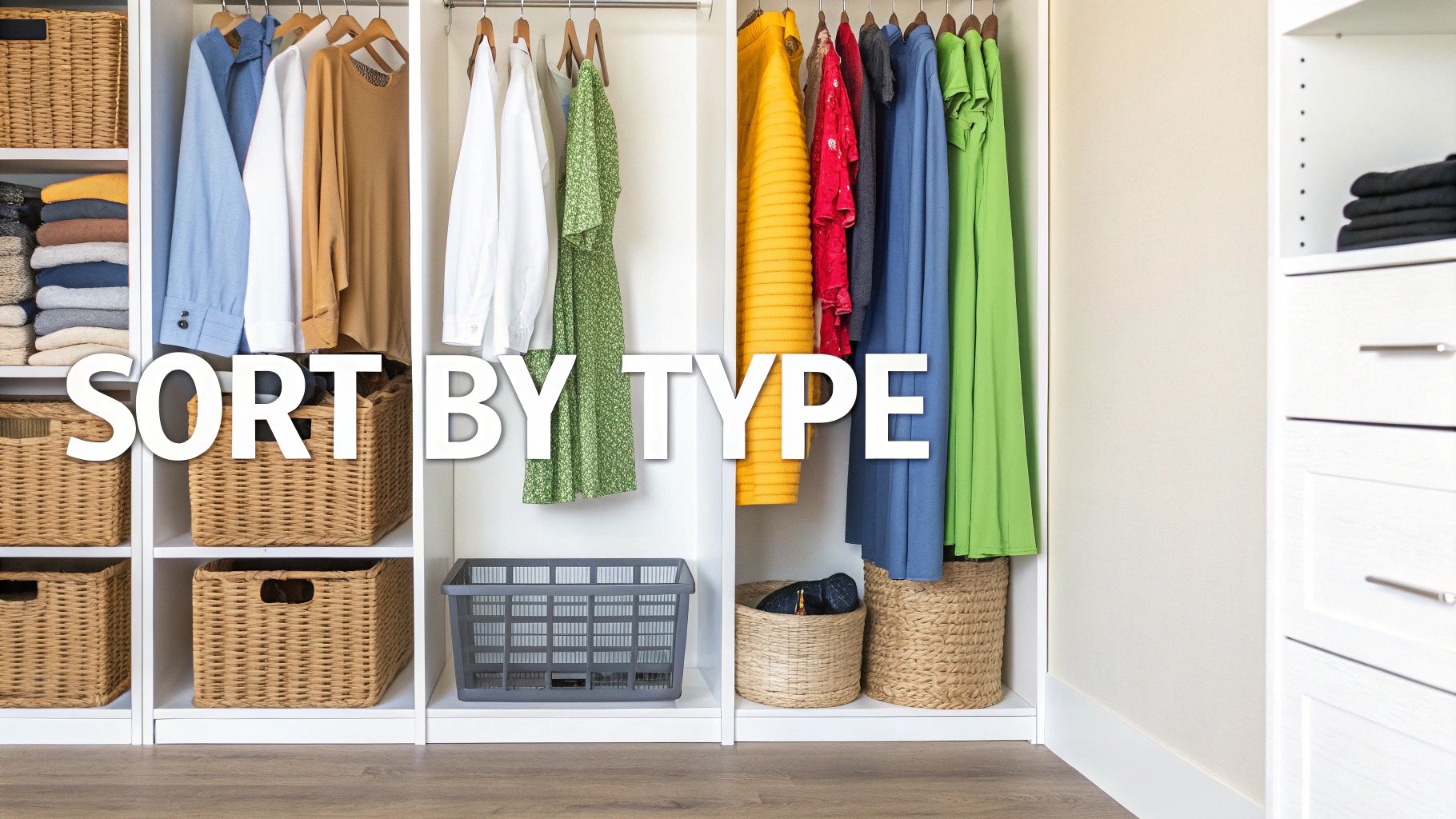
Alright, you've done the hard part and now you're left with a pile of clothes you genuinely love. This is where the real fun begins. We're not just stuffing things back in; we're creating a smart, intuitive system within your closet that makes getting dressed every morning feel effortless. A good sorting method is the foundation of a closet that actually stays organized.
Learning how to organize clothes in a closet is all about starting broad and then zeroing in on the details. This layered approach is what turns closet chaos into a functional, easy-to-navigate space.
Start with Broad Categories
First things first, let's group everything by type. This might sound obvious, but it’s a critical step that so many people miss. It's about creating logical zones in your closet so you're not digging through dresses to find a pair of jeans ever again.
Lay out your "keep" pile and start sorting into these main groups:
- Tops: This includes everything from t-shirts and blouses to sweaters and camisoles.
- Bottoms: All your pants, jeans, skirts, and shorts belong here.
- Dresses and Jumpsuits: One-piece outfits get their own dedicated section.
- Outerwear: Group your coats, blazers, and jackets together.
This simple sort immediately creates a sense of order. It's also pretty eye-opening to see exactly how many of each item you own!
Sub-Categorize for Your Lifestyle
Now it's time to get personal. Those broad categories need to be broken down into sub-categories that actually reflect how you live your life. After all, a corporate lawyer's closet is going to look a lot different than a freelance artist's, and that's exactly how it should be.
Let's take that "Tops" pile, for instance. You could break it down into:
- Work Blouses
- Casual T-Shirts
- Knit Sweaters
- Workout Tops
Do the same for your bottoms—maybe you have work trousers, weekend jeans, and summer shorts. The goal here is to create zones that match your daily routines. When you need a work outfit, you'll know exactly where in the closet to look. This is the next logical step after you’ve tackled the initial purge we cover in our guide on decluttering clothes tips.
Organize by Color and Placement
This last step is the secret to making your closet look like a high-end boutique. Within each sub-category, arrange your items by color, usually from light to dark. Not only does it look incredibly calming and beautiful, but it also makes finding that specific navy blue sweater a two-second job.
Place your most-used items—your everyday work clothes or go-to casual wear—right at eye level in the most accessible spot. Less-worn pieces, like formal gowns or heavy winter coats, can be stored on higher shelves or at the far ends of the closet.
Putting this much thought into your closet isn't just a niche hobby anymore. The global home organization market is expected to hit $13.27 billion by 2025. More specifically, the closet organizers market was valued at around $4.2 billion in 2024, which shows just how much people are willing to invest in a well-ordered space.
By layering your organization this way—from broad type to lifestyle sub-category to color—you give every single item a specific home inside your closet. This makes finding things a breeze and, just as importantly, makes putting them away completely mindless.
Choosing the Right Tools to Maximize Closet Space
Alright, you've sorted through your clothes and have your keep, donate, and toss piles ready. Now for the fun part: outfitting your closet with the right gear. Smart closet storage isn't about cramming more stuff in; it’s about choosing a few key tools that make your space work for you, often making it feel twice as big without any construction.
The single most impactful change you can make? Your hangers. A jumbled mix of plastic, wire, and bulky wooden hangers doesn't just look messy—it actively wastes precious rail space. Ditching them for a uniform set is the first real step toward a closet that actually stays organized.
The Power of Uniform Hangers
Switching to one style of hanger instantly brings a sense of calm and order to your closet, but the real magic is in the space you get back.
-
Slim Velvet Hangers: These are an absolute game-changer. I'm not kidding when I say their ultra-thin profile can give you back up to 50% of your hanging space. The non-slip velvet grip also means no more silky tops or wide-neck shirts slipping onto the floor.
-
Sturdy Wooden Hangers: While I love velvet for most things, your heavy winter coats and structured blazers need more support. A small, dedicated set of quality wooden hangers will protect their shape and prevent shoulder sagging over time.
-
Padded Hangers: For those truly delicate pieces—a silk dress, vintage finds, or lingerie—padded hangers are a must. They prevent any snagging or stretching and keep those items in perfect condition.
By simply standardizing your hangers, you create a cohesive system that looks amazing and functions even better. It’s one of the fastest, most satisfying ways to transform your closet from chaotic to curated.
Beyond the basic hanger, specialty designs are your secret weapon for condensing your closet. Think of them as a way to unlock vertical space. For instance, a single multi-pant hanger can hold five pairs of trousers in the same vertical footprint as one. Cascading hangers are also brilliant for grouping outfits, which can be a lifesaver when you're planning your week. For more ideas on wrangling your collection, check out our complete guide on how to store hangers.
Beyond the Hanging Rod
Hangers are the stars of the show, but a few other key players are essential for a truly organized closet. Of course, none of this works without solid hanging rails for your wardrobe as the foundation. Once you've got that sorted, here are a few other items I swear by.
-
Clear Storage Bins: These are perfect for stashing off-season sweaters or accessories like scarves and beanies on those hard-to-reach top shelves. Being able to see what’s inside means you won’t have to pull down three boxes just to find one thing.
-
Fabric Drawer Dividers: An absolute necessity for keeping socks, underwear, and rolled t-shirts tidy in closet drawers. They create simple, clean compartments so you can find what you need without rummaging.
-
Over-the-Door Organizers: Don't forget about the back of your closet door! It's valuable real estate. A pocket organizer is fantastic for shoes, belts, or small handbags, keeping them visible and off the floor.
Choosing these tools strategically is what turns a closet from a simple box into a high-functioning, organized system. Every piece has a job, helping you maintain the order you just worked so hard to create.
Mastering Smart Folding and Hanging Techniques for Your Closet
Now that your closet is kitted out with the right tools, it’s time to focus on how you actually put your clothes away. This might seem like a small detail, but it’s the secret to protecting your clothes and making your morning routine a whole lot smoother.
The golden rule is pretty simple: fold what can stretch, and hang what can wrinkle.
Anything made from delicate or structured fabric gets a hanger. Think linen shirts, silk blouses, dresses, and blazers. Hanging them up in your closet prevents those deep-set wrinkles that are a pain to iron out. On the other hand, heavy knit sweaters, t-shirts, and most of your activewear are better off folded on a shelf or in a drawer. Putting these on a hanger can cause the shoulders to stretch out and lose their shape over time.
This graphic really breaks down the must-have tools for a tidy closet.
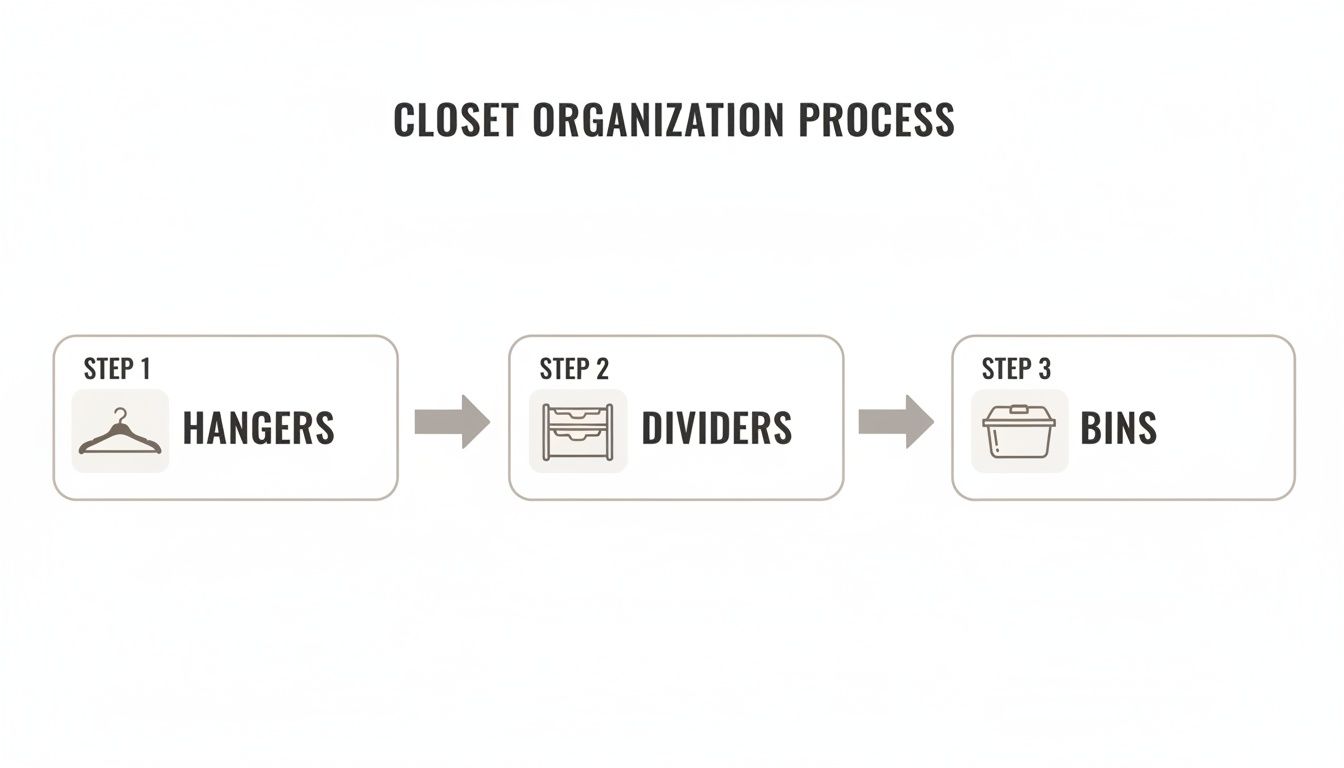
It’s a great visual for seeing how hangers, dividers, and bins can work together to create a system that just makes sense.
Perfecting Your Hanging Method
Believe it or not, how you hang something is just as important as the decision to hang it in the first place. A classic mistake with trousers is just slinging them over the hanger bar. This usually leads to a sharp crease right across the middle and a pile of pants on the closet floor.
A much better approach is the "Savile Row fold."
Hold your trousers by the hems, thread one leg through the hanger so it rests on the bar, then simply fold the second leg over the first. This creates a clever self-locking hold that stops them from slipping and prevents that dreaded crease. It’s a game-changer for keeping pants looking crisp in your wardrobe.
Here's a pro tip that instantly makes any closet look 100% better: consistency. Always face your hangers in the same direction, with the hook opening pointing inward, away from you. It creates a clean, uniform line that’s visually calming and makes browsing so much easier.
The Art of File Folding for Drawers and Shelves
When it comes to folded clothes, it's time to stop stacking. Piling items on top of each other means you can only ever see what's on top, and grabbing anything from the bottom creates a mess on your closet shelf.
The solution? File folding.
This technique has you fold items into compact, rectangular parcels that stand up on their own in your drawers or on shelves, just like files in a cabinet. Suddenly, you can see every single t-shirt or pair of leggings at a single glance. No more digging!
Not only does this make finding things a breeze, but it also maximizes every last inch of your space. If you want to really get this technique down, check out our complete guide on folding clothes to save space. By adopting these specific folding and hanging methods, you’ll turn your closet from a chaotic storage space into a truly functional wardrobe.
Keeping Your Closet Organized for the Long Haul
Getting your closet perfectly organized feels incredible, doesn't it? But the real win is keeping it that way. The secret isn't another huge weekend overhaul; it's about building small, consistent habits that maintain your hard work.
Think of it less as a one-and-done project and more like a simple routine. By weaving a few key practices into your weekly life, you can stop the clutter from ever creeping back in, keeping your closet a calm, functional space for good.
Adopt the 'One In, One Out' Rule
If you only adopt one new habit, make it this one. The "one in, one out" rule is your single best defense against an overstuffed closet. The concept is beautifully simple: for every new item you bring home, an old one has to go.
Bought a new pair of jeans? Great! Now, take a minute to pick out a pair you haven't worn in a year and add it to the donation bag. This constant, gentle culling of your wardrobe keeps it curated and ensures you'll never face a massive decluttering project again.
It's no surprise that people are looking for smarter storage solutions. The global closet organizer market was valued at a whopping $12.5 billion in 2023 and is expected to climb to $19.8 billion by 2032. This boom is especially noticeable where living spaces are tight, making every square inch count. You can dive deeper into these global closet organization trends to see how the world is tidying up.
The goal isn't just a clean closet for today. It's building a system so simple that it practically maintains itself. All it really takes is a 10-minute reset each week.
Master the Seasonal Swap
If you live somewhere with four distinct seasons, rotating your closet is a non-negotiable. This twice-a-year swap is the perfect chance to take stock of what you own, check for any damage, and keep your closet streamlined with only what's relevant right now.
Here’s how to make the transition painless and protect your clothes:
- Clean Everything First: Never store dirty clothes. Stains have a nasty habit of setting in over time, and even faint body odors can attract pests.
- Let Them Breathe: Ditch the airtight plastic bins. They trap moisture, which is a recipe for mildew. Instead, opt for canvas bins or fabric storage bags that allow for air circulation.
- Fold, Don’t Hang: Heavy knits and sweaters should always be folded. Hanging them for months on end will stretch them out and ruin their shape.
- Find a Cool, Dry Spot: Attics and basements can be humidity traps. A better bet is under a bed or in a guest room closet where the climate is more stable.
Proper storage is the key to making sure your favorite pieces are in perfect condition when you pull them out next year. If you do happen to find a little dampness got in, knowing the right way for removing mould from fabric can save the day. It's these little maintenance routines that turn closet care from a dreaded chore into an effortless part of your life.
Common Questions About Organizing Your Closet
Let's be honest, even with the best plan, you're going to hit a few snags when you're deep in a closet overhaul. Learning how to organize your clothes is a skill, and figuring out these common little problems is just part of building a closet system that actually works for you.
Think of this as a quick-reference guide to get you past those hurdles and keep the momentum going.
How Often Should I Declutter My Closet?
The big, deep-dive closet declutter? I recommend doing that once or twice a year. Tying it to the change of seasons is a perfect built-in reminder. It's the ideal time to take stock of what you truly wore over the last six months and what can be packed away until next year.
But what about the rest of the year? For day-to-day upkeep, the ‘one in, one out’ rule is your secret weapon. Seriously. Every single time a new shirt or pair of jeans comes into your home, an old one has to go. This one simple habit is the absolute key to making sure your closet never gets out of control again.
What Is The Best Way To Organize a Small Closet?
When you're working with a small closet, your mantra needs to be: go vertical. Every inch of height is precious real estate, so you want to draw the eye upward and use the space all the way to the ceiling.
Here are a few tactics that work wonders in tight spaces:
- Embrace space-saving hangers. These are the hangers that let you hang several pairs of pants or skirts in the space normally taken by just one. They're a game-changer.
- Add a second hanging rod. If you have the height, this is a no-brainer. It instantly doubles your hanging space for shirts, folded pants, and skirts.
- Don't forget the door. Over-the-door organizers are fantastic for getting shoes, scarves, and belts off the floor and into a spot where you can actually see them.
Anything you can do to get items off the floor and stacked neatly is a win. I also love using simple shelf dividers to keep piles of sweaters from toppling over into a messy heap.
The gold standard for a functional, beautiful closet is to organize by type first, then by color. There's a reason every professional organizer does it this way—it just works.
Start by getting all your like items together. Put all your t-shirts in one spot, all your trousers in another, and so on. Then, within each of those groups, arrange everything by color, moving from light to dark. It not only looks incredibly satisfying but it also cuts your "what should I wear?" time in half because you can find what you need instantly.
What Clothes Should Be Folded Versus Hung in a Closet?
This is a big one, and getting it right can actually extend the life of your clothes. The basic rule is pretty simple: hang fabrics that wrinkle easily and fold fabrics that can stretch out.
You'll want to hang anything made of light, flowy materials like silk, rayon, or linen. Blazers, crisp blouses, and dress pants also need to be on hangers to keep their structure and shape.
On the other hand, always fold anything heavy, bulky, or stretchy. That means all of your knit sweaters, most t-shirts, and your denim should be folded on a shelf or placed in a drawer within your closet. Hanging a heavy wool sweater, for instance, is a recipe for sad, stretched-out shoulders and a misshapen neckline.
Ready to put these strategies into action with tools that are built for the job? MORALVE has a whole range of space-saving hangers designed to help you create that clean, organized closet you've been dreaming of. Find the perfect hangers for your closet at https://moralve.com.
Leave a comment