
How to Organize Clothes Drawers for a Tidy Closet

Before you can dream of a perfectly organized closet with tidy dividers, you have to tackle a critical component: your clothes drawers. A thorough declutter of your drawers isn't just about cleaning a dresser; it's a non-negotiable first step toward creating a closet system that actually works and lasts.
The First Step to an Organized Closet: Decluttering Your Drawers
Let's be honest. The real reason our drawers—and by extension, our closets—are a mess isn't a lack of fancy containers. It's usually because we have too much stuff crammed into them. Getting your entire closet organized becomes so much easier once you’ve edited your wardrobe down to what you truly love and wear, starting with the drawers.
The first move? Pull every single item out. And I mean everything. Don't just shuffle things around. Empty the entire contents of your drawers onto your bed or a clean spot on the floor. It might look like a clothing explosion, but seeing it all at once is a powerful reality check for your whole wardrobe. You can’t organize what you can’t see.
For a deeper dive into this initial phase, our guide on how to declutter your closet can give you an even more comprehensive game plan.
Create a Simple Sorting System
With your mountain of clothes in front of you, the goal is to make quick, decisive choices. The easiest way I've found to do this is with three simple categories.
- Keep: These are the clothes you love, that fit you well, and that you reach for regularly. No hesitation here.
- Donate/Sell: Items that are still in great shape but just aren't you anymore. Someone else will love them.
- Discard: Anything that’s seen better days—think stubborn stains, irreparable holes, or stretched-out elastic.
This method completely eliminates that dreaded "maybe" pile, which is usually just a pitstop on the way back to clutter.
Ask the Right Questions for Each Item
As you pick up each piece, you have to be honest with yourself. This is your chance to curate a wardrobe that makes getting dressed in the morning feel good.
The goal is to surround yourself only with items that you find useful or beautiful. By making mindful choices now, you're not just cleaning your drawers—you're defining your personal space and simplifying your daily routine.
Here are the questions I run through to keep myself on track:
- When did I last wear this? If the answer is over a year ago, it's a pretty strong sign it's time to let go.
- Does this still fit my body and my current style?
- Do I feel confident when I wear this?
- Is it damaged? And if so, will I actually take the time to fix it?
This same decluttering logic can be a lifesaver in other parts of your home, too. You can see how these principles apply elsewhere with this great guide on how to organise a linen cupboard.
Once you have your final "keep" pile, you’re officially ready to start organizing.
Mastering Folds That Maximize Closet and Drawer Space
Now that your drawers are clean slates and you have a curated "keep" pile, we get to the fun part: folding. This is where the real magic happens. If you've always just stacked your clothes flat, you know the frustration—the shirt you want is always at the very bottom. It’s time to change that.
Adopting a few smart folding techniques isn't just about being tidy. It's about transforming your drawers into a perfectly organized, visual catalog of your clothes. Think of it as creating neat little parcels that save space, protect your garments from wrinkles, and let you see everything you own at a single glance.
The Power of the File Fold
For most items in your drawers, the single most effective technique you can learn is the vertical file fold. Marie Kondo made this method famous for a reason—it’s a total game-changer for closet organization. Instead of laying clothes flat, you fold them into compact rectangles that stand up on their own, like files in a filing cabinet. No more digging.
Here's how you’d tackle a basic t-shirt:
- Lay the shirt flat and fold one long side in toward the center.
- Neatly fold the sleeve back over the section you just brought in.
- Do the same thing on the other side, creating one long rectangle.
- Now, fold that rectangle in half or in thirds until it’s just the right height to stand up proudly in your drawer.
This simple method works beautifully for t-shirts, tank tops, pajamas, and even shorts. It’s the secret to turning a messy jumble into an orderly grid. For a deeper dive, our complete guide on folding clothes to save space has detailed steps for all kinds of items.
Of course, before you can even think about folding, you have to get through the initial decluttering.
This simple flow—Empty, Sort, and Decide—is the essential foundation for any closet project. You can’t organize clutter, so this step makes everything that follows possible.
Choosing the Right Folding Technique
Not every item is a candidate for the file fold. A bulky sweater needs a different approach than a pair of socks. The real skill is matching the folding technique to the garment’s fabric, size, and its place in your closet.
Here’s a quick comparison to help you decide what’s best for your clothes.
| Folding Method | Best For | Pros | Cons |
|---|---|---|---|
| File Fold | T-shirts, tanks, shorts, pants, pajamas | Excellent visibility; maximizes drawer space; easy access to every item. | Can be time-consuming at first; less effective for very bulky items. |
| Ranger Roll | Sweatshirts, hoodies, activewear, jeans | Extremely compact; great for travel or deep drawers; items won't unravel. | Can cause wrinkles in some fabrics; hides logos or designs. |
| Flat Fold/Stack | Sweaters, delicate knits on closet shelves | Prevents stretching of heavy fabrics; simple and quick. | Hides items at the bottom; stack can easily become messy. |
Ultimately, the best system is often a mix of all three. Use what makes sense for the item and the drawer or shelf you're putting it in.
Folding Techniques for Different Items
Let's look at a couple of specific scenarios.
For Bulky Items: The Ranger Roll
We’ve all got them—the hoodies and chunky sweatshirts that devour drawer space. This is where the ranger roll comes in. It’s a military-inspired technique for creating a tight, compressed bundle that holds its shape. You essentially fold the item into a rectangle, roll it up as tightly as possible, and then tuck the end into a cuff you make at the beginning. It's surprisingly effective.
For Small Items: Socks and Underwear
These are the usual suspects for drawer chaos. Stop balling up your socks! It ruins the elastic over time. A better way is to lay one sock on top of the other and simply fold them in half or thirds. For underwear, just fold the sides in to create a rectangle, then fold it into a tiny, file-able square.
By learning just a few core folding methods, you can create a customized system that works for every single item you own, making your entire closet more functional. It’s not about perfection; it’s about creating a visible, and easily maintained space.
Using Dividers to Design Your Drawer Layout
You’ve sorted and folded everything, and the urge to just put it all back is strong. But wait. This is the moment that separates a temporary tidy-up from a closet organization system that lasts. Think of your empty drawers as a blank canvas. This is your chance to strategically design the space instead of just filling it.
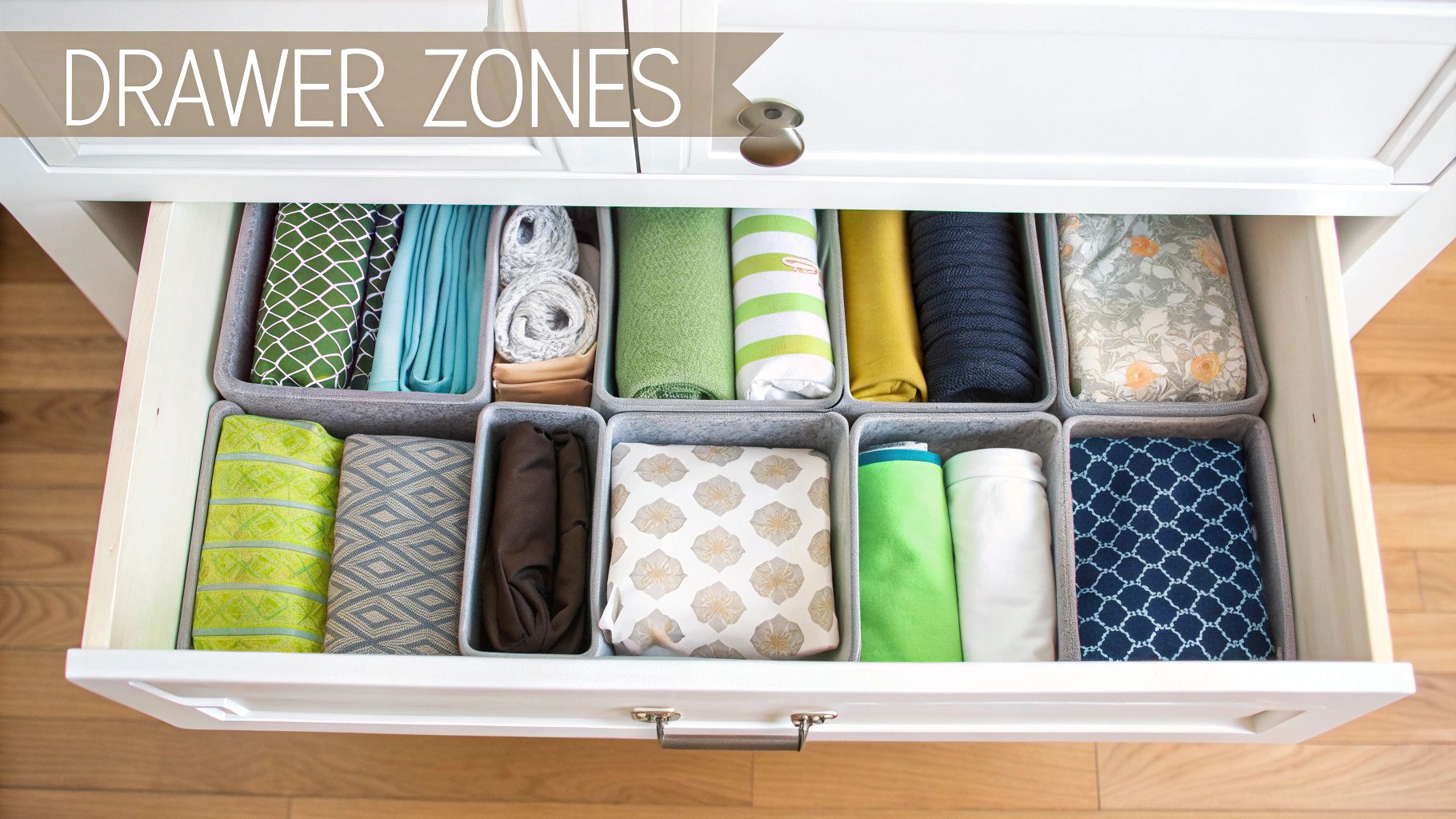
Taking a few minutes to plan your layout with dividers, bins, and other organizers is what makes the whole system stick. You’re creating permanent, dedicated homes for every category of clothing, which stops everything from slowly devolving back into a jumbled mess. It’s the framework that holds all your hard work together.
Choosing the Right Tools for the Job
Drawer organizers aren't a one-size-fits-all solution. What works best really depends on the size of the drawer and what you plan to put inside. I've found that mixing and matching different types of dividers usually gets the best results.
- Adjustable Spring-Loaded Dividers: These are my go-to for versatility. They're perfect for creating custom-sized rows for file-folded t-shirts, jeans, or shorts, keeping everything upright and easy to see.
- Honeycomb Organizers: Absolutely essential for small, chaotic items. Those little interlocking cells are a lifesaver for socks, underwear, ties, and rolled-up belts. Each tiny piece gets its own slot.
- Fabric Bins or Boxes: These are great for creating modular sections within a drawer. I use them to group things like workout tops, pajamas, or swimwear. They’re especially handy in deep drawers where you can create logical groups.
This drive for smarter storage isn't just a niche trend. The global market for closet organizers hit a massive USD 12.5 billion in 2023 and is expected to jump to USD 19.8 billion by 2032. That's a huge shift, showing that people are serious about investing in more functional, peaceful home environments. You can see more data on these trends over at Dataintelo.
Mapping Out Your Drawer Strategy
Before you start placing dividers, think about your daily routine. The whole point of closet organization is to create a flow that makes getting dressed completely effortless.
Group Similar Items Together
The golden rule is to store like with like. All your t-shirts belong in one area, and all your athletic shorts in another. It sounds obvious, but dividers enforce this rule and prevent categories from blending together over time.
For instance, in a t-shirt drawer:
- Use a long divider to create separate channels for short-sleeve and long-sleeve tees.
- If you have a lot of shirts, add another divider to split casual tops from workout gear.
By assigning a permanent, defined home for every single item, you eliminate guesswork. You'll never have to wonder where your favorite running socks are because they will always be in their designated honeycomb cell. This simple act builds a powerful habit for a tidy closet.
Consider Item Frequency and Drawer Placement
Arrange your drawers based on how often you reach for things. It's a simple change that makes a big difference to your closet system.
- Top Drawers: This is prime real estate. Reserve it for daily essentials like underwear, socks, and your most-worn t-shirts.
- Middle Drawers: Perfect for things you wear often but not every single day, like pajamas, workout clothes, or jeans.
- Bottom Drawers: This space is best for less-used items, such as seasonal clothing (think bulky sweaters) or accessories for formal wear.
This tiered system means you won't have to bend over and rummage around for your socks every morning. It’s a small, but significant, improvement to your daily routine. If you're working with a tiny closet or no closet at all, check out our guide on clothes organizers for small spaces for some more specialized ideas.
How to Keep Your Drawers Organized for Good
https://www.youtube.com/embed/jBt_0qOJOyQ
Getting your drawers organized is one thing; keeping them that way is the real challenge. The truth is, a beautifully organized closet isn't the result of a single, massive clean-out. It comes from building a few simple, repeatable habits.
After all the work you've put in—decluttering, folding, and arranging—the last piece of the puzzle is creating a system that keeps your drawers from ever becoming a mess again. This isn't about adding another big chore to your list. It's about integrating small, effortless actions into your daily routine that maintain order automatically.
Build Sustainable Daily Habits
The best way to keep your drawers neat is to stop clutter before it even has a chance to form. Small choices you make every day have a huge impact on your closet's organization over time, and they’ll save you from ever having to do a major overhaul again.
- The 'One-In, One-Out' Rule: This is my favorite trick for a reason—it works. Every time you buy a new t-shirt, an old one has to leave. This simple exchange prevents the slow, creeping accumulation that leads to overstuffed, chaotic drawers. It's a game-changer.
- Put Laundry Away the Right Way: We've all been there—you're tired, and it's so tempting to just cram clean clothes into the nearest drawer. Resist! Take those extra two minutes to use the folding method you chose. Consistently file-folding or rolling items reinforces your system, keeping everything neat and easy to find.
Maintaining organization is less about marathon cleaning sessions and more about small, consistent course corrections. Five minutes of tidying each day is far more effective than a five-hour cleanup session once a season.
Schedule Regular Check-Ins
Even the most perfect system needs a tune-up every now and then. Life happens. Your style evolves, your needs change, and your closet organization should be flexible enough to change with you.
Setting aside a little time for a quick reset is key to making sure your drawers stay functional for the long haul.
Perform Seasonal Resets
A couple of times a year, usually when you're swapping your summer and winter clothes, dedicate an extra 15-20 minutes to a drawer check-in. This is the perfect opportunity to:
- Pull out anything you didn't wear all season. If you didn't reach for it in the last 3-4 months, will you next year?
- Quickly refold any items that have gotten a bit messy.
- Adjust your drawer dividers. Maybe you’ve acquired more workout gear and need to shrink your sock section to make room.
Think of this seasonal check-in as a mini-declutter. It catches clutter before it gets out of hand and ensures your closet setup continues to serve you well, cementing your new skills in how to organize clothes drawers like a pro.
Solutions for Tricky Items and Awkward Drawers
Every closet organization project has its problem children. You know the ones: the bulky sweaters that eat up an entire drawer, the slippery workout clothes that refuse to stay folded, and that tangled nest of scarves and belts. Then there are the drawers themselves—so deep things get lost in the abyss, or so shallow they feel useless.
This is where a little creative thinking comes in. When you hit these common roadblocks, it's time to move beyond the basics and find solutions that work for your specific stuff and space. This is how you master the art of organizing clothes drawers for good.
Conquering Bulky and Slippery Items
Thick knits and slinky activewear are notorious drawer-hogs and escape artists. Instead of forcing them into a file-folding system that just won't stick, it’s time to adapt your technique.
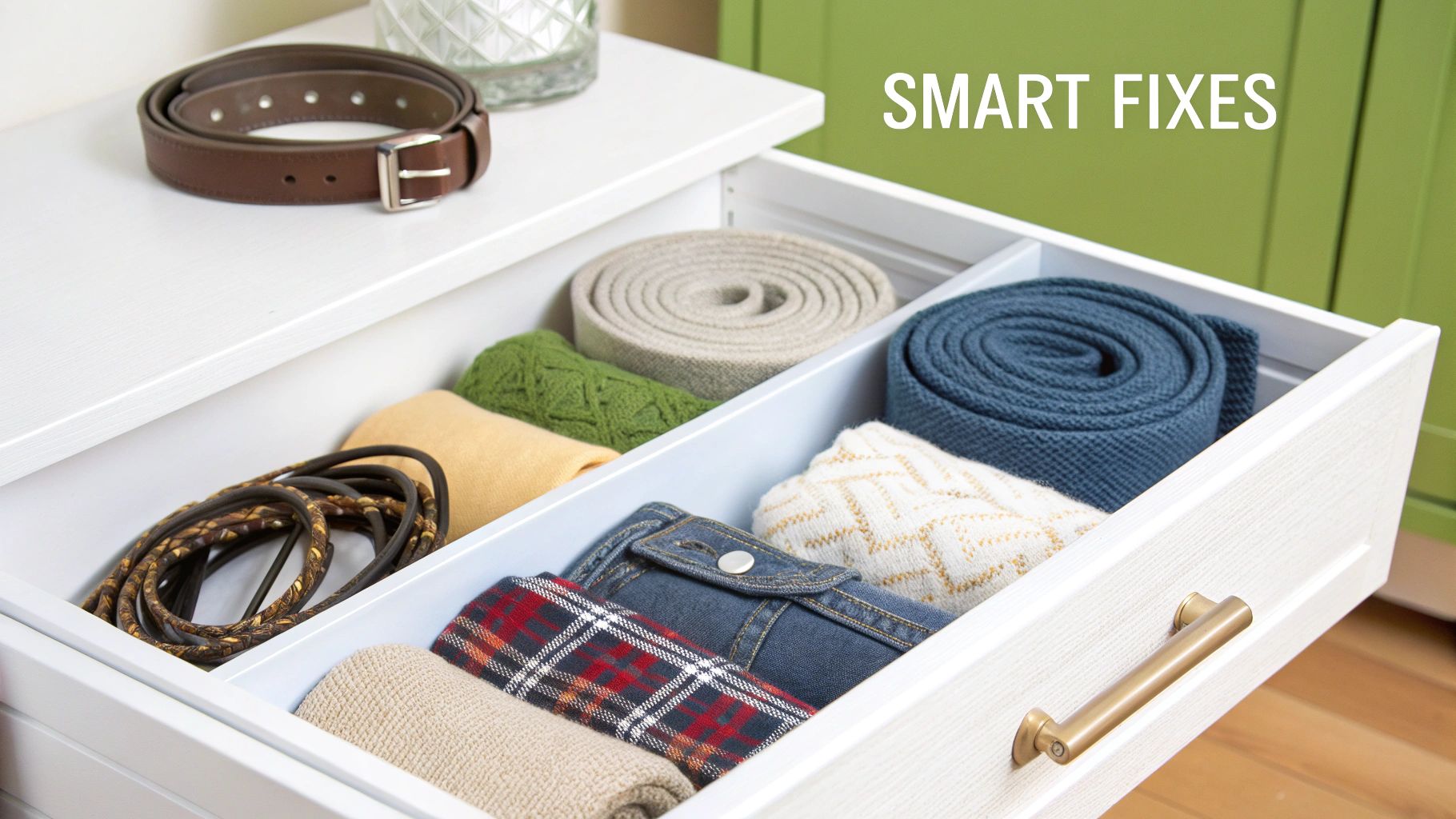
- Bulky Sweaters: Honestly, cramming chunky sweaters into drawers is rarely the best move—it can stretch them out. A far better option is usually to fold them neatly and place them on a closet shelf, saving that valuable drawer real estate.
- Athletic Wear: The slick, synthetic fabric of leggings and workout tops means they slide apart the second you turn your back. The trick is to give them nowhere to go. Roll them tightly and pack them snugly into fabric bins or deep drawer dividers. When they're packed together, they hold each other in place.
- Accessories: For belts and scarves, rolling is your best friend. A honeycomb organizer is fantastic for this, giving each rolled item its own little cubby. This simple trick prevents that frustrating, tangled mess you have to sort through every morning.
Strategies for Unconventional Drawer Spaces
Let's face it, not all drawers are perfect rectangles. Deep, shallow, or oddly shaped drawers demand a custom approach to become truly useful parts of your closet system.
The secret is to work with the drawer’s limitations, not against them. The right insert can turn an awkward, frustrating space into a powerhouse of organization.
This applies to less common storage spots, too. Think about those often-underused futon bed storage drawers—with the right dividers, they can become incredibly valuable.
Sometimes, the furniture itself is the real challenge. It's no surprise that people are investing more in quality storage. The global market for dressers and chests of drawers hit an estimated $15 billion in 2025 and is expected to climb to nearly $22 billion by 2033. It shows a clear trend: we're realizing that good furniture is the foundation of an organized home. You can read more about this growing market and its drivers. Starting with drawers that actually fit your wardrobe is half the battle won.
Common Questions About Organizing Drawers
Even after you've got a solid plan, a few questions always seem to pop up when you're in the middle of a drawer organization project. Getting these details right is what makes the system stick, so let's tackle a few of the most common ones I hear.
What’s The Best Way To Fold Bulky Sweaters And Hoodies?
This is a classic problem for any closet. Chunky knits and hoodies can quickly turn into a jumbled mess. Forget trying to stack them—that's a recipe for disaster. The trick is to get them to stand up vertically, just like your t-shirts.
Lay the sweater or hoodie flat, fold the sleeves in, and then fold the sides toward the middle to create a nice, clean rectangle. From there, fold it in half or into thirds. The goal is to create a compact package that can stand upright on its own in the drawer. This way, you see everything at a glance.
Another great option is the ranger roll. After you fold in the sleeves, just roll the whole thing up tightly from the bottom hem. It creates a tight, neat little bundle that won’t come undone and slots perfectly into your drawer.
How Often Should I Really Reorganize My Drawers?
A big seasonal clear-out is fantastic, and I recommend doing one twice a year when you're switching your wardrobe from warm to cold weather (and back again). But the real secret to keeping things in order isn't the big overhaul; it's the weekly maintenance.
Honestly, the most powerful habit you can build is spending five minutes once a week just tidying up. Put stray items back, refold that one shirt you rummaged for, and straighten the dividers. This tiny bit of effort keeps the chaos from ever taking hold again.
When you do this consistently, those big seasonal sorts become way less intimidating.
Are Expensive Drawer Dividers Actually Worth It?
Not always! It's easy to get wowed by beautiful bamboo or clear acrylic dividers, and they certainly look sharp. But you absolutely do not need to spend a lot of money to get the same results. The only job a divider has is to create a boundary for your categories.
Here are a few budget-friendly ideas that work just as well:
- Adjustable tension-rod dividers are amazing because they can fit almost any drawer.
- Simple fabric storage bins are perfect for grouping small things like socks or underwear.
- Old shoeboxes (with the lids cut off) are free and work surprisingly well.
At the end of the day, the best organizer is the one that fits your drawer and helps you maintain your system. Functionality is always more important than price.
Ready to create a closet system that truly lasts? The right tools make all the difference. Explore the collection at MORALVE to find innovative, space-saving solutions that will transform your drawers and closets from cluttered to calm. Start building your perfectly organized space today by visiting the MORALVE website.
Leave a comment