

How to Organize Small Closet Space and Reclaim Your Wardrobe

When it comes to organizing a small closet, it really boils down to three things: a brutally honest declutter, thinking vertically, and getting the right tools for the job. That’s it. This simple approach is what takes a closet from a source of daily stress to a space that actually works for you.
Your Game Plan For A Clutter-Free Small Closet
Staring into a cramped, chaotic closet can be completely overwhelming, but getting it under control is more achievable than you think. This guide is all about breaking the project down into simple, manageable phases you can tackle without losing your mind.
We’re going to walk through everything from an effective clear-out to smart organization that squeezes function out of every last inch. The secret lies in a mix of ruthless decluttering, clever use of vertical space, and the right gear. That’s where specialized solutions, like space-saving hangers from MORALVE, come in and make a huge difference.
A New Mindset For Small Spaces
Before you touch a single item, the first step is actually a mental one. Think of it less as tidying up and more as curating your wardrobe. To really master your small space, it helps to adopt some broader strategies to organize small spaces in general. It all starts with being more intentional about what you decide to keep.
The goal isn’t just to fit more stuff into your closet. The true objective is to create a space that contains only items you love and use, making your daily routine simpler and less stressful.
To get you started on the right foot, we’ve broken down the entire process into a clear, four-phase plan. Think of this as your roadmap from clutter to calm.
Four Phases to Master Your Small Closet
Here’s a high-level look at the journey we’re about to take. Each phase builds on the last, ensuring you create a system that's not just organized for a day, but for the long haul.
| Phase | Objective | Key Action |
|---|---|---|
| 1. The Great Closet Purge | Declutter and keep only what you love and wear. | Sort all items into 'Keep,' 'Donate,' 'Toss,' and 'Relocate' piles. |
| 2. Assess & Plan | Understand your space and plan an efficient layout. | Measure your closet and sketch a new organization plan. |
| 3. Strategic Organizing | Implement smart storage solutions to maximize space. | Install shelves, bins, and space-saving hangers like MORALVE's. |
| 4. Maintain the Calm | Establish routines to keep the closet organized. | Implement a "one-in, one-out" rule and schedule quick touch-ups. |
With this framework in mind, you’re ready to dive in. Let's start with the most crucial—and often most difficult—part: the purge.
The Great Closet Clear-Out: Your Starting Point
The journey to a beautifully organized closet doesn't start with buying bins or fancy new hangers. It begins with creating a completely blank slate. Take every single item out. Every last shirt, that pair of shoes you forgot you owned, and that scarf from three seasons ago. Pile it all on your bed or the floor.
This step is non-negotiable, and here's why. It forces you to physically touch each item, which stops you from just shuffling clutter around. More importantly, it reveals the true, unvarnished reality of the space you have to work with. You'll probably be surprised at how much room you actually have once it's empty.
The Four-Pile Sorting Method
Alright, with your closet bare, it's time to make some tough decisions. Create four distinct piles or zones: Keep, Donate, Store, and Discard. This simple system transforms that daunting mountain of clothes into manageable categories, making the whole process feel less overwhelming.
Be brutally honest with yourself as you handle each piece. The goal isn't just to get rid of stuff; it's to curate a collection of clothing that you genuinely love and, more importantly, actually wear.
Asking the Right Questions
To break free from that paralyzing "what if I need it someday?" trap, you need to interrogate every item. This is your best defense against keeping things you don't need.
- Have I worn this in the last year? If the answer is no, it's a strong candidate for the donate pile. Obvious exceptions are formal wear or highly specific seasonal gear.
- Does this fit me right now? We've all done it—kept clothes that are too small "for when I lose weight." This just creates guilt and wastes precious space. Let it go.
- Is this damaged? Be realistic. Are you really going to fix that missing button or broken zipper? If you haven't by now, you probably won't.
- Does this reflect my current style? Our tastes evolve. It’s perfectly okay to release items that no longer feel like "you," even if they're in perfect condition.
For sentimental pieces, think about storing them somewhere other than the prime real estate of your closet. For a deeper dive, our complete guide on how to declutter your closet offers even more strategies to tackle this step effectively.
The most liberating part of decluttering is realizing you're not just making space in your closet—you're making space in your life. You're removing decision fatigue and creating a wardrobe that serves you, not the other way around.
By the time you're done, you should be left only with clothes that fit well, make you feel good, and that you reach for regularly. This curated collection is the foundation for building your newly organized small closet.
Unlocking Hidden Potential with Vertical Storage
After you’ve sorted through what to keep, it’s time to tackle the most overlooked part of any small closet: the vertical space. Most of us just see the single hanging rod and think that's all the room we have. But the real magic happens when you start looking up and down. All that empty air above your top shelf and the open floor beneath your clothes? That’s prime real estate just waiting to be claimed.
Thinking vertically is the secret that separates a crowded closet from a truly organized one. When you layer your storage, you can fit so much more in without anything feeling crammed or chaotic.
This is a bigger deal than you might think. Just look at where space gets wasted in the average closet.
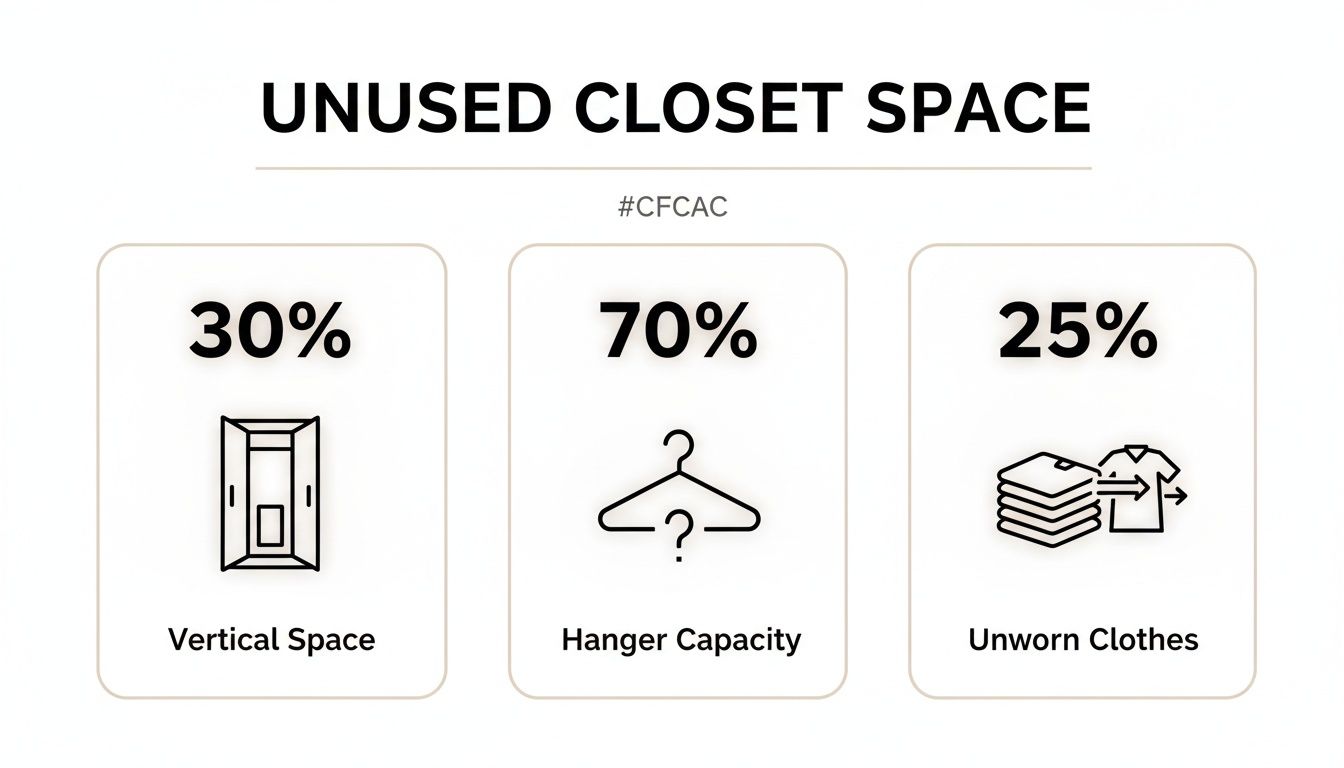
The numbers don't lie. A staggering 30% of potential vertical space often goes completely unused. That’s a huge opportunity just sitting there.
Double Your Hanging Space Instantly
One of the easiest, most impactful changes you can make is adding a second hanging rod. If your closet has a standard high rod with a ton of open space below your shirts, you've struck organizational gold. Installing a lower rod creates a double-hang section that's perfect for blouses, folded trousers, and skirts.
This simple fix literally doubles your hanging capacity for shorter items. You can hang your blouses up top and your folded pants on the bottom rod. It's a cheap, high-impact solution that puts your closet to work immediately.
If your built-in closet is just too small no matter what, well-designed freestanding wardrobes can be a lifesaver, giving you that much-needed vertical storage.
The Power of Smart Hangers
Let's be clear: not all hangers are created equal. This is where a small investment can make a massive difference. The quickest win for any small closet is swapping out those bulky, mismatched hangers for a uniform set of slim ones. Professional organizers will tell you that this simple change alone can free up 25% to 40% more rod space.
It’s about more than just looks, though. Slim hangers let your clothes glide easily, preventing snags and creating a clean, cohesive look that instantly cuts down on visual noise. That feeling of calm is just as valuable as the physical space you gain.
“The single biggest mistake I see in small closets is the wrong type of hanger. Bulky hangers are space thieves. Switching to slim or multi-tier hangers is the quickest win you can get.”
To take it a step further, specialized multi-tier hangers are absolute game-changers. For instance, MORALVE multi-tier pant hangers let you hang five pairs of pants in the same vertical space as just one traditional hanger. Imagine replacing ten individual pant hangers with just two—you’ve instantly reclaimed a huge chunk of your closet rod.
Space-Saving Hanger Comparison
To really see the difference, let's break down how traditional hangers stack up against smart, space-saving designs.
| Hanger Type | Garments Held | Approx. Rod Space Used | Best For |
|---|---|---|---|
| Bulky Wooden Hanger | 1 | 1.5 inches | Heavy coats, suits |
| Standard Plastic Hanger | 1 | 0.75 inches | Everyday shirts, dresses |
| MORALVE Multi-Pant Hanger | 5 | 1.5 inches | Trousers, jeans, scarves |
| MORALVE Multi-Shirt Hanger | 8 | 2 inches | Blouses, t-shirts, tank tops |
The table makes it obvious: multi-tier hangers dramatically increase your closet's capacity by using vertical space that would otherwise be wasted. It's the most efficient way to store more clothes in less horizontal space.
Leverage Shelves and Over-The-Door Organizers
Vertical thinking doesn't stop at the rod. That top shelf, which is so often a messy pile of forgotten sweaters, can be transformed with clear bins or simple shelf dividers. These let you stack items neatly and see what you have at a glance. For some great inspiration, check out these creative shelving ideas for closets.
And don't forget about the back of your door! It’s the most underutilized surface in the room. An over-the-door organizer is perfect for stashing shoes, belts, scarves, and purses—all the things that tend to create clutter elsewhere. You're essentially creating a whole new storage area out of thin air.
Smart Folding and Sorting for Shelves and Drawers
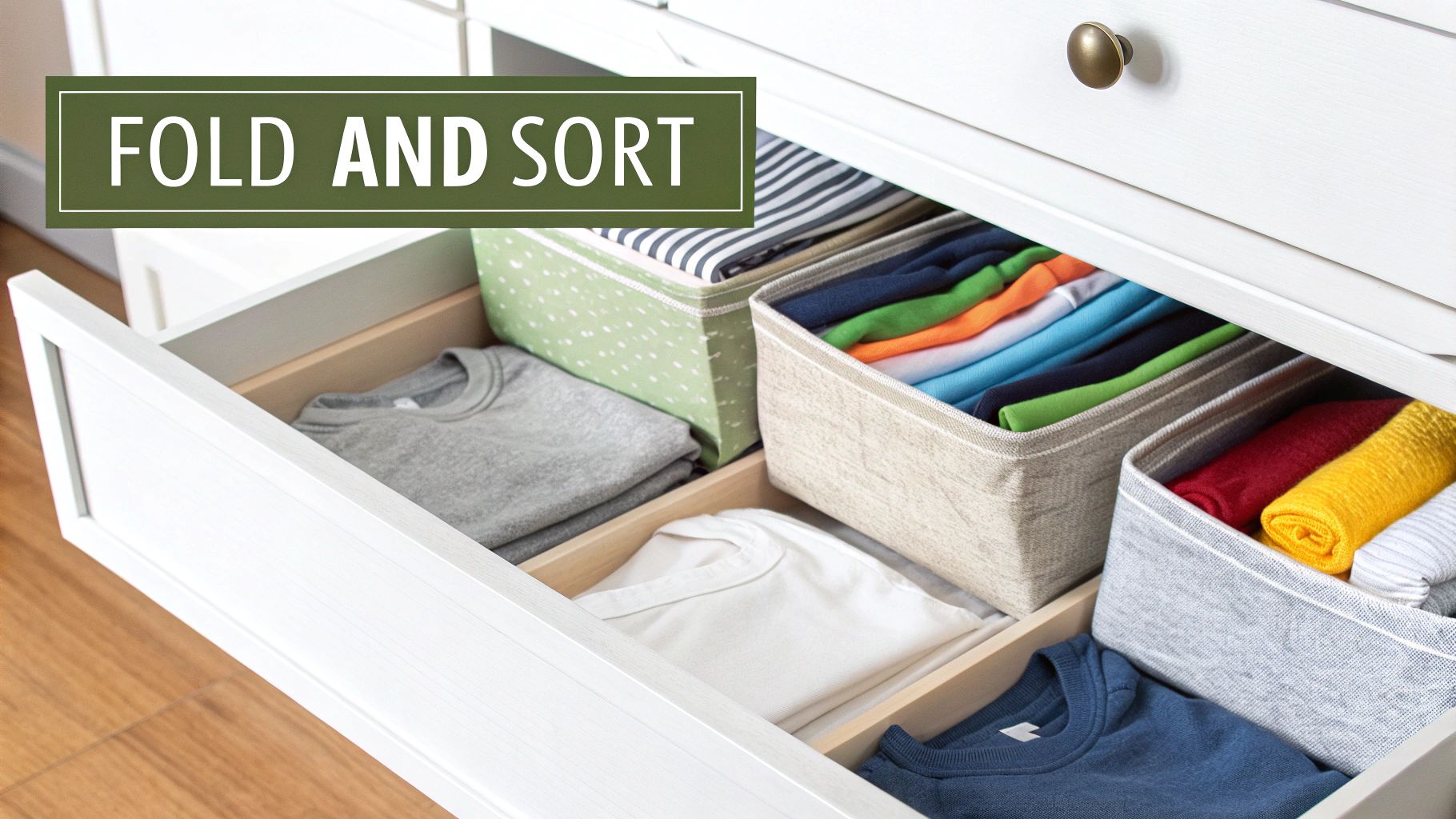
Getting your hanging rod in order is a massive victory, but the real secret to a functional small closet lies in how you handle your shelves and drawers. We’ve all been there: you toss folded items onto a shelf, and the moment you need that one sweater from the bottom, the whole stack topples over.
To really conquer your closet, you have to think differently. Your shelves and drawers aren't just catch-all pits; they’re filing cabinets for your clothes. Shifting your mindset from "stacking" to "filing" is what turns a chaotic space into a smooth, grab-and-go system.
Create Logical Clothing Zones
Before a single item gets folded, you need a game plan. Grouping clothes into logical categories is the only way to build a system that sticks. Instead of one giant, jumbled pile of T-shirts or sweaters, give everything its own neighborhood.
Here are a few ways this works wonders:
- By Occasion: Give your work clothes, weekend wear, and gym gear their own dedicated shelves or drawers. When you're rushing to a spin class, the last thing you want is to be digging through blazers.
- By Item Type: This is the most intuitive one—keep like with like. All your jeans live in one spot, chunky sweaters in another, and so on. Simple, but effective.
- By Color: For basics like t-shirts, arranging them by color within their category is a pro move. It looks fantastic and makes finding that specific heather gray tee a two-second job.
This simple act of zoning puts an end to the daily rummage that undoes all your hard work. You’ll know exactly where everything is, which can be a huge time-saver on busy mornings.
Master the Art of File Folding
Okay, let's get into technique. The old way of stacking clothes flat is a space-killer in a small closet. The real game-changer here is file folding. You might know it as the KonMari method, and it's popular for a reason. You fold items into tight little rectangles that can actually stand up on their own.
When you line them up vertically in a drawer—just like files in a cabinet—you can see everything you own in one glance. No more digging! This technique works beautifully for T-shirts, sweaters, and even bulky jeans. If you're new to this, checking out some guides on folding clothes to save space can show you exactly how it’s done.
The point of folding this way isn't just to make things smaller; it’s to make them visible. When you can see everything you own, you’re far more likely to wear it and less likely to buy something you already have.
Tame Small Items With Dividers and Bins
Finally, let's deal with the small stuff that causes the most chaos: socks, underwear, scarves, and belts. These are the items that quickly turn a neat drawer into a jumbled mess.
This is where simple tools become your best friends.
Grab some drawer dividers to create custom little corrals for socks and underwear. For shelves, small fabric bins are perfect for containing scarves, winter hats, or rolled-up belts. If you really want to level up, label the bins. It makes finding things—and, more importantly, putting them away—completely mindless. This is the final touch that transforms cluttered drawers and shelves into a genuinely tidy, easy-to-use system.
Keeping Your Newly Organized Closet from Going Back to Chaos
Getting your closet organized feels incredible, but the real win isn't just the picture-perfect "after" shot—it's what that closet looks like six months from now. Keeping a small space tidy is less about a massive one-time purge and more about building a few simple, sustainable habits.
The goal here isn't to add complicated chores to your list. It's about making small, consistent efforts part of your daily and weekly routine. That's the secret sauce that turns a major overhaul into effortless upkeep, preventing that slow slide back into clutter.
Master the Seasonal Swap
One of the biggest game-changers for a small closet is getting everything you can't wear right now out of there. Stashing your off-season clothes away frees up a shocking amount of space and makes getting dressed in the morning so much faster.
When the seasons change, make the swap an easy, repeatable process:
- Clean Before You Store: Always wash or dry-clean everything before packing it away. This stops stains from setting in for good and keeps pests from seeing your favorite sweater as a snack.
- Choose the Right Containers: Breathable fabric bins or dedicated under-bed containers are your best friends. Try to avoid airtight plastic bags, as they can trap moisture and lead to musty smells or even mildew.
- Give Them a Home: Find a specific spot for your off-season gear—under the bed, on that high shelf you can't reach anyway, or in a storage unit. Consistency is key.
Think of this seasonal ritual as a built-in decluttering session. As you’re packing up your winter coats, you’ll have a crystal-clear memory of which ones you actually wore and which ones just took up space. It's the perfect time to make a quick decision about what to donate.
Build Simple, Clutter-Busting Habits
To stop clutter from staging a comeback, you need a few non-negotiable rules. These aren't meant to feel restrictive; they’re just guardrails to protect the calm, organized space you worked so hard to create.
The most effective habit by far is the 'one-in, one-out' rule. It's simple: every time a new item comes into your closet, a similar item has to leave. This turns your closet into a zero-sum game, making it physically impossible to overstuff it again.
Another lifesaver is the 10-minute weekly reset. Seriously, just ten minutes. Use that time to hang up the clothes that have migrated to "the chair," straighten the sweaters on your shelves, and put your shoes back where they belong. This tiny weekly investment stops small messes from turning into an overwhelming weekend project.
Common Questions About Small Closet Organization
Even with the best plan, you're bound to hit a snag or two when you're deep in a decluttering project. When it comes to learning how to organize a small closet, a few common hurdles always seem to pop up. Let's tackle the questions most often asked so you can get unstuck and keep making progress.
What Is the Very First Thing I Should Do to Organize a Small Closet?
Take everything out. Seriously, everything.
This sounds like a monumental task, but it’s the only way to truly reset the space. Starting with a completely empty closet forces you to physically touch every single item, which makes those "keep or toss" decisions feel much more deliberate. You can't just shove things around.
This gives you a completely blank canvas. You finally get to see the true dimensions you're working with, which often sparks new ideas on how to use every inch more effectively.
Are Expensive Organizing Products Really Necessary?
Not all of them, no. But a few strategic investments can completely change the game. While you can get by with things like old shoeboxes for dividers, you’ll get the biggest bang for your buck by focusing on tools that solve your biggest problem. For most people with small closets, that problem is a critical lack of hanging space.
This is where you have to be smart with your budget. Pinpoint your main frustration and invest there. If your hanging rod is so packed you can't squeeze another shirt in, products designed specifically to multiply that space will deliver the most dramatic results.
Think about it: specialized multi-tier pant hangers or a set of uniform, slim velvet hangers aren't just for making things look neat. They are engineered to fundamentally alter your closet's capacity, literally creating room where there was none before.
How Do I Keep My Small Closet Organized for Good?
Long-term organization is all about building simple habits, not relying on a single, massive clean-out. The most powerful trick in the book is the 'one-in, one-out' rule. Anytime a new piece of clothing comes in, a similar item has to go out. It creates a self-sustaining balance and makes it physically impossible to overstuff your closet.
Another game-changer is scheduling a quick 10-minute 'closet reset' once a week. Just take ten minutes to re-hang anything you threw on a chair, straighten up folded items on the shelves, and put your shoes back where they belong. This tiny bit of regular maintenance prevents the clutter from piling up and saves you from ever needing another huge overhaul.
My Closet Has No Shelves—Only a Single Rod. What Should I Do?
This is a fantastic opportunity to build your own storage system from the ground up. A closet with just a single rod is a blank slate just waiting for you to add smart, vertical solutions.
Here's what you can do right away:
- Grab a hanging shelf organizer. These fabric cubbies hang right from your existing rod and instantly give you shelves for sweaters, folded jeans, or T-shirts.
- Use the floor. Don't forget about that prime real estate! A small set of drawers or a simple shoe rack placed on the floor can create brand-new surfaces for storage.
- Put the door to work. An over-the-door organizer is an absolute lifesaver. It’s perfect for holding accessories, scarves, belts, or even flat shoes without using a single inch of rod or floor space.
The idea is to introduce new layers of storage where none existed, effectively turning that one rod into a multi-level, highly functional system.
Ready to see what the right tools can do for your space? Head over to MORALVE to check out our collection of space-saving hangers and find the perfect solutions to finally conquer your closet clutter.
Leave a comment