

How to Organize Your Shoes in a Closet Like a Pro

Before you even think about buying a single shoe rack or bin for your closet, you have to do the hard part first: a ruthless declutter. The absolute first step is to sort every shoe you own into one of four piles—keep, donate, repair, or toss. If you skip this, you’re just organizing clutter, not creating a functional closet space.
Start with a Smart Shoe Declutter
Let's be honest. Most closet organization projects fall flat because we try to find a home for junk we should have gotten rid of in the first place. A proper declutter gives you a realistic inventory to work with, making everything that comes next—the measuring, the planning, the storing inside your closet—infinitely easier.
The process itself is simple, but it demands a bit of brutal honesty. Your mission is to round up every single pair of shoes you own and bring them to one central location. Seeing them all together in one giant pile is usually the wake-up-call we all need to reclaim our closet space.
Create Your Sorting Stations
Once you’ve assembled your shoe mountain, set up four distinct zones. Physically separating them is key to staying on track and not letting shoes creep back into the wrong pile.
- Keep: These are your non-negotiables. You love them, you wear them, and they’re in great shape. These are the shoes that will earn a spot back in your closet.
- Donate: Shoes that are perfectly fine, but just not for you anymore. Maybe they pinch your feet, or they just don’t match your style these days.
- Repair: For those favorite pairs that have seen better days—a snapped heel, a scuffed toe. Just be real with yourself: will you actually get them fixed? If not, they might belong in another pile.
- Toss: This is the end of the line for shoes that are truly worn out, broken beyond repair, or just too far gone to be donated.
I get it, letting go can be tough. When I'm stuck, I ask myself three questions: Have I worn this in the last year? Can I comfortably wear it for more than an hour? Does it still feel like me? If I get a hard "no" on any of these, it’s time to say goodbye.
This isn't just about clearing out space. You're thoughtfully curating a shoe collection that actually works for your real life and fits neatly within your closet. The time you spend now will save you a little bit of stress every single morning.
This careful approach is part of a larger movement. People are investing more in taking care of what they own. The global shoe care market is already valued at $4.47 billion and is expected to keep growing, which tells you that maintaining and preserving footwear is a big deal. Good closet organization is a huge part of that—it protects your shoes from scuffs, dust, and damage, making them last longer.
For a bigger-picture look at decluttering that goes way beyond shoes, a comprehensive decluttering and moving checklist can give you a fantastic system for tackling your entire home. And for more targeted advice, our own guide on how to declutter your closet has some great room-specific tips.
Find the Right Closet Storage Solution
Alright, you've done the hard part. The decluttering is behind you, and what’s left is a collection of shoes you actually love and wear. Now it’s time to give them a proper home inside your closet, turning that chaotic floor pile into a truly functional and accessible space. Choosing the right storage is more than just getting tidy; it's about protecting your footwear from dust, scuffs, and losing its shape over time.
There’s a reason the market for shoe organizers is booming—it's valued at around $2.5 billion globally. As more of us live in smaller spaces, smart closet storage has gone from a nice-to-have to a necessity. People are looking for systems that are both incredibly efficient and look good, too.
Maximize Your Closet's Vertical Space
Most closets have a secret weapon hiding in plain sight: vertical space. Instead of letting shoes eat up your precious floor real estate, start thinking upwards. This is hands-down one of the best strategies for anyone trying to figure out how to organize shoes in a tight closet space.
- Hanging Organizers: Those fabric organizers with multiple cubbies that hang right from your closet rod are a game-changer. They’re perfect for lightweight shoes like flats, sandals, and sneakers, keeping pairs together and instantly freeing up the floor.
- Over-the-Door Racks: Don't forget the back of your closet door! It's often completely unused real estate. An over-the-door rack can hold a surprising number of shoes and is brilliant for the pairs you grab on a daily basis.
The simple choices you made earlier—what to keep, donate, or toss—make this next step so much easier.
When you only have to find a home for shoes you truly want, the whole process feels less overwhelming.
Choose Solutions Based on Shoe Type
Let's be honest, not all shoe storage is created equal. Your tall leather boots have very different needs than your strappy summer sandals. A one-size-fits-all approach is a recipe for damaged shoes and wasted closet space, so it pays to match the solution to the shoe.
For example, tall boots need to be stored upright to prevent ugly creasing and slumping. I always recommend using boot shapers or hanging them from specialized boot clips inside the closet. On the other hand, delicate heels do best when they have their own individual compartments to protect them from snagging and scuffing.
Pro Tip: I'm a huge fan of clear, stackable shoe boxes. They create a clean, boutique-like feel in a closet and protect your shoes from dust. Best of all, you can see exactly what you have at a glance, so you’ll never forget about that perfect pair hidden in the back.
Here's a quick comparison of some popular options to help you decide.
Closet Shoe Storage Solutions Compared
A comparison of popular closet shoe storage options to help you choose the best fit for your space, collection size, and accessibility needs.
| Storage Type | Best For | Space Efficiency | Shoe Protection |
|---|---|---|---|
| Hanging Organizer | Flats, sneakers, sandals, and lightweight shoes. | Excellent for vertical space; uses closet rod. | Good. Protects from dust and scuffs. |
| Over-the-Door Rack | Frequently worn shoes, smaller collections. | Excellent for using unused door space. | Fair. Shoes are exposed but off the floor. |
| Stackable Boxes | Heels, loafers, dress shoes, seasonal pairs. | Good. Customizable to fit any shelf height. | Excellent. Full protection from dust/moisture. |
| Boot Hangers/Shapers | Tall boots (knee-high, over-the-knee). | Good. Prevents creasing and saves floor space. | Excellent. Maintains boot shape and material. |
| Angled Shelves | Displaying a curated collection of heels/sneakers. | Moderate. Best with ample shelf space. | Good. Keeps shoes visible and organized. |
Choosing the right combination from this list will depend entirely on what’s in your shoe collection and how much closet space you're working with.
And if you have existing closet shelves that have seen better days, a simple DIY upgrade can make a huge difference. A quick and easy guide on how to wrap a shelf with interior film can give your space a polished, custom look without the hassle of a major renovation. This small touch really elevates the entire feel of your closet, making it a space you'll be proud of.
Arrange Your Shoes for Daily Life
Okay, so you’ve got the right shelves and organizers in your closet. That’s a huge first step. But the real magic happens in how you arrange your shoes. This is where you transform a chaotic pile into a system that actually makes your daily routine simpler. It’s less about following strict rules and more about creating a setup that genuinely works for you.
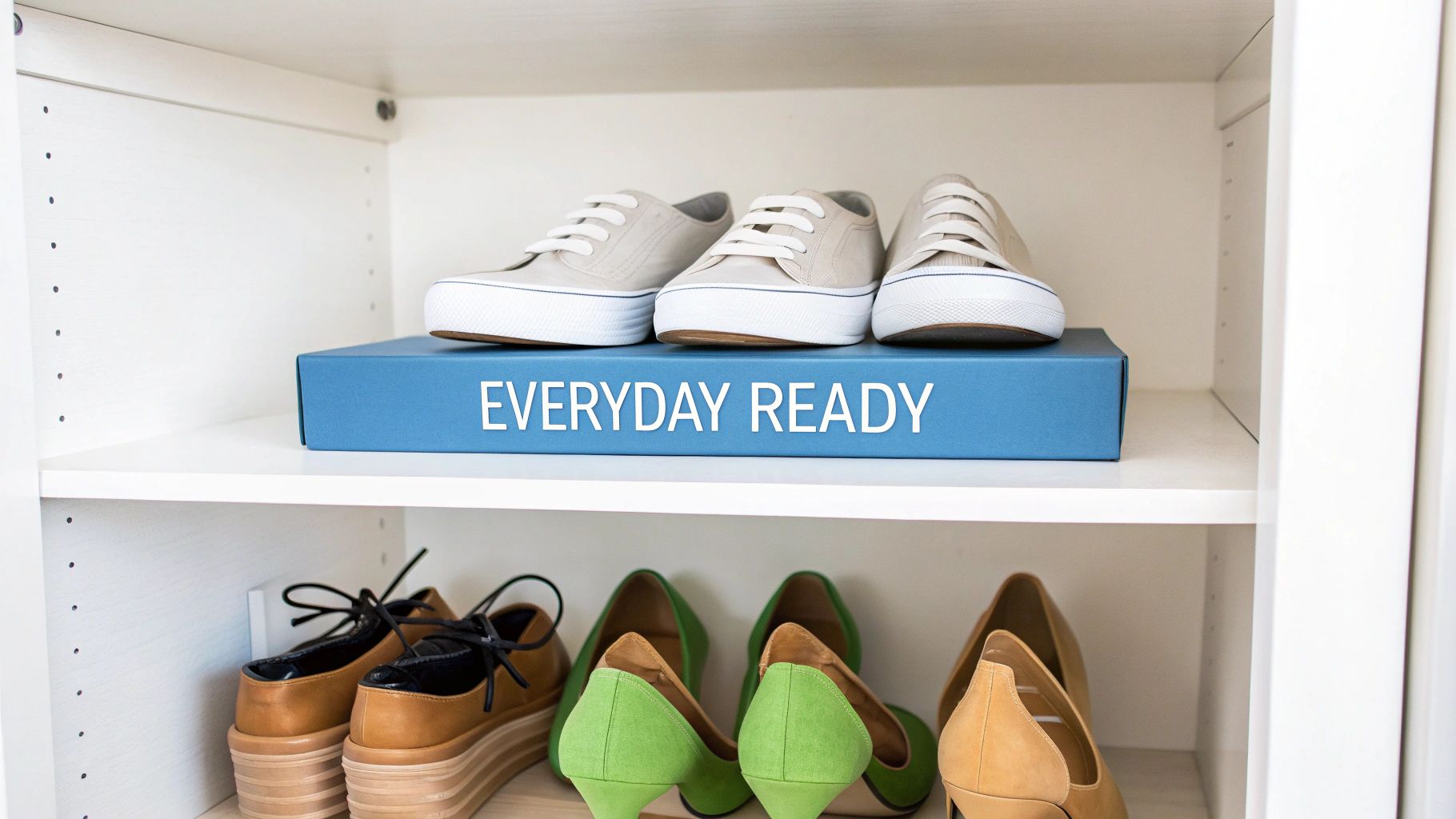
The single most effective trick is to organize based on how often you wear things. Think about it: those sneakers you basically live in, or the loafers you always grab for work? They need to be front and center in your closet—at eye level and super easy to grab without a second thought.
Meanwhile, those stunning heels for special occasions or your heavy winter boots can go on the higher shelves or be tucked away in boxes at the bottom of the closet. This simple hierarchy is a game-changer, saving you precious minutes every morning. No more frantic digging for the right pair.
Group Your Shoes by Category
With your everyday shoes in prime position, it's time to bring some order to the rest of the collection by grouping them into logical categories. This is what makes finding a specific pair quick and painless. There’s no single "best" way to do this; it all comes down to your personal collection and lifestyle.
Here are a few methods I’ve seen work wonders:
- Sort by Occasion: This is my personal favorite for pure function. You create zones in your closet: work shoes here, gym sneakers there, casual weekend kicks in another spot, and a separate section for formal wear. Simple.
- Sort by Type: If you own a dozen different kinds of boots, this one's for you. Group all your sneakers, boots, sandals, and heels together. It's clean, intuitive, and visually satisfying.
- Sort by Color: If you're a visual person, arranging shoes by color can turn your closet into what looks like a high-end boutique. It not only looks incredible but also makes coordinating outfits a breeze.
Don't be afraid to mix and match. You could group by occasion first, and then arrange the shoes within each section by color. Play around with it until it feels right.
Your closet should work for you, not the other way around. Arranging your shoes thoughtfully means you'll spend less time searching and more time enjoying your collection. It’s a small change that has a big impact on your daily routine.
Use Your Closet Space Intelligently
Smart placement isn't just about which shelf you use—it's also about how the shoes sit on that shelf. To squeeze out every last inch of space, try alternating each pair with one shoe facing forward and the other backward. I was shocked by how effective this "heel-to-toe" trick is; you can often fit an extra pair on each row.
If your shelves are deep, that's another opportunity. Keep your less-worn shoes at the back and line up your daily drivers in the front. For more great tips on using your vertical and horizontal space, checking out different shelving ideas for closets can spark some fresh inspiration and help you build a truly efficient system.
Implement a Seasonal Shoe Rotation
Your closet is prime real estate. Let's be honest, it shouldn't be clogged with bulky snow boots in July or strappy sandals in January. A seasonal shoe rotation is a simple, twice-a-year habit that frees up an incredible amount of closet space and keeps it feeling functional and ready for the day.
Think of it like this: your most accessible closet space should only hold the shoes you're actually wearing right now. Everything else can be safely tucked away until its season rolls back around. This simple switch not only clears out the clutter but also makes getting ready in the morning so much faster.
Prepare Your Shoes for Hibernation
Before you pack anything away, a little prep work is non-negotiable. Just tossing dirty or damp shoes into a box is a recipe for disaster—you're basically inviting mold, permanent stains, and misshapen leather. A few minutes of effort now will save you a lot of heartache later.
First things first, give every pair a good cleaning. Wipe away all the dirt, salt, and city grime from your boots. If you have leather or suede, now's the time to treat them with a conditioner. For sneakers and sandals, a gentle scrub usually does the trick. Crucially, make sure every shoe is completely dry before it goes anywhere near a storage box.
Next, you want to help your shoes keep their shape. I always use shoe trees for my dress shoes and loafers. For boots, I stuff them with acid-free paper or dedicated boot shapers to stop them from creasing and slumping over. It’s a small step that makes a huge difference in preserving the structure of your more expensive footwear.
This seasonal swap is the perfect time for a mini-declutter. As you handle each pair, ask yourself: "Do I still love these? Did I even wear them last season?" If the answer is no, it's probably time to donate them and make space.
Find the Right Off-Season Storage Spot
Once your shoes are clean and prepped, they need a home outside of your main closet. You're looking for a spot that's climate-controlled. I can't stress this enough—avoid attics and garages. The wild temperature swings in those places can wreak havoc on materials like leather, suede, and even the glue holding your shoes together.
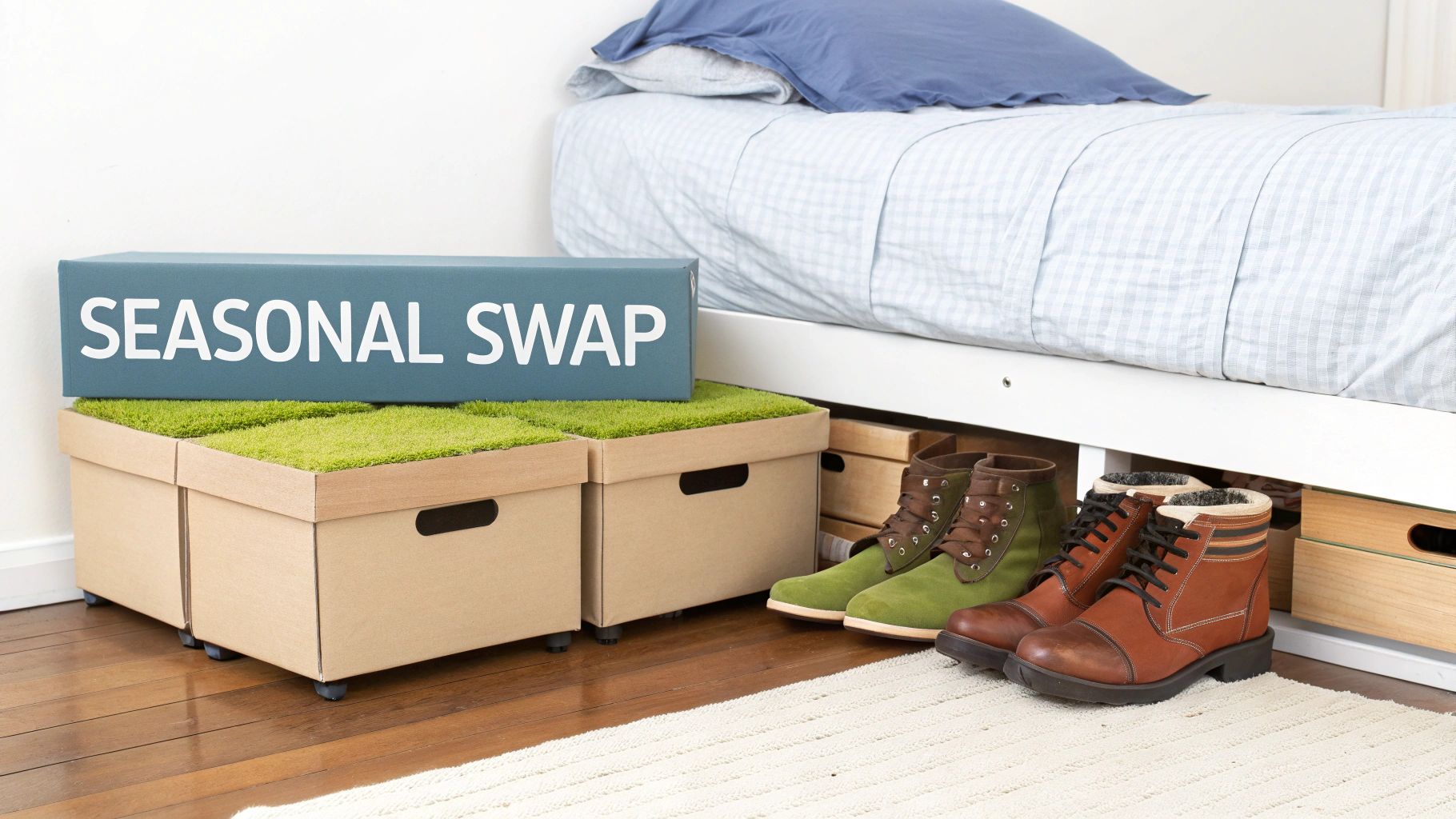
Here are a few of my go-to spots for off-season storage:
- Under the bed: This is my personal favorite. Low-profile, clear bins with lids are perfect. They keep the dust out, and you can easily see what’s inside without having to pull everything out.
- A guest room closet: The top shelf is gold. It’s the ideal place for shoe boxes you only need to get to a couple of times a year.
- High shelves in your own closet: If you're blessed with vertical space, use it! Designate the highest, hardest-to-reach shelf for your out-of-season collection.
If you want to get your whole seasonal swap done in one go, our guide on how to store winter clothes has some great tips that will help you tackle your entire wardrobe at once. Making this a regular habit is the secret to a closet that's always ready for the season ahead.
Keep Your Shoe Closet Organized for Good
Alright, you’ve put in the work. You’ve decluttered, sorted, and created a closet shoe storage system that would make a professional organizer proud. But now comes the real test: keeping it that way. The secret isn't another weekend-long purge; it's about weaving a few simple habits into your daily routine.
Think of it less like a chore and more like a defense system against the slow creep of clutter. These small, consistent actions are what separate a temporary fix from a truly permanent solution. It's how you ensure all that hard work actually sticks.
Adopt the One-In, One-Out Rule
This is probably the single most effective habit you can build to keep your collection under control. The one-in, one-out rule is as simple as it sounds: for every new pair of shoes you bring home, an old pair has to go. No exceptions.
This little rule completely changes how you shop. Suddenly, you're not just asking if you like those new boots; you're asking which current pair they're going to replace. It forces you to be intentional, making sure your closet only holds shoes you genuinely love and wear. It stops clutter dead in its tracks.
Master the Two-Minute Tidy
Forget spending hours reorganizing every month. The real magic lies in consistency. Just give yourself two minutes every single day to put your shoes back where they belong in the closet. That’s it.
Before you head to bed, do a quick sweep. Are your running shoes still by the door? Are your work heels kicked off under your desk? Take those 120 seconds to return them to their designated spot. It’s a tiny investment with a massive payoff.
This simple daily reset is the secret to a permanently organized space. It prevents small messes from snowballing into overwhelming clutter, making maintenance feel like a non-event rather than a chore.
Tack it onto an existing habit, like brushing your teeth or setting out your clothes for the next day, and it will become second nature in no time.
Schedule Periodic Check-Ins
Even the most perfect system needs a little tune-up now and then. While you'll do a major seasonal swap a couple of times a year, a quick monthly or bi-monthly check-in is crucial for keeping things running smoothly. This is your chance to make sure your closet setup is still serving you well.
Set aside 15 minutes and run through this quick checklist:
- Assess Placement: Are the shoes you wear most often still the easiest to access? Maybe your go-to work shoes have changed, or you're reaching for sneakers more than loafers. Adjust your closet layout accordingly.
- Check for Damage: Give your shoes a quick once-over. Do any need a good cleaning, a new sole, or a scuff polished out? Catching it early prevents bigger problems later.
- Identify Misfits: Spot any pairs you haven't worn since your last check-in? That's a red flag. These might be first on the chopping block the next time you use the one-in, one-out rule.
This proactive approach is what makes all the difference. It ensures your beautifully organized closet doesn't just look good for a week—it stays that way for good.
Answering Your Top Shoe Organization Questions
Even the best-laid plans can hit a snag. When it comes to shoe organization in a closet, a few common questions always seem to pop up. Let's tackle them right now, so you can build a system that truly works for you and your space.
What's the Best Way to Store Shoes in a Small Closet?
When you're dealing with a tiny closet, the golden rule is to think vertically. You have to go up. Every inch of floor space is prime real estate, so getting shoes off the ground is your number one priority.
The most effective approach I've found is to mix and match a few different vertical storage solutions.
- Over-the-door shoe organizers are a classic for a reason. They’re perfect for grabbing sandals, flats, and other slim footwear without taking up any internal closet space.
- Hanging shoe shelves, the kind that hang right from your closet rod, create instant columns of storage for sneakers, loafers, and everyday shoes.
- Clear, stackable shoe boxes are a game-changer for those high, hard-to-reach shelves. You can see exactly what's inside and build a customized "shoe wall" in that previously empty space above the clothing rod.
How Can I Keep My Expensive Shoes from Getting Damaged in Storage?
Protecting your investment pieces is all about creating the right environment inside your closet. For starters, give each pair its own home—the original box is fine, but clear, ventilated boxes are even better so you can see what you have at a glance. I always recommend using acid-free tissue paper or adjustable shoe trees; they're essential for helping shoes hold their shape and preventing ugly creases.
Before you put them away, make sure they are completely clean and dry. Dirt and moisture are the enemy. Then, find a spot that’s climate-controlled, meaning no extreme temperature swings, and definitely away from direct sunlight and humidity. Those are the biggest culprits for causing leather to crack, suede to fade, and mold to grow.
The secret to preserving high-quality footwear is a stable environment. A few minutes of prep before you store them can add years to their life and keep them looking fantastic.
How Many Pairs of Shoes Should I Actually Own?
Honestly, there's no magic number. It's a question I get all the time, but the "right" amount is completely personal. It depends on your job, your hobbies, your style—everything. A marathon runner's collection will look vastly different from that of a corporate lawyer.
Instead of focusing on a number, ask yourself this: "Do I genuinely wear and love every single pair I own?" The goal isn't to hit a specific count, but to build a collection that serves your life and fits comfortably within your closet space. You want shoes for work, for weekends, for workouts, and for special occasions, without a bunch of clutter you never touch. Regular, thoughtful decluttering is always more valuable than fixating on a number.
Ready to take back your closet and make the most of every inch? The innovative, space-saving hangers from MORALVE are designed to help you build a beautifully organized wardrobe without the headache. Explore our collection and start your organization journey today.
Leave a comment