

How to Organize a Small Closet and Maximize Space

Before you can even think about organizing, you have to declutter. This isn't the fun part where you buy cute new bins; it's the most critical first step to reclaiming your space. You need to pull everything out and sort every single item. This initial purge creates a clean slate and lays the groundwork for a system that actually works.
Your First Move: Tackling Closet Clutter

To get a real handle on a small closet, you have to see exactly what you’re working with. Yes, that means taking it all out—every last shirt, shoe, and scarf. It might look chaotic for a little while, but this step is non-negotiable. An empty closet is a blank canvas, giving you the mental and physical space to build a functional organization system from scratch.
Think of it as a strategic evaluation of your wardrobe. To really give your closet a fresh start, you can even apply the principles of home staging, which always begin with a ruthless decluttering process. The goal isn't just a tidy space; it's a curated collection of items you genuinely love and use.
The Four-Box Method
To keep from getting overwhelmed, grab four boxes or just designate four piles on your floor: Keep, Donate, Store, and Toss. Pick up each item one by one and ask yourself some honest questions:
- Have I worn this in the last 12 months?
- Does it fit me right now and make me feel good?
- If I saw this in a store today, would I buy it again?
If it’s a confident "yes" to all, it goes in the Keep pile. Anything else needs a different home. This method forces you to make decisions and prevents that "I'll deal with it later" paralysis.
The secret to great closet organization isn’t more space—it’s owning fewer, better things. Every item you decide to keep should truly earn its place.
For a deeper dive into this crucial first step, our complete guide on how to declutter your closet has even more pro tips.
To streamline the process, here’s a quick breakdown of the Four-Box Method.
The Four-Box Decluttering Method
| Box Category | What Goes Inside | Action Required |
|---|---|---|
| Keep | Items you love, wear often, and that fit perfectly. | Place back in the closet once it's organized. |
| Donate | Good-condition items you no longer wear or need. | Bag up and take to your local charity or thrift store. |
| Store | Off-season clothing or sentimental items you can't part with. | Put into storage bins for under the bed or another area. |
| Toss | Worn-out, stained, or damaged items beyond repair. | Place directly into the trash or recycling bin. |
This simple system helps you confront the clutter head-on. The Store box alone can be a game-changer, freeing up a massive amount of prime real estate in a small closet.
After the Purge
Once you’re done, your Keep pile is all that’s left—a wardrobe that actually works for you. With the excess gone, you're no longer just managing a mess. You’re ready to design an organized space you love. This shift reflects a broader trend: the global closet organizers market, valued at USD 4.03 billion in 2025, is projected to grow because people want more functional homes. This shows a clear demand for smarter storage that makes life easier.
Map Your Space for Maximum Potential

Now that your closet is completely empty, you can finally see what you’re really working with. This next part—the planning stage—is the one most people skip, but it’s honestly the most important step when you organize a small closet. It’s the difference between buying organizers that almost fit and finding solutions that feel like they were made just for your space.
Don't rush out to buy bins and shelves just yet. First, grab a tape measure and a notepad (or your phone) and create a simple blueprint. We're not talking about architectural-level drawings, just a quick sketch with the key numbers that will shape every decision you make from here on.
Measure Everything Twice
You need more than just the basic width, depth, and height. To build a system that truly works, you have to account for every little quirk of the space. Get these numbers down, and you'll be golden.
- Door Clearance: Measure how far the door swings into the closet. This is a classic "gotcha" that determines where you can place drawers or shelf towers without blocking the entrance.
- Existing Fixtures: Jot down the exact location and height of any built-in rods or shelves. Are you keeping them or tearing them out? Decide now.
- Usable Depth: This is a big one. Measure from the back wall to just inside the door frame. An organizer might say it's 15 inches deep, but if your usable depth is only 14 inches, it's a no-go.
Taking a few extra minutes to measure properly prevents that frustrating moment when you realize the perfect organizer blocks the door from closing or won't clear an existing shelf. For a deeper dive into this, our guide on how to design a closet system covers all these little details.
Create Your Closet Zones
Okay, now think about your actual wardrobe. A truly great closet reflects your daily routines. This is a concept called closet zoning, and it’s all about creating dedicated areas for different categories of clothing.
On your sketch, start dividing the closet into logical zones. For example, your work clothes probably need prime, easy-to-grab hanging space. Gym clothes can go in bins on a lower shelf. Those bulky winter sweaters? They’re perfect for that hard-to-reach top shelf.
Your closet map is your secret weapon. It turns guesswork into a deliberate strategy, ensuring every inch serves a purpose that’s tailored to your wardrobe, not just some generic organizing template.
By mapping your space and creating zones, you’re building a personalized plan. This strategic blueprint makes everything that comes next—choosing the right hangers, folding techniques, and organizers—so much easier and more effective. You’re no longer just cleaning up; you're engineering a space that actively works for you.
Unlock Your Closet's Vertical Space

In a small closet, floor space is gold—and it’s always the first thing to go. The single best trick for tackling a cramped closet is to stop thinking side-to-side and start thinking up. This mental shift, from square footage to cubic footage, can literally double your storage without any major renovations.
Your mission is to turn all that wasted air into usable, easy-to-reach storage. Look at the empty gap between your hanging rod and the ceiling. What about that dead zone beneath your shirts? These are your biggest opportunities. By going vertical, you're essentially adding new real estate inside your closet.
Go Up with Hangers and Shelves
The quickest wins in closet organization are usually with your hanging clothes. Your average hanger creates just one layer of storage, but a few simple tools can fix that in minutes. Just think about how much rod space a handful of individual hangers for pants or skirts eats up.
- Multi-Tier Hangers: These are absolute lifesavers for pants and skirts. A single one can hold five pairs of pants in the same vertical footprint as a single, bulky hanger.
- Hanging Shelf Organizers: These fabric cubbies hang right on the rod, giving you an instant spot for folded sweaters, jeans, or even shoes.
- Double Hanging Rods: If you have the height, a second tension rod installed below the main one can instantly double your space for shirts, jackets, and folded trousers.
These simple additions let you reclaim valuable rod space and create new organizational zones. To really get the most out of this approach, check out our guide on the best space-saving hangers for clothes.
Stackable Solutions from the Ground Up
Once you’ve tackled the hanging space, it’s time to look down at the floor and up at that top shelf. Let's be honest, piles of shoes or bags just become a jumbled mess. The answer is to add structure that lets you build stable, vertical stacks.
By thinking vertically, you're not just tidying up; you're fundamentally changing the geometry of your storage. Every vertical inch you claim is an inch you don't have to find elsewhere.
This is where stackable containers become your best friend. Clear, stackable shoeboxes are fantastic because they protect your shoes from dust while letting you see exactly what’s inside. You can create a neat, uniform tower that makes the most of your floor space. The same idea works for accessories—use smaller stackable drawers for scarves, belts, and hats.
It's no surprise that products like these are in high demand. The global home organization market was valued at USD 12.59 billion in 2024 and is expected to climb to USD 20.21 billion by 2033. This isn't just a fleeting trend; it’s a reflection of people everywhere trying to make their homes work smarter. Investing in vertical storage is simply a practical response to modern life.
Smart Storage Techniques That Save Space
Once you’ve cleared everything out and made a plan, the real magic begins with how you put it all back. To get a small closet truly organized, you have to think beyond just folding a few shirts and stacking them on a shelf. The right folding and filing techniques don't just make your closet look tidier—they completely change how you use it, making every single item easy to see and grab.
Let's be honest, unstable piles are the enemy. You know the drill: you pull that one shirt from the bottom of the stack, and the whole thing topples over. Instant mess. The solution is to stop stacking altogether and start filing. Think of your clothes like documents in a filing cabinet, and you'll create a system that's shockingly simple to keep up.
Master the File Fold
For drawers and bins, the file fold is an absolute game-changer. Instead of laying shirts flat on top of one another, you fold them into compact little rectangles that can stand up on their own. This lets you line them up vertically, so you can see everything you own in a single glance. No more digging!
Here’s a quick rundown for a standard t-shirt:
- Lay it flat: Place the shirt face down on a bed or the floor.
- Fold in the sides: Fold the left third of the shirt toward the center, then repeat with the right third. You should have a long rectangle now.
- Fold it up: Fold that rectangle in half from the bottom up, and then fold it in half again. What you're left with is a neat little package that stands perfectly upright.
This simple trick works for t-shirts, tank tops, workout clothes, and even shorts. By filing them away in a drawer or a bin, you've just eliminated the root cause of closet chaos.
The goal is to create a "grab-and-go" system. When you can see everything you own at once, you’ll not only get ready faster but also wear a wider variety of your clothes.
Tame Your Bulky Items
Sweaters and hoodies are notorious space hogs. Hanging them often stretches out the shoulders, and stacking them creates those wobbly towers that are just waiting to collapse. The secret is to fold them in a way that compresses their volume without creating a mess.
For a chunky sweater, give this a try:
- Lay it flat on its face.
- Fold the arms across the back, making a cross shape.
- Fold the sides inward to form a clean rectangle.
- Finally, fold it in half or thirds. This creates a tight bundle you can easily place on a shelf or tuck into a bin.
To really make every inch count, think about adding some internal divisions. It’s the same principle behind how self-storage partition systems are employed for maximum space efficiency in much larger spaces. Simple drawer dividers can keep your perfectly folded items from sliding into a jumbled mess. With these techniques, you can transform your closet from a passive storage box into a functional wardrobe that actually works for you, every single day.
Choosing Organizers That Actually Work
https://www.youtube.com/embed/bPDhOg2LEy0
Alright, you've got your plan mapped out. Now for the fun part: picking the tools that will bring your beautifully organized closet to life. The right organizers are more than just containers; they’re problem-solvers designed to tackle the unique challenges of a small space. Choosing smart from the get-go saves you from a pile of plastic bins that looked great at the store but just don’t work in your closet.
You have to match the product to the problem. Are your blouses constantly slipping off cheap plastic hangers and ending up in a puddle on the floor? The solution isn't just more hangers—it's better hangers. This is precisely why so many of us swear by velvet hangers. They’re slim, which immediately saves space, but their real magic is that non-slip surface that grabs onto silky tops and wide-neck shirts and doesn’t let go.
The Most Valuable Players in Closet Organization
Not all organizers are created equal. Some are true workhorses, giving you the biggest bang for your buck in a cramped space. When you're dealing with a small closet, you want to focus on items that either multiply the space you already have or make completely unused areas suddenly functional.
Here are a few non-negotiables for better closet organization:
- Over-the-Door Organizers: This is the most overlooked piece of real estate in any closet. An over-the-door shoe organizer is a game-changer for way more than just shoes—think scarves, belts, rolled-up t-shirts, and all those little accessories that get lost.
- Clear Storage Bins: Out of sight, out of mind, right? That’s a disaster for closet organization. Clear bins let you see exactly what’s inside, so you’re not pulling down three different boxes just to find that one chunky sweater. They’re perfect for that awkward top shelf.
- Drawer Dividers: These simple little inserts are the secret to taming the chaos in your dresser drawers. Use them to create dedicated lanes for your socks, underwear, and file-folded shirts. No more jumbled mess.
If you’re wondering how to handle your shirts, this little diagram can help you decide whether to fold them for a drawer or a shelf.
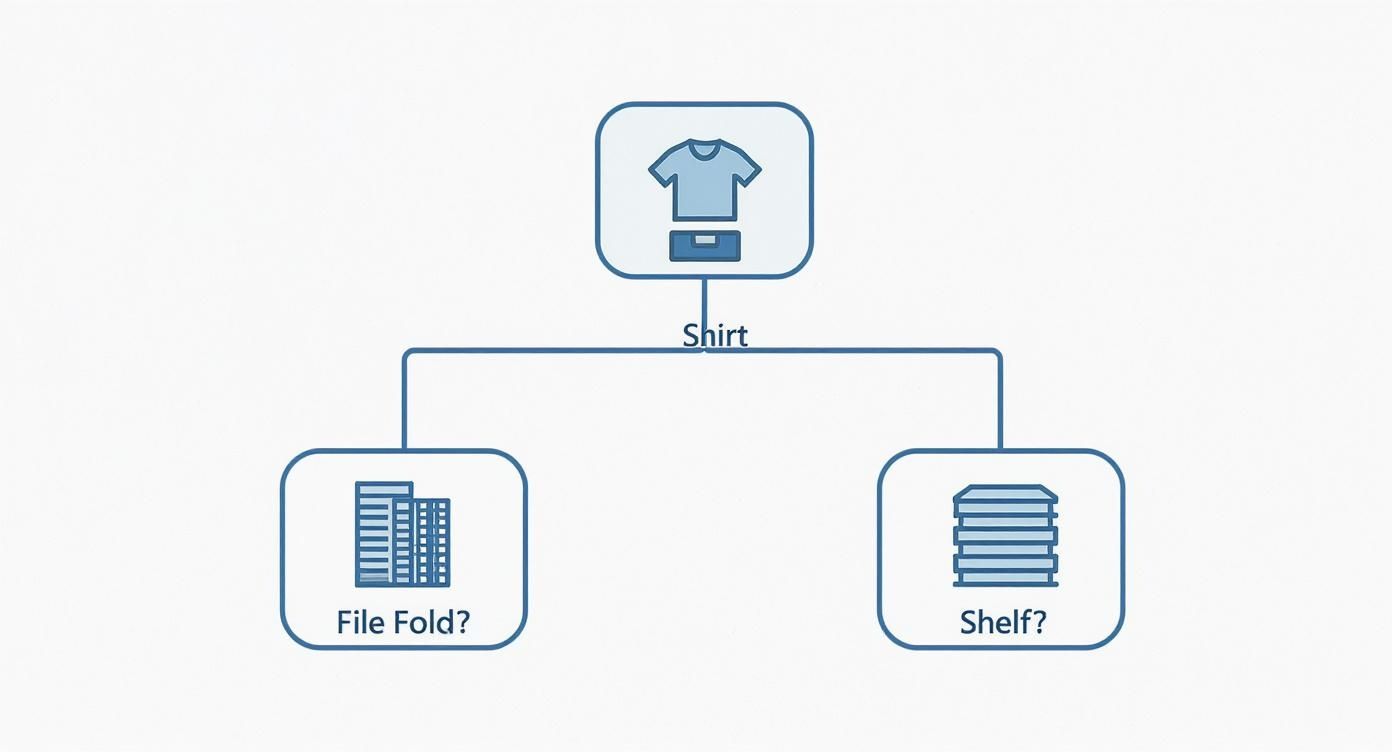
As you can see, file-folding is fantastic for drawers because you can see everything at once, while a neat stack works just fine for open shelving.
A Quick Comparison of Essential Organizers
Making the best choice often comes down to knowing what each tool is truly good for. And you're not alone in seeking these solutions—the global closet organizer market was valued at around USD 12.5 billion in 2023 and is expected to soar to nearly USD 19.8 billion by 2032 as more of us look for smart storage in smaller homes. If you're interested in the numbers, you can discover more insights about these market trends on dataintelo.com.
To help you invest your money wisely, I've put together a quick comparison of the top contenders.
Essential Organizers for Small Closets
Here's a breakdown of the most popular closet organization tools to help you choose the best options for your wardrobe and specific needs.
| Organizer Type | Best For | Space-Saving Benefit |
|---|---|---|
| Velvet Hangers | Blouses, dresses, slippery fabrics | Their ultra-slim design can increase hanging space by up to 50% compared to bulky plastic or wood hangers. |
| Multi-Tier Hangers | Pants, skirts, trousers | Consolidates 4-5 items into the vertical space of a single hanger, freeing up significant rod length. |
| Hanging Shelves | Sweaters, jeans, handbags | Instantly creates a vertical "dresser" on your closet rod for bulky, foldable items without any installation. |
| Clear Shoe Boxes | Shoes, small accessories | Allows for neat, visible stacking on the floor or a shelf, protecting items from dust and damage. |
This table makes it clear that each tool serves a distinct purpose, maximizing space in a different way.
My best piece of advice? The best organizers are the ones you'll actually use consistently. Pick systems that feel natural for your daily routine. It should be just as easy to put something away as it is to take it out.
Ultimately, it’s all about buying with intention. When you align your purchases with the closet map you created and the clothes you actually own, you ensure every single item you bring in serves a purpose. That's how you turn a frustratingly small closet into a masterpiece of efficiency.
Keeping Your Small Closet Organized for Good
You’ve done the hard work. You’ve purged, planned, and put everything in its perfect place. But let's be honest, the real challenge isn't getting the closet organized; it's keeping it that way. The good news is that staying organized doesn't require a massive overhaul every month.
It really comes down to building a few simple, sustainable habits. Think of them as small, intentional actions that stop clutter before it even has a chance to start. This is how you turn a one-time closet organization project into a permanent solution.
Adopt the One-In, One-Out Rule
If you only take away one tip from this guide, make it this one: the one-in, one-out rule. The idea is beautifully simple. Every time a new item of clothing comes into your home, an old one has to go. This single habit acts as a built-in gatekeeper for your closet, forcing you to be mindful about what you acquire.
Just bought a new sweater? Fantastic. Now, pick one you haven't worn in a while to donate. This constant, gentle curation process means your closet never gets overstuffed. It’s a tiny mental shift that prevents the slow creep of clutter and is probably the most effective strategy out there for keeping a small closet under control.
This isn't about depriving yourself. It's about consciously curating your wardrobe so that every single item in your closet is something you truly want and value.
Do a 10-Minute Weekly Reset
Life happens. Clothes get tossed on a chair, shoes don't make it back to the rack. A weekly reset is your defense against this slow slide back into chaos. All it takes is 10 minutes once a week—maybe on a Sunday evening—to hit the reset button.
- Round up the strays: Grab any clothes draped over furniture and hang them up properly.
- Quickly refold: Straighten out any messy piles on shelves or in bins.
- Line up your shoes: Put your shoes back in their designated spot so they look neat and tidy.
This isn't a deep clean. It's just a quick maintenance routine that stops small messes from turning into a weekend-long reorganization project.
Master the Seasonal Swap
One of the easiest ways to create a feeling of spaciousness is to only keep what’s seasonally appropriate in your main closet. Storing your off-season clothes somewhere else—like in bins under the bed or on a high shelf—instantly frees up valuable, everyday-use space. This makes getting ready in the morning so much faster and less frustrating.
Here’s a quick-and-dirty checklist for a seamless seasonal swap:
- Pull it all out: Empty the closet so you can give it a quick wipe-down.
- Sort and decide: As you pack away off-season clothes, decide what’s truly worth keeping. If you didn't wear that bulky sweater all winter, it's probably time to donate it.
- Store it right: Use airtight containers or vacuum-sealed bags to protect your clothes from dust and pests while they’re in storage.
- Rotate in the new season: Bring your current season's wardrobe front and center where everything is easy to see and grab.
Sticking to these simple habits is what makes all your initial hard work pay off in the long run.
Ready to conquer clutter with tools genuinely designed for small spaces? The space-saving hangers from MORALVE are engineered to maximize every last inch of your closet. Explore our collection and start your journey to a permanently organized closet today at https://moralve.com.
Leave a comment