

Smart Organizing Closet Ideas to Transform Your Space

That feeling of staring into a packed closet and thinking, "I have nothing to wear," is something we've all experienced. It’s a frustrating way to start the day. The best organizing closet ideas aren't about just tidying up; they're about creating a system that actually works for you, saving you time and cutting down on that daily dose of chaos.
This process begins with a clear-eyed assessment of why your current setup isn't working and envisioning a closet that truly supports your lifestyle.
Your Journey to an Effortless Closet Starts Here
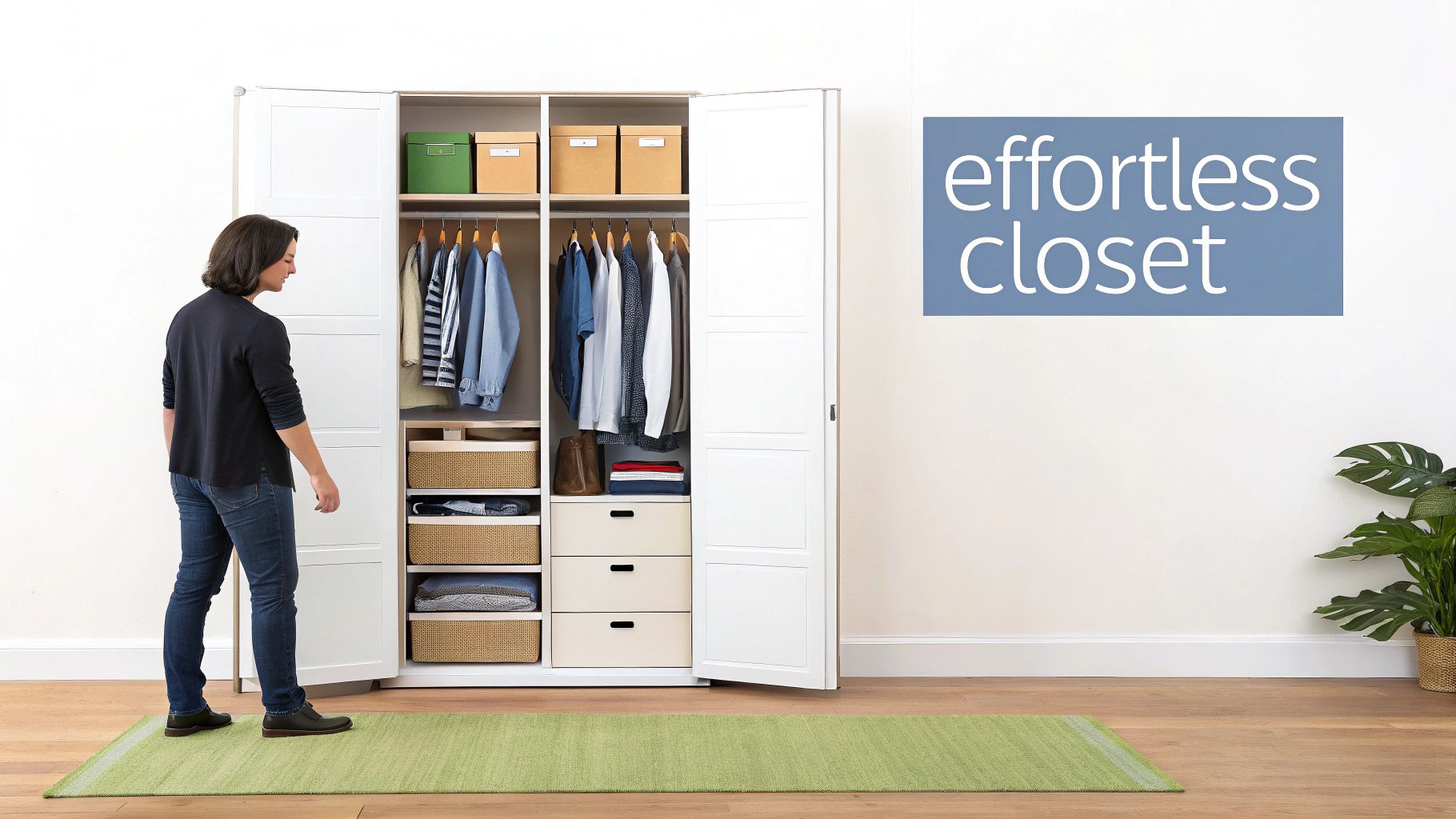
Let’s be honest, the real win here isn’t just a pretty, Instagram-worthy closet. It’s about making your morning routine smoother and a lot more pleasant. Most closets don't fail because they're too small; they fail because there's no strategy. Overflowing drawers, a tangled mess of hangers, and empty vertical space are all signs of a system that's just not working. This guide is here to help you get beyond the quick fixes and build something that lasts.
Instead of seeing your closet as a source of stress, start thinking of it as your own personal boutique, curated just for you. With a clear plan and the right tools, you can completely transform it. This is about more than cleaning up—it's about reclaiming your personal space and making your wardrobe an ally, not an enemy.
Why a System Matters More Than Tidiness
A tidy closet can still be completely dysfunctional. Shoving things into neat piles doesn't solve the underlying problem if you can't find anything. A true organization system, on the other hand, is all about logic and accessibility.
Every single item gets a designated home. This makes it simple to find what you need and, crucially, just as simple to put it away. That systematic approach is what keeps the chaos from creeping back in. The first step is always the hardest, which is why figuring out how to declutter your closet is the essential starting point before you even think about organizing.
The objective isn't just a clean closet; it's about saving time, reducing daily stress, and regaining control over your personal space. A well-organized closet gives you back valuable minutes every single morning.
This guide is packed with practical, real-world organizing closet ideas designed to solve common frustrations. We’ll walk through how to assess your space, make tough but necessary decluttering decisions, and use smart solutions to maximize every last inch. You'll see how a few simple changes can make a huge difference in your daily life, turning closet dread into a sense of calm and control.
The Foundational Closet Cleanout Method
Before you even think about buying a new hanger or installing a shelf, the real work begins with what you already have. Let’s be honest: true closet organization isn't about finding clever ways to cram more stuff in. It's about curating a wardrobe that actually works for you. This initial cleanout is the bedrock of any system that lasts, paving the way for a space that’s not just tidy, but a genuine reflection of who you are today.
I know the thought of tackling an entire closet at once can feel completely paralyzing. The classic move of pulling everything out and creating a mountain of clothes on the bed often leads to burnout. Instead, we're going to take a much more strategic approach—one that builds momentum and turns a dreaded chore into an empowering act of reclaiming your space.
Start Small With a Single Category
Here's the secret: don't face the entire beast at once. Pick one, and only one, category of clothing to start with. Forget the whole wardrobe for a moment and just focus on your t-shirts, your jeans, or your shoes.
When you narrow your focus like this, the decision-making becomes so much simpler. It's far easier to compare similar items and be brutally honest about what you actually wear. Plus, once you've successfully conquered one small section, you get a rush of accomplishment that fuels you to take on the next.
For instance, try pulling out every single pair of jeans you own. Lay them all out on your bed so you can see the entire collection at a glance. This simple visual immediately shows you the duplicates and the forgotten styles you haven't touched in years, making those first cuts surprisingly easy.
Implement the Four-Box Method
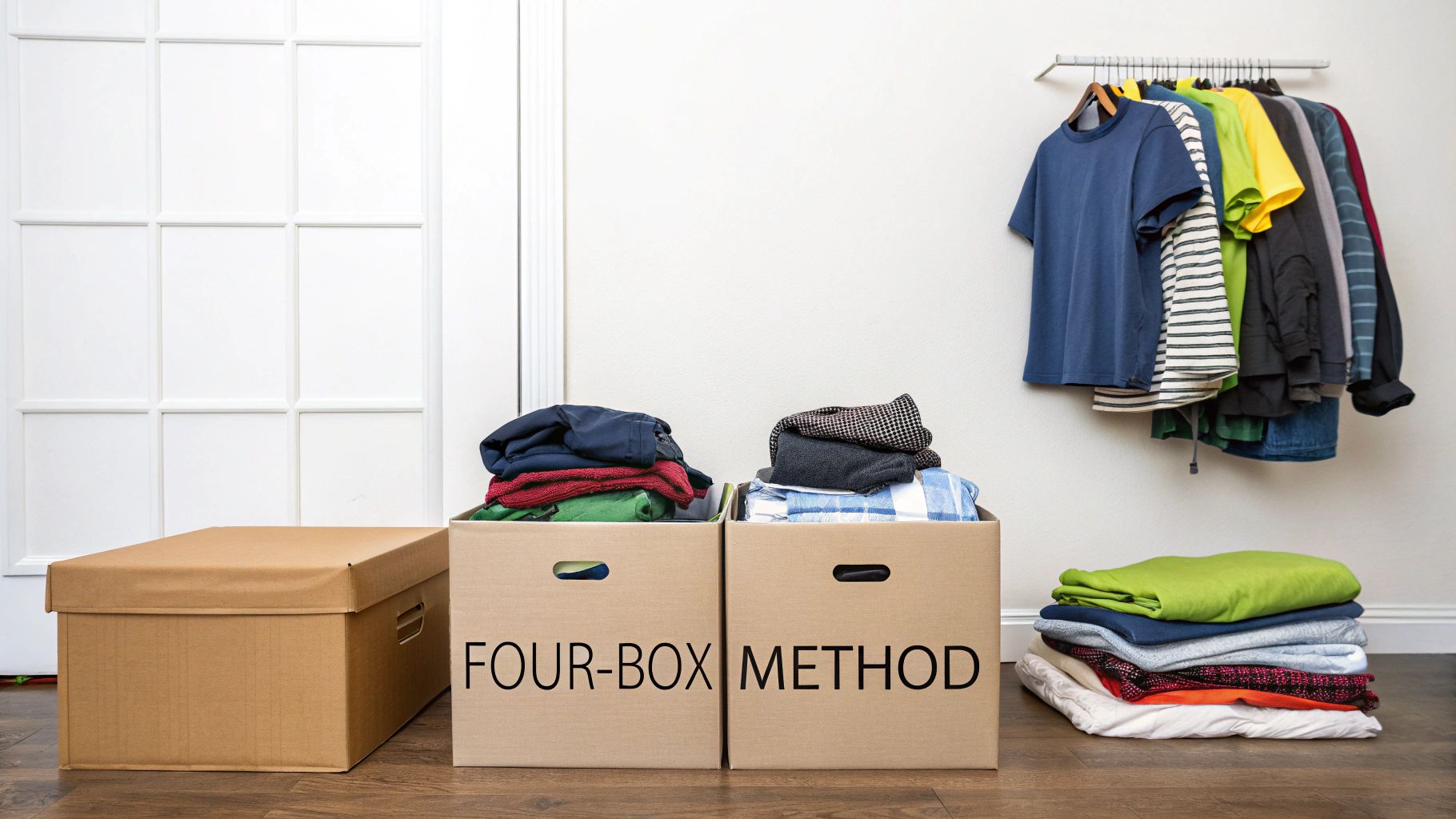
As you work through your chosen category, set up four distinct zones. This sorting system is one of the most effective organizing closet ideas because it forces you to make a clear decision for every single item. Grab some boxes, laundry baskets, or just create piles labeled:
- Keep: These are the no-brainers. You love them, wear them all the time, and they fit your life right now. They go straight into the "yes" pile.
- Donate/Sell: Garments that are still in good shape but just aren't you anymore. Maybe they're the wrong size, a style you've moved on from, or something you simply never reach for.
- Store: This is for sentimental pieces or off-season clothing you don't need access to right now. Think bulky winter coats in the middle of summer or that formal dress for a special occasion.
- Discard: This pile is exclusively for items that are stained, torn, or just too worn-out to be donated. Be realistic about clothes that have reached the end of their life.
This method kills ambiguity. Every item must go into one of these four piles. No more "I'll decide later" pile to derail your progress.
Ask the Tough Questions for Every Item
Making the final call is always the hardest part. To cut through the indecision, you need a set of sharp, non-emotional questions. As you hold up each piece, get past the "maybe I'll wear it someday" trap and get real.
If I saw this in a store today, would I buy it? This is the ultimate test. If the answer is a hard no, it’s a crystal-clear sign your style has evolved and it’s time to let that item go.
Beyond that key question, here are a few others to guide you. Think of this as an objective filter that separates the true keepers from the clutter.
Your Decluttering Checklist
- Have I worn this in the last year? If the answer is no, the odds of you wearing it again are pretty slim. Be honest about your actual habits, not your fantasy self.
- Does this fit my body right now? Holding onto "goal" clothes often does more harm than good. Your closet should be filled with things that make you feel great today.
- Is it comfortable and in good condition? If it's itchy, pinches, or has a stain you can't get out, you will always find an excuse not to wear it.
- Does this align with my current lifestyle? That impressive collection of power suits might not make sense if you’ve been working from home for the past three years. Your wardrobe should reflect who you are now, not who you were.
Answering these questions honestly shifts the entire process. It’s no longer just about tidying up; it's about thoughtfully curating your personal style and ensuring every single item in your closet has earned its valuable real estate.
Designing a Strategic Closet Layout
Now that you've edited your wardrobe down to the essentials, it’s time for the fun part. Designing your closet layout is a bit like playing Tetris, but with your clothes. You’re turning a simple box into a super-functional system that makes getting dressed feel less like a chore and more like a treat. A smart layout isn't about having a massive walk-in; it's about making every single inch count.
Before you even think about buying organizers, grab a tape measure. You have to know the exact height, width, and depth of your space to really unlock its potential. Get all the numbers. Don't forget to measure the forgotten zones, like the space behind the door or the vast emptiness above and below your current hanging rod. Trust me, these are the most overlooked goldmines in any closet.
Create Intelligent Closet Zones
Think of your closet like a well-run kitchen—everything has a logical place. Creating "zones" for different clothing categories is one of the most effective organizing closet ideas because it brings order to the chaos. This simple habit of grouping like with like will put a stop to those frantic morning searches for that one specific shirt.
Start by mapping out where each category will live. The stuff you wear all the time—your work clothes, your favorite weekend outfits—should be front and center, right at eye level. This is your prime real estate.
Common Closet Zones to Consider:
- Workwear Zone: Get all your blazers, dress pants, and work-appropriate tops hanging together. Pulling together an office outfit becomes a quick, painless process.
- Casual & Weekend Zone: This is for all your go-to jeans, comfy tees, and sweaters. Keep them in their own easy-to-reach spot.
- Special Occasion Zone: That formal dress or suit you only pull out a few times a year? It can live at the far end of the rod, out of the way of your daily rotation.
- Seasonal Storage: Those bulky winter coats don't need to hog space in July. Store them on a high shelf or in the back during their off-season to free up valuable room.
Maximize Vertical Space and Hidden Corners
Let's be honest, most standard closets are horribly inefficient. They usually come with a single rod and a high shelf, which leaves an enormous amount of vertical space completely wasted. Your mission is to claim that territory.
One of the easiest wins is adjusting or adding shelving. A shelf placed just above your hanging rod is the perfect home for bins of off-season clothes. You can also add a lower shelf or a small set of drawers under shorter hanging items like shirts, instantly creating a spot for shoes or folded clothes. The humble hanging rail is often the backbone of a closet; learning to choose the right hanging rails for wardrobe can make all the difference in efficiency.
I see people make this mistake all the time: they only think horizontally. The real secret to a game-changing closet is to think vertically. By using the full height of your space, you can often double your storage capacity without a single renovation.
The back of the closet door is another storage powerhouse. A simple over-the-door organizer can hold a surprising number of shoes, scarves, or belts, keeping them visible and, more importantly, off the floor. This one addition can literally free up an entire shelf.
The Power of Specialized Hangers
This is where having the right tools makes a huge difference. A random collection of bulky, mismatched hangers doesn't just look messy—it eats up a shocking amount of rod space. Switching to a uniform set of slim hangers is a quick upgrade with a massive impact, both visually and spatially. But to truly conquer a small or packed closet, you need to go beyond the basics.
Specialized hangers are designed to solve specific problems. For instance:
- Cascading Pant Hangers: These are an absolute must if you own more than a couple of pairs of trousers or jeans. They let you hang multiple pairs vertically, taking up the same tiny sliver of rod space as a single bulky hanger.
- Tiered Skirt Hangers: Similar in concept, these hangers have multiple clips on one frame, letting you neatly organize your skirts so they don't slip off or take over the whole closet.
These small investments aren't just about being tidy; they're about multiplying your space. MORALVE's designs, for example, are specifically engineered to tackle the real-world challenges of modern living. In fact, the closet organizer market is expected to hit USD 8.3 billion by 2033, a boom driven largely by people living in smaller homes. With 44% of urban US households living in apartments—often with tiny closets—solutions that expand capacity are more than a luxury; they're a necessity.
By combining a well-measured space, logical zones, and purpose-built tools, you create a layout that isn't just organized—it's intuitive. This kind of strategic thinking ensures your closet works with you, not against you, every single day. For a more detailed walkthrough, check out our guide on how to design a closet from the ground up.
Putting Your New Closet System into Action
Alright, you’ve done the hard work of planning and decluttering. Now for the fun part: bringing your new, organized closet to life. This is where all that prep pays off, and you finally get to see your vision become a reality. With the right techniques and a few clever tools, you can take your closet from chaotic to calm in just an afternoon.
The goal here isn't just to jam everything back in. We're creating a system that feels natural and easy to maintain. You'll learn how to handle different clothes to maximize every inch of space while keeping them in great shape. It's amazing how small tweaks—like how you hang your jeans or fold a sweater—can completely change your daily routine for the better.
If you're feeling the squeeze, you're not alone. The statistics, especially for apartment dwellers, paint a clear picture of the struggle for space.
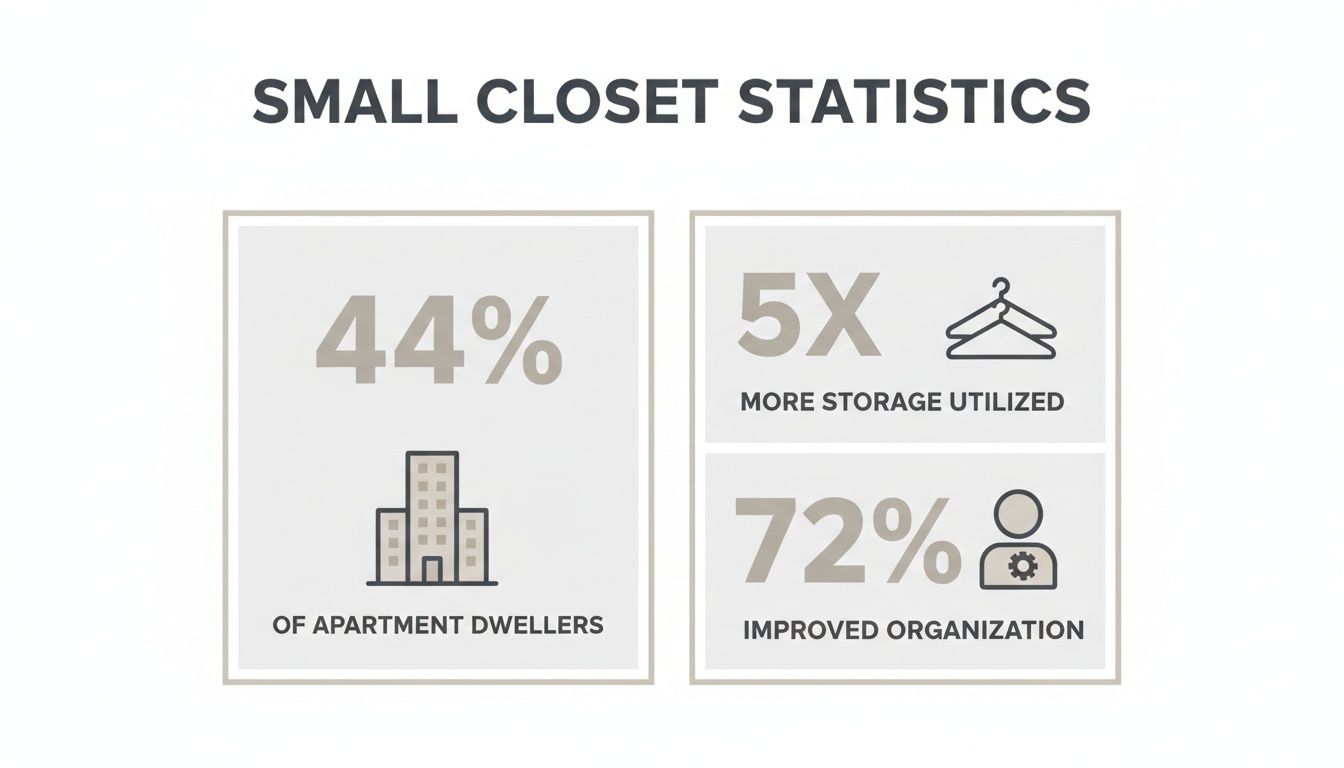
The data really drives it home: with 44% of urban households living in apartments, smart storage that can multiply space by up to 5X isn't a luxury—it's a necessity. It’s no wonder that 72% of people are looking for these kinds of multifunctional solutions.
Master High-Impact Hanging Techniques
Honestly, the way you hang your clothes is one of the most powerful organizing closet ideas you can use. Let's tackle the biggest space-eaters first: pants and jeans. Ditching the traditional method of folding them over a bulky hanger is a game-changer. Instead, switch to cascading pant hangers. This one simple move lets you hang five (or more!) pairs vertically in the space a single pair used to hog.
The same logic applies to skirts. A multi-garment skirt hanger with adjustable clips can consolidate a whole section of your wardrobe. Imagine hanging four or five skirts on one tiered hanger—think of all the rail space you'll get back! Plus, they’ll stay perfectly wrinkle-free. This isn't just about saving room; it’s about making your clothes easier to see and grab.
The biggest mistake I see people make is using one type of hanger for everything. Specialty hangers are your secret weapon. They’re tools designed to solve specific storage headaches, and they’re what separate a cluttered closet from a truly streamlined one.
This isn’t just a niche idea; the global closet organizers market, valued at a whopping USD 8.5 billion in 2024, is built on this very principle of targeted solutions. For example, a single set of MORALVE's cascading skirt hangers can reclaim up to 80% of your rod space. And for busy folks, tools like their tank top hangers can save an average of two hours a week just by cutting out tedious folding. You can see more on the industry's growth in this Market Trends Analysis.
The right hanger can completely transform a section of your closet. Here’s a quick rundown to help you pick the perfect tool for the job.
Maximize Your Space with the Right MORALVE Hanger
| Hanger Type | Best For | Key Benefit | Space Saved (Approx.) |
|---|---|---|---|
| Cascading Pant Hangers | Jeans, trousers, slacks, leggings | Hangs 5+ pairs vertically, eliminating bulky folds. | Up to 80% |
| Tiered Skirt Hangers | Skirts, shorts, pants with adjustable clips | Consolidates multiple items onto one hanger, freeing up rail space. | Up to 80% |
| Tank Top/Camisole Hanger | Tank tops, camisoles, bras, swimsuits | Organizes up to 8 strappy items without slipping or tangling. | Up to 70% |
| Multi-Shirt Hanger Organizer | Blouses, shirts, light jackets | Hangs 5 shirts on one unit, ideal for creating outfit combinations. | Up to 80% |
Choosing the right tool is the first step. Once you see how much space a single specialty hanger can create, you'll be hooked.
Perfect Your Folding and Stacking Game
Let's be real: not everything should be hung up. Heavy knit sweaters are a prime example—hanging them is a one-way ticket to stretched-out shoulders and misshapen fabric. The solution is folding and stacking them on shelves. But a leaning tower of sweaters is just another form of clutter waiting to happen.
Here are two techniques I swear by:
- File Folding: Stop stacking sweaters one on top of the other. Instead, "file" them vertically in a drawer or bin like you would documents. This way, you can see every single sweater at a glance without toppling the whole pile. It's a lifesaver for t-shirts and sweatshirts, too.
- Shelf Dividers: For open shelves, clear acrylic or wire shelf dividers are an absolute must. They create neat, tidy "cubbies" for your folded clothes, stopping those stacks from collapsing into each other.
With these simple methods, your shelves and drawers will become incredibly organized and so much easier to navigate.
Clever Hacks for Small Closets
A small closet isn't a life sentence for clutter. It just means you have to get a little more creative. The trick is to find and use all that overlooked space.
Here are a few of my favorite high-impact hacks:
- Add a Second Rod: If you have a single high rod, you can instantly double your hanging space by adding a lower one. It’s perfect for shirts on top and skirts or folded pants below.
- Use the Door: The back of your closet door is pure gold. An over-the-door organizer is perfect for shoes, scarves, belts, and accessories, getting all that stuff off your floor and shelves.
- Go Vertical with Bins: Use a set of matching bins on those hard-to-reach high shelves. They’re great for stashing off-season clothes or items you don’t need often. Just make sure to label them clearly so you know what’s inside.
These small adjustments are some of the most practical organizing closet ideas for anyone working with limited space. They prove you don't need a huge walk-in to have a wardrobe that feels calm, organized, and works for you.
Keeping Your Organized Closet That Way for Good
You’ve done the hard part—the sorting, the purging, the brilliant reorganization. But let’s be real, the real win is keeping your closet from sliding back into chaos.
A truly organized closet isn’t the result of a single heroic effort. It’s all about building simple, sustainable habits that fit right into your life. The goal is to make tidiness the easy choice, so you never have to face a massive cleanup project again.
The One-In, One-Out Rule
This is probably the single most effective habit you can adopt to prevent future clutter. It’s dead simple: for every new thing you bring home, something similar has to go.
Bought a new pair of jeans? Great! Now, take a minute to pull out an old pair you don't wear much anymore and add it to the donation pile. This little rule forces you to be intentional with your purchases and stops your wardrobe from slowly but surely outgrowing your space. You'll start thinking of your closet as a curated collection, not just a holding pen for clothes.
The 10-Minute Weekly Tidy-Up
Life is messy. A shirt gets tossed on a chair, shoes pile up by the door, and before you know it, disorder is creeping back in. Your secret weapon? The 10-minute weekly reset.
Pick a time that works for you—maybe Sunday night before the week kicks off. Set a timer for just 10 minutes and tackle the small stuff:
- Hang up any clothes that have been left out.
- Line up your shoes.
- Quickly re-fold any sweaters that have been rummaged through.
- Gather all the empty hangers and put them back in one spot.
It’s a tiny investment of time, but it makes a world of difference. This quick sweep stops the little messes from turning into a big, overwhelming project.
Maintaining an organized closet is less about marathon cleaning sessions and more about consistent, small actions. A weekly 10-minute tidy-up does more to prevent long-term clutter than a massive cleanout every six months.
And it seems everyone is catching on. The demand for streamlined living spaces is exploding, with the custom closets market projected to jump from USD 31,430 million in 2025 to USD 67,945 million by 2035. This isn't just a fad; after the pandemic, 61% of people are more focused on creating peaceful homes, and for 47% of them, a messy closet is a major source of stress. The payoff is tangible, too—an organized closet can boost daily productivity by 15% and slash the time it takes to find an outfit by 28%.
Master the Seasonal Swap
If you live somewhere with distinct seasons, swapping out your clothes is a non-negotiable strategy for keeping your closet sane and usable. Hiding away your off-season items frees up a ton of valuable real estate, making it so much easier to see and access what you actually need right now.
Here’s how to make the swap quick and painless:
- Purge Before You Pack: As you pull out last season's clothes, give them a quick once-over. Anything you didn't wear or fell out of love with? Donate it. There's no sense in storing something you won't be excited to wear next year.
- Clean Everything First: This is critical. Always wash or dry-clean your clothes before storing them for months. It prevents stains from setting and keeps pests away. For more on this, check out our guide on how to store clothes long term.
- Use the Right Containers: Breathable storage is key. Think fabric bins or garment bags. Steer clear of plastic bags, which can trap moisture and cause fabrics to yellow over time.
- Store It Smart: Put the packed containers somewhere out of the way—a high shelf, under the bed, or in a spare closet. This keeps your prime closet space free for all your current-season favorites.
Got Questions? We’ve Got Answers.
Even the most well-thought-out closet overhaul can leave you with a few nagging questions. That’s totally normal. Pushing past these final hurdles is what separates a short-term fix from a system that actually sticks. Let's tackle some of the most common dilemmas I hear about all the time.
Think of this as your personal troubleshooting guide. We'll get into the nitty-gritty issues that can trip you up, so you can confidently put the finishing touches on your new, organized space.
How Often Should I Really Be Decluttering My Closet?
A big, satisfying purge is fantastic once or twice a year, but staying organized is more of a habit than a one-off event. It’s like tending a garden—a little bit of weeding here and there prevents a total jungle takeover later.
The best cadence I've found is to do a deep dive when the seasons change. It just makes sense when you're already swapping out heavy coats for sundresses. But for the day-to-day? The "one-in, one-out" rule is your secret weapon. Seriously. Every time you bring home a new shirt, an old one has to go. This one simple practice is the single best way to stop clutter from creeping back in.
What’s the Best Way to Store Bulky Items?
Ah, the bulky sweaters and puffer coats. They’re notorious space-eaters, but they're actually pretty easy to manage if you know the tricks. For sweaters, the absolute number one rule is to fold, never hang. Putting a heavy knit on a hanger is a death sentence for the shoulders—they’ll get stretched out and permanently misshapen.
- Sweaters: Fold them nicely and stack them on a shelf. If your stacks tend to tumble, grab some simple acrylic dividers to keep them in line.
- Coats: Heavy winter coats demand sturdy hangers that can take the weight without sagging. In the off-season, I pop mine into breathable garment bags to keep the dust off and stash them in the back of the closet or on a hard-to-reach top shelf.
Help! My Closet Is Tiny. What Are My Options?
When you’re dealing with a seriously small closet, you have to think vertically. Every single inch of height is prime real estate that can't be wasted. This is where tools that literally multiply your storage become non-negotiable.
If you do only one thing to transform a tiny closet, switch to cascading hangers. They tap into all that vertical space you’re currently ignoring, giving you up to five times the hanging room from a single hook. It's a game-changer.
A few other powerful moves? An over-the-door organizer is a lifesaver for shoes, belts, and scarves. You can also often add a second tension rod below your main one to instantly double your hanging space for shirts and skirts. And never underestimate the visual and physical space you save just by using a uniform set of slim hangers.
How Do I Pick the Right Organizers Without Wasting Money?
This is a big one. The single greatest mistake people make is buying a cartful of bins and organizers before they’ve even started decluttering. You end up with a bunch of products that don’t actually fit the stuff you decided to keep.
Always, always, always purge first. Get rid of everything you don't need. Only then will you see what's left and what storage problems you actually have. Start with the essentials that will make the biggest impact—like space-saving hangers that can wrangle your massive collection of pants. Once those big-ticket problems are solved, you can fill in the gaps with smaller solutions like drawer inserts or shelf dividers.
Ready to turn these ideas into reality? MORALVE has a complete lineup of space-saving hangers built to solve these exact closet headaches. Explore our collection and start building your dream closet today at MORALVE.com.
Leave a comment