
Walk In Closet Layout Ideas to Maximize Your Space and Organization

Before you start pinning gorgeous closet designs, let’s get back to basics. The best walk-in closet layouts—the ones that feel truly intuitive and make your life easier—aren't just picked from a catalog. They're built from a smart organizational plan that starts with two simple things: your space and your stuff.
Getting this foundation right is what separates a pretty-but-impractical closet from one that’s genuinely organized and functional for you.
Crafting Your Perfect Walk-In Closet From The Ground Up
Before we get to the fun part of choosing finishes and organizational systems, we need a solid blueprint. This first phase is all about the raw data—the exact dimensions of your room and a realistic assessment of your wardrobe. I know it's not glamorous, but trust me, getting this organizational groundwork right now saves you from major headaches and costly mistakes down the line.
And it’s clear homeowners are catching on. The global market for walk-in closets hit a staggering USD 11.1 billion in 2023 and is on track to double to USD 22.3 billion by 2033. People want smart, organized storage, with 70% of new luxury U.S. homes now being built with walk-ins. You can dive deeper into these trends over at DataHorizzon Research.
Accurately Measure Your Canvas
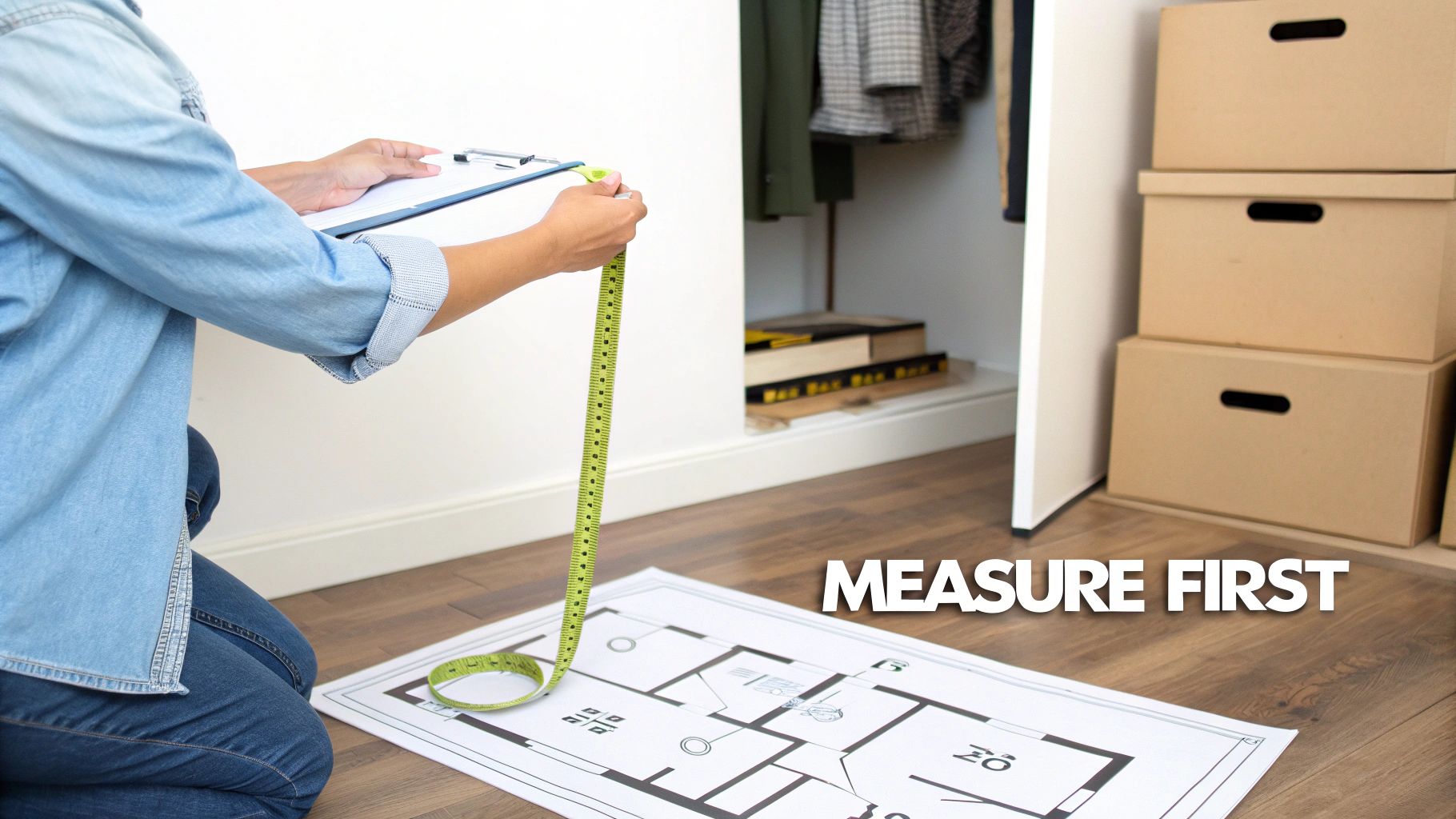
First things first: grab a tape measure. You need to map out every single inch of your closet space. Don't just eyeball it or settle for the basic length and width; precision is your best friend here for effective organization.
- Wall Dimensions: Get the length and height of every wall.
- Ceiling Height: Measure from floor to ceiling. If you have angled or sloped ceilings, make sure to measure both the lowest and highest points.
- Obstructions: This is a big one. Note the exact location and size of windows, doors (and which way they swing!), light switches, outlets, and any vents. These elements will dictate your organizational layout.
Think of this as creating a detailed map. It’s your guide for everything that follows, helping you see the limitations and opportunities of your space before you commit to a design that won't work.
Pro Tip: I always tell my clients to sketch the room on graph paper. It doesn't have to be perfect, but marking down all your measurements and obstructions gives you a powerful visual reference when you start planning your organization.
Conduct a Thorough Wardrobe Inventory
A great closet layout is a direct reflection of the clothes you actually own. It’s not about how many items you have, but what kinds of items. This inventory process is the heart and soul of creating a personalized, hyper-efficient, and organized space.
It’s time to pull everything out. And I mean everything. Lay it all out and start grouping items into logical categories to understand your storage needs.
Key Categories to Assess:
- Short-Hanging Items: Think blouses, shirts, and jackets.
- Long-Hanging Items: This is for your dresses, long coats, and jumpsuits.
- Folded Items: Sweaters, denim, and t-shirts that live on shelves.
- Accessories: Handbags, scarves, belts, and hats.
- Footwear: All of it—heels, flats, boots, and sneakers.
- Drawered Items: Socks, underwear, and workout gear that need to be contained.
Once everything is sorted, take your tape measure and see how much linear space each hanging category currently takes up on the rod. This gives you a real, hard number to work with. You might be surprised to find you need way more double-hanging space for shirts than you do long-hanging for dresses, or that your shoe collection is big enough to demand its own dedicated wall.
This data-driven approach is the secret sauce to closet organization. For a deeper dive into this part of the process, our guide on closet system design has you covered.
The Art of Closet Zoning: Creating Your Organizational Blueprint
With your measurements in hand and a good sense of your wardrobe, it's time for the fun part: zoning. This is the single most important principle behind a truly functional walk-in closet. It's all about creating a logical flow by dividing your space into dedicated zones for hanging, shelving, and drawers based on how you actually get dressed.
Think of it like setting up a professional kitchen. Everything has a home, and the most-used items are always right where you need them. The result? Getting ready in the morning feels less like a chore and more like a seamless, organized routine.
Of course, before you can organize, you have to purge. If you're staring at a mountain of clothes, a good declutter is the best first step. For some great tips on tackling that, check out this guide on Cleaning Out Your Closet Doesn't Have To Be So Bad.
H3: Nailing Down Your Hanging Space
Your hanging area is the backbone of your closet's organization, so let's get it right. The goal isn't just to hang clothes; it's to do it strategically to maximize every inch.
The easiest win? Separate your clothes by length. This one simple move can unlock a surprising amount of usable space.
-
Double-Hanging Rods: This is the undisputed champion for saving space. Stacking one rod above another instantly doubles your capacity for shirts, blouses, skirts, and folded trousers. For a good fit, aim to place the top rod around 82 inches from the floor and the bottom one at about 40 inches.
-
Single-Hanging Rods: Don't forget to dedicate a section for your longer pieces. This is crucial for dresses, long coats, and jumpsuits that need to hang freely. A single rod installed at 65-70 inches high usually does the trick.
Segmenting your hanging space this way prevents that awkward, wasted gap under your shorter clothes and gives the whole closet a much cleaner, more organized look.
H3: Smart Shelving Strategies
Shelves give your closet structure and provide a home for folded items like sweaters and jeans. The secret to great shelving is getting the depth and spacing just right—this is what prevents those frustrating, messy piles from toppling over.
Most closet systems rely on a standard shelf depth of 12 to 14 inches. This is the sweet spot. It’s deep enough for a neat stack of sweaters but not so deep that things get lost in the back. It's a common mistake to think deeper is better, but anything over 16 inches can quickly become a black hole where clothes go to be forgotten.
A design I see gaining a lot of traction, especially for a 10x12 ft space, is the 'zone-divided layout.' This typically breaks down to 50% hanging, 30% shelving, and 20% for accessories. It’s a simple formula for organization, but user surveys show it can slash clutter by as much as 50%. You can dig into more custom closet trends from Global Market Statistics if you're curious.
H3: Mastering Your Drawer Space
Drawers are your secret weapon for containing the small stuff and maintaining organization. They’re the perfect home for all those unruly items that would otherwise create clutter on open shelves.
This is where you'll want to tuck away things like:
- Socks, underwear, and bras
- Pajamas and workout gear
- Belts, scarves, and other small accessories
To take your organization to the next level, invest in some good dividers. They create little compartments that keep everything neat and visible, turning a potential jumble into a perfectly organized grid. It’s a small detail that makes a huge difference in the long run.
To help you visualize this, here's a quick blueprint for zoning your closet.
Closet Zoning Blueprint At a Glance
This quick reference guide breaks down how to allocate space and keep your primary closet zones organized for daily use.
| Zone | Best For | Organization Tip | MORALVE Solution |
|---|---|---|---|
| Double-Hanging | Shirts, blouses, folded pants, jackets | Group by clothing type, then by color. | Use slim velvet hangers to maximize rod space. |
| Single-Hanging | Dresses, long coats, jumpsuits | Give items breathing room to prevent wrinkles. | Heavier wooden hangers work best for coats. |
| Open Shelving | Sweaters, jeans, sweatshirts, purses | Use shelf dividers to keep stacks from toppling. | Fold items uniformly for a boutique look. |
| Drawers | Undergarments, socks, PJs, accessories | Use drawer dividers to create small compartments. | Roll t-shirts and activewear to save space. |
This table acts as a simple map, ensuring every item has a logical, designated home for peak organization.
H3: Creating Your "Prime Real Estate"
Finally, think about how you arrange these zones. Your most frequently worn items—your work uniform, your go-to jeans, that favorite t-shirt—should live in your closet's "prime real estate." This is the area at eye level and directly within arm's reach. No bending, no stretching.
Items you use less often, like heavy winter coats or formal wear, can be stored in less accessible spots like the top shelf or the back corners. By creating this simple organizational hierarchy, you remove all the friction from your morning routine. You’re building a system that works for you, not one you have to fight against every day.
Popular Walk In Closet Layouts For Every Space
Finding the right layout for your walk-in closet is a lot like tailoring a suit—the perfect fit depends entirely on the unique dimensions of your space and how you plan to organize it. There's no one-size-fits-all answer. Instead, the goal is to match a proven configuration to your room's shape and your daily routine.
We'll walk through the three most common and effective closet layouts: the L-shape, the U-shape, and the Galley. Each has its own organizational strengths, whether you're working with a tight corner, a spacious room, or a long, narrow corridor.
Before we dive in, it helps to know what you should hang versus what you should fold. This simple decision tree can be a great starting point for planning your storage zones.
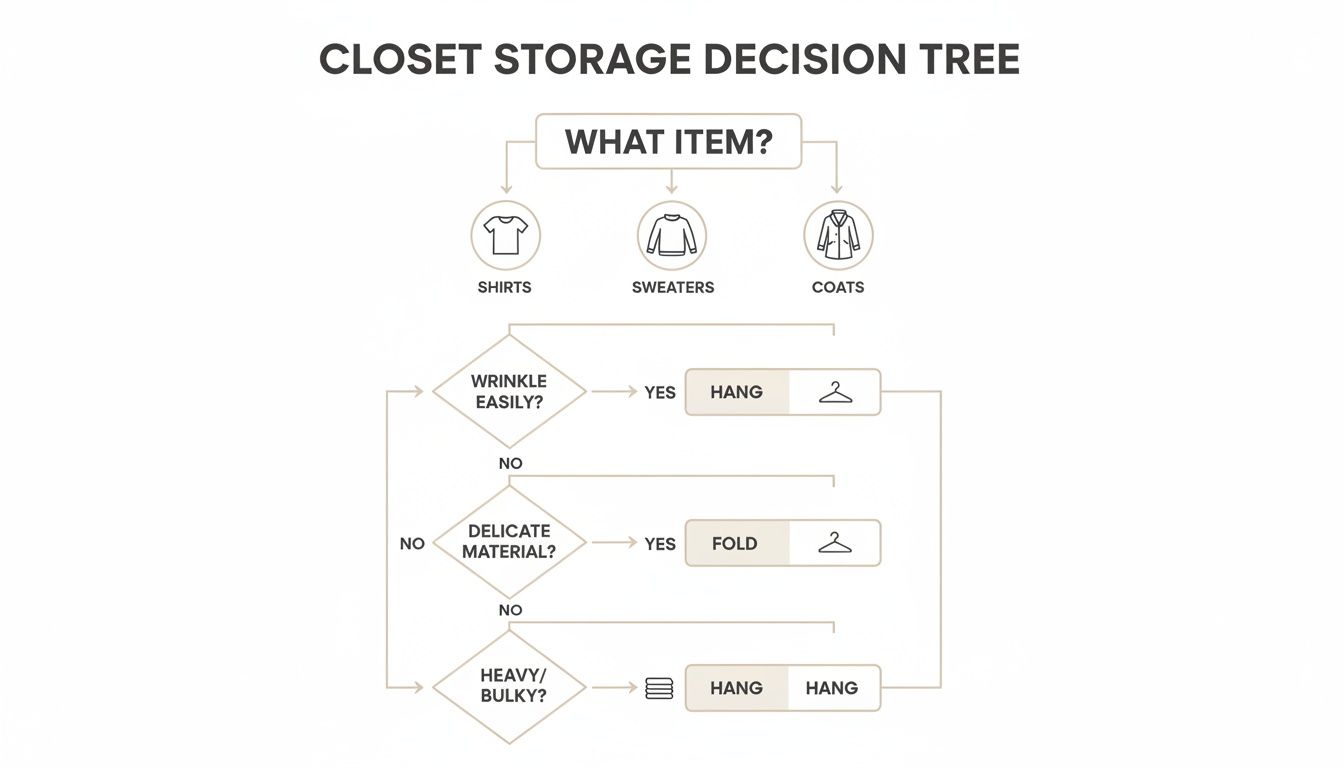
As you can see, hanging isn't always the best option. For delicate knits and heavy sweaters, folding is a much better way to prevent stretching and keep them in great shape.
The L-Shaped Layout For Corner Spaces
If you're working with a smaller walk-in or an awkward corner, the L-shaped layout is a brilliant solution for organization. By running your storage along two adjacent walls, you keep the floor plan open, which immediately makes the closet feel bigger and less cramped. It's the perfect choice for square-shaped rooms where a U-shape would feel claustrophobic.
One of the best organizational benefits of an L-shaped design is that it naturally carves out dedicated floor space. This open area is perfect for adding a full-length mirror, a small dressing bench, or a valet stand for laying out tomorrow's outfit. It elevates a simple storage space into a true dressing room.
A typical setup in a 7x7 foot L-shaped closet might have one wall with double-hanging rods and the other with a mix of single-hang space and shelving. This creates a really nice balance of organized storage without sacrificing that open, airy feel.
The U-Shaped Layout For Maximum Storage
When you’ve got a sizable wardrobe and the room to match, nothing beats the U-shaped layout for pure storage and organization. It puts three walls to work, essentially wrapping you in your entire collection of clothes, shoes, and accessories. This is the design I recommend for larger, more rectangular closets.
The U-shape gives you incredible organizational freedom. You can dedicate each of the three walls to a different category—one for hanging, another for drawers and shelves, and the third just for shoes and accessories. This zoning creates an intuitive flow that makes finding anything a breeze.
A word of advice: for a U-shaped layout to feel comfortable, your closet needs to be at least 10 feet wide. This guarantees you'll have a minimum of 36 inches of clear walkway down the middle once you've installed standard 24-inch deep storage on both sides.
If you have the luxury of even more space, this layout is perfect for a central island. Adding a small island with drawers or a chic ottoman in the middle can give your closet a high-end, boutique feel, adding both functional storage and a convenient spot to sit.
The Galley Style Layout For Narrow Closets
Have a walk-in that’s long and narrow? The Galley layout is your best friend for organization. Sometimes called a "straight" or "his and hers" layout, it simply runs storage along the two parallel walls, creating a clean, efficient corridor.
This design is a lifesaver in spaces less than 6 feet wide, where trying to force a U-shape would make the room feel boxed in. By leaving the back wall open, you create a sense of depth and keep the space from feeling too tight. The non-negotiable rule here is to maintain a clear pathway of at least 36 inches between the two sides so you can move around comfortably.
To keep a galley layout from feeling too one-dimensional, I always suggest creating distinct organizational zones on each wall. For example:
- Wall One: This could be all about hanging. Maximize your space with double rods for shirts and pants, plus a dedicated section for long coats and dresses.
- Wall Two: This side could be a mix of drawers for private items and open shelving for folded sweaters, jeans, and displaying things like handbags or hats.
This approach not only breaks up the visual monotony but also adds a smart organizational layer, making it easy to find what you need even in a compact closet.
Maximize Your Space With Smart Organization Strategies
So you’ve measured, planned your zones, and have a solid layout on paper. That's the blueprint. Now comes the fun part: bringing it to life with smart organization that makes every inch of your walk-in closet pull its weight. This is where a few clever tools and simple habits can transform a well-designed space into a genuinely effortless one.
Believe it or not, getting your closet in order is big business. The market for closet organizers is expected to surge from USD 4,033.3 million in 2025 to a whopping USD 8,529.7 million by 2035. Why the boom? Homeowners are realizing how much a functional, organized system can improve their daily routine. In fact, e-commerce sales for these organizers shot up 55% after 2020. You can read more about these market trends and what's driving them.
This trend just confirms what I’ve seen for years: the right organizational tools are what unlock a closet's true potential.
Go Vertical With Space-Saving Hangers
If you want the biggest bang for your buck in closet organization, start with your hanging rods. Clunky, mismatched hangers are the number one culprit of wasted space, creating awkward gaps and making your wardrobe feel crowded and messy. A simple switch to a more strategic hanger system can instantly condense your clothes and free up a surprising amount of rod real estate.
-
Pant and Skirt Hangers: Instead of giving each pair of pants its own bulky hanger, think vertically. Hangers that let you stack multiple items are a game-changer. For example, MORALVE’s space-saving pant hangers can hold several pairs in the same horizontal space that a single traditional hanger eats up. This one swap alone can reclaim a huge chunk of your closet rod.
-
Tank Top and Camisole Organizers: Let’s be honest—tank tops, camisoles, and other delicates tend to get lost in the shuffle or take up way too much precious rod space. A dedicated tank top hanger neatly organizes multiple pieces on a single, slim unit. Suddenly, everything is easy to find and takes up a fraction of the space.
These specialized hangers are one of the fastest and most effective walk in closet layout ideas you can put into action for an immediate, visible improvement in organization.
The goal isn't just to cram more stuff in; it's to make everything you own easy to see and grab. When you can actually browse your wardrobe instead of digging through it, you'll find yourself wearing things you forgot you even had.
Leverage Every Corner With Clever Organizers
Beyond the hanging rod, look around. There are so many opportunities to optimize your shelves, drawers, and even the back of your door. A truly organized closet puts every available surface to work without ever feeling cluttered.
Vertical Shelf Dividers
Open shelves are fantastic for folded sweaters and jeans, but those neat stacks have a tendency to topple over. Clear acrylic or metal shelf dividers are the perfect fix. They just slide right onto your existing shelves to create tidy, stable cubbies that keep your piles upright and prevent different categories of clothing from merging into one messy heap.
Clear Storage Bins
For off-season items, special occasion accessories, or things you just can't part with, clear storage bins are non-negotiable. Unlike opaque boxes that hide their contents, you can see exactly what’s inside at a glance—no more pulling down three different bins to find one sweater. Stick them on the highest shelf to keep your prime real estate open for your everyday wardrobe.
Over-the-Door Organizers
The back of your closet door is probably the most overlooked spot in the entire space. An over-the-door organizer is an absolute workhorse for storing shoes, belts, scarves, and small handbags. It gets all those items off your floor and shelves, freeing up that space for bulkier things. It’s such a simple addition, but the amount of storage it adds is incredible.
For more practical solutions like these, check out our full guide on how to create more closet space.
Finishing Touches to Elevate Your Closet Design
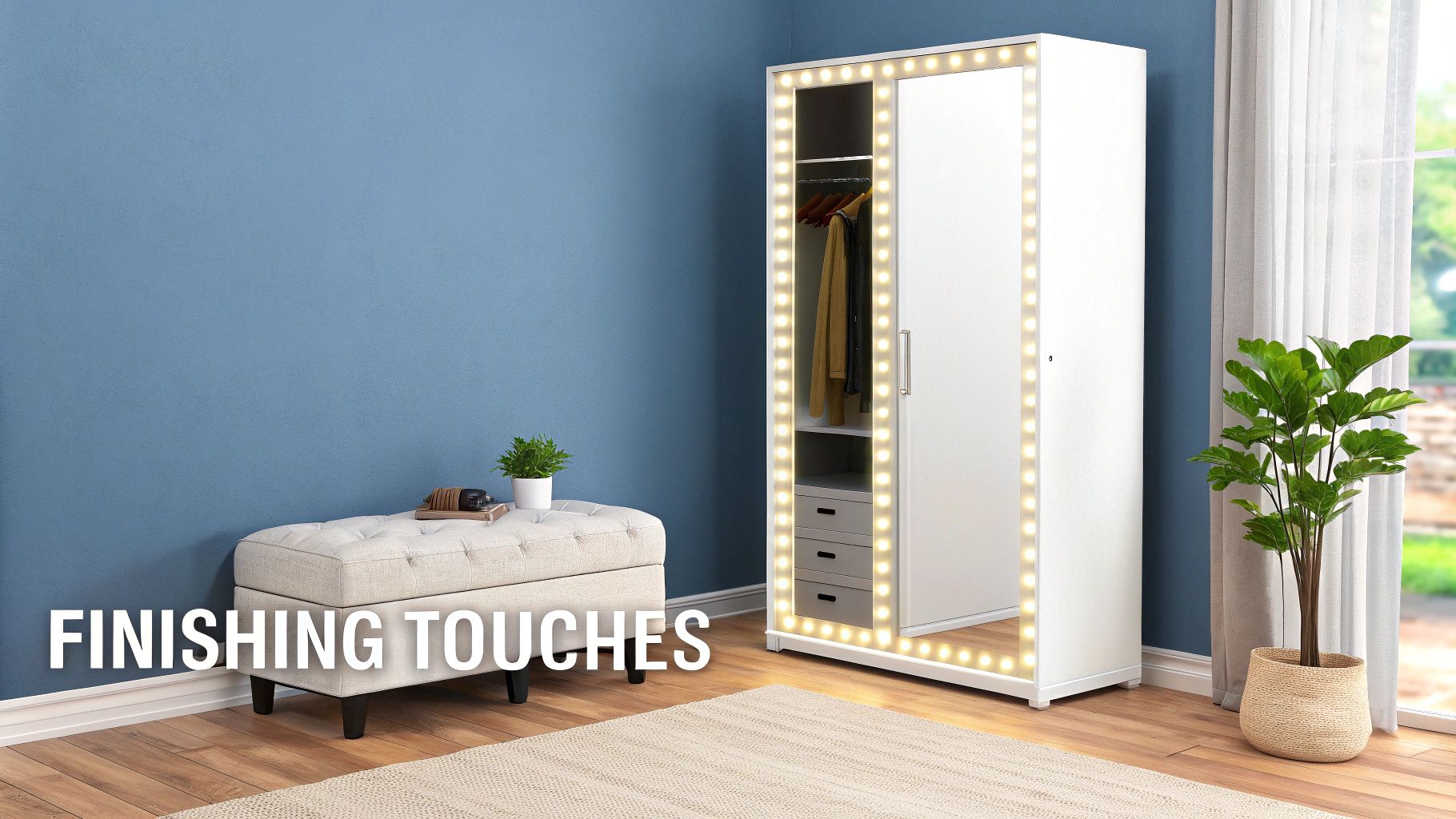
Think of your closet layout as the skeleton. It’s the essential structure, but the finishing touches are what bring it to life. This is where you infuse personality into the space, turning a practical storage area into a personal sanctuary with details like lighting, hardware, and smart décor.
These are the small investments that make a huge difference, transforming the daily routine of getting ready from a chore into a quiet ritual. It’s all about adding layers that make the space feel less like a closet and more like an extension of your home.
Illuminate Your Wardrobe with Strategic Lighting
If there's one detail you shouldn't skimp on, it's lighting. Nothing kills the vibe of a beautiful, organized closet faster than a single, dim overhead bulb that makes it impossible to tell your black pants from your navy ones. To really get it right, a layered approach is key, and understanding the best lighting for walk-in closets will make all the difference.
Instead of one fixture doing all the heavy lifting, combine different types of light for a functional, atmospheric space.
- Ambient Lighting: This sets the overall mood. Think of a chic chandelier or a modern flush-mount fixture that brightens the entire room.
- Task Lighting: This is where the magic happens for organization. We’re talking about LED strips tucked under shelves or running along the hanging rods. They cast light directly on your clothes and shoes, making everything easy to see.
- Accent Lighting: This is your "wow" factor. A few small, directional spotlights can highlight a handbag collection or your favorite pair of shoes, giving the closet a boutique feel.
Good lighting isn't just practical; it's a luxury that makes your organized wardrobe feel curated and high-end.
Upgrade Hardware for a Custom Look
Never underestimate the power of hardware. Drawer knobs and cabinet pulls are the jewelry of your closet system. It’s amazing how swapping out the standard, builder-grade stuff for something with more personality can completely change the look.
This is a simple, budget-friendly update with a massive visual payoff. Consider brushed brass for a warm, classic vibe, matte black for a sleek and modern edge, or even crystal knobs if you're going for a touch of glam. It’s this tiny detail that ties the whole design together and makes your closet feel truly custom.
Expert Tip: Don't just stop at the knobs and pulls. For a truly polished and cohesive look, match the finish of your closet rods to your new hardware. A black rod paired with matte black pulls, for example, looks incredibly intentional and sophisticated.
Add Functional Decor and Seating
The last layer involves pieces that add comfort and convenience, officially graduating your closet into a proper dressing room. These are the items that bridge the gap between pure storage and a genuinely enjoyable, livable space.
If you have the room, try incorporating a few of these functional extras:
- A Full-Length Mirror: This is non-negotiable. A great-looking framed mirror doesn't just let you check your outfit; it bounces light around the room, making your closet feel bigger and brighter.
- A Comfortable Ottoman or Bench: Having a place to sit down while putting on shoes is a game-changer. A storage ottoman is even better—it’s seating and a discreet spot to stash extra bags or blankets.
- A Valet Rod: This simple slide-out rod is one of my favorite little luxuries. It gives you a perfect spot to hang tomorrow's outfit or to hold items just back from the dry cleaner.
These thoughtful additions make your closet one of the most useful and personal rooms in your house. For even more organizational inspiration, check out our guide on shelving ideas for closets.
Common Questions About Walk-In Closet Layouts
Even the most meticulously crafted organizational plans can leave you with a few lingering questions. Let's be honest, designing a walk-in closet involves a ton of small decisions that can feel a bit overwhelming. I've been there.
To help you get past those final hurdles, I’ve pulled together the questions I hear most often. These are the tricky little details that can make or break your design, so let's tackle them head-on.
What Is The Best Layout For A Small Walk-In Closet?
When you're working with a smaller walk-in—anything under 70 square feet—it's all about being smart with your organization. The two layouts I consistently recommend are the 'L-shaped' or the 'Galley' style.
An L-shape is fantastic because it uses two connected walls for storage, which leaves the floor feeling surprisingly open. It avoids that cramped feeling you can get in tight spaces.
A galley layout, where you have storage running along two opposite walls, works wonders for long, skinny closets. The trick for both is to think vertically. Go all the way to the ceiling with shelves, use double-hanging rods, and get some slim hangers. Whatever you do, skip the central island; it’ll just get in the way.
How Much Hanging Space Do I Actually Need?
There’s no one-size-fits-all answer here, but a solid rule of thumb is to plan for about 48 inches of rod space per person. The absolute best way to know for sure? Grab a measuring tape and measure what you currently have hanging.
If you're looking for a quicker estimate, here are some industry standards I use:
- Allow 1 inch of rod space for a standard shirt.
- Budget 1.25 inches for pants folded over a hanger.
- Give a bulky coat or suit jacket a good 2-3 inches.
When you're setting up your hanging zones, place your top rod for double-hanging at 80-82 inches from the floor, and the bottom rod around 40 inches. For a single rod to handle long dresses and coats, a height of 65-70 inches is just about perfect. And remember, good space-saving hangers can practically double your capacity, often cutting your space needs by up to 50%.
Pro Tip: Don't underestimate the power of paint. A lighter, airy color like a soft blue or light gray can make a small closet feel much bigger. In a larger space, a bold, dark color can create a really dramatic, boutique-like vibe.
Should I Use Drawers Or Shelves In My Closet Layout?
You need both for optimal organization. The best closet designs I’ve ever seen strike a perfect balance between drawers and shelves because they each do a very different job.
Shelves are your best friend for items you want to grab and go—think folded sweaters, stacks of jeans, and your favorite handbags. They keep everything visible and within easy reach. My advice is to always opt for adjustable shelving; it gives you the flexibility to change things up as your wardrobe evolves over time.
Drawers, on the other hand, are the secret to a clutter-free, organized look. They’re perfect for corralling all the small things that can make a space look messy.
Use them for:
- Socks and underwear
- Workout clothes and PJs
- Belts, scarves, and other accessories
By tucking these items away, you keep the overall look clean and serene. I usually start with a 60/40 or 70/30 split of shelving to drawers and then adjust based on what a person actually owns. It’s a balanced approach to organization that just works.
Ready to bring order to your closet? At MORALVE, we believe a well-organized space makes life simpler. Our space-saving hangers are designed to help you maximize your storage and create the walk-in closet you've always wanted. Explore our collection and start your transformation at https://moralve.com.
Leave a comment