

10 Effective Ways to Organize Your Closet for Good

Is your closet a source of daily stress, a jumble of clothes that makes getting dressed feel like a chore? You're not alone. Many of us face the daunting task of managing an overflowing wardrobe, where finding the right outfit is more of an archaeological dig than a simple morning ritual. The good news is that a perfectly organized closet is not an unattainable dream. It's a practical goal you can achieve with the right strategies, transforming cluttered chaos into a streamlined, functional, and even beautiful space.
This comprehensive guide explores ten powerful and distinct ways to organize your closet, moving beyond generic advice to provide actionable, in-depth methods. Whether you're working with a small apartment closet, a spacious walk-in, or a shared family space, you'll find a system that fits your lifestyle and needs. Before diving into specific organizational frameworks, it’s helpful to adopt the right mindset. Having strategies for making the task of cleaning out your closet less daunting can set you up for success from the very beginning.
We will explore everything from the minimalist Capsule Wardrobe and the joy-sparking KonMari Method to practical systems like seasonal rotation and category-based vertical stacking. Each method is broken down into clear, actionable steps, highlighting common pitfalls to avoid. We will also demonstrate how innovative tools, such as MORALVE's specialized space-saving hangers for pants, skirts, and tank tops, can amplify your efforts and help you maximize every valuable square inch of storage. Prepare to revolutionize your daily routine, reduce decision fatigue, and fall in love with your wardrobe all over again.
1. The KonMari Method
Popularized by organizing consultant Marie Kondo, the KonMari Method is less about tidying and more about curating a life filled with items that bring you genuine happiness. One of the most transformative ways to organize your closet, this philosophy centers on a simple question: "Does this spark joy?" Instead of shuffling items around, you gather all your clothing into one large pile and handle each piece individually, keeping only those that evoke a positive emotional response.

The result is a highly personal and intentional wardrobe. Rather than a closet overflowing with "maybe" items, you're left with a collection of clothes you truly love and feel great wearing. This method is especially effective for those who feel overwhelmed by clutter and struggle with sentimental attachments to clothing they never wear.
How to Implement the KonMari Method
This approach requires commitment but delivers powerful, lasting results. Follow these actionable steps to apply it to your closet:
- Categorize and Gather: Instead of tackling one section of your closet, gather every single piece of clothing you own from all locations (closets, dressers, storage bins) and place them in one central pile.
- The Joy Check: Pick up each item one by one. Ask yourself how it makes you feel. If it sparks joy, keep it. If it doesn't, thank the item for its service and place it in a discard pile.
- Fold Vertically: For items you keep that will go in drawers, use the KonMari vertical folding technique. This method allows you to see every piece at a glance, preventing clothes from getting lost at the bottom of a stack.
- Organize for Visibility: Hang the remaining joy-sparking items in a way that makes them visible and accessible. To maximize your newly curated space, consider using multi-functional hangers. MORALVE’s space-saving pant hangers, for instance, let you hang several pairs vertically, aligning perfectly with the KonMari principle of efficient, visible storage.
For a deeper dive into letting go of clothing, you can find more strategies in this comprehensive guide on how to declutter your closet.
2. Color-Blocking Organization
Color-blocking is one of the most visually satisfying ways to organize your closet. This method transforms your wardrobe into a functional work of art by arranging all clothing by color, typically following the ROYGBIV rainbow spectrum. Beyond its aesthetic appeal, a color-coded closet simplifies the process of finding specific items and creating outfits, making your morning routine faster and more intuitive.
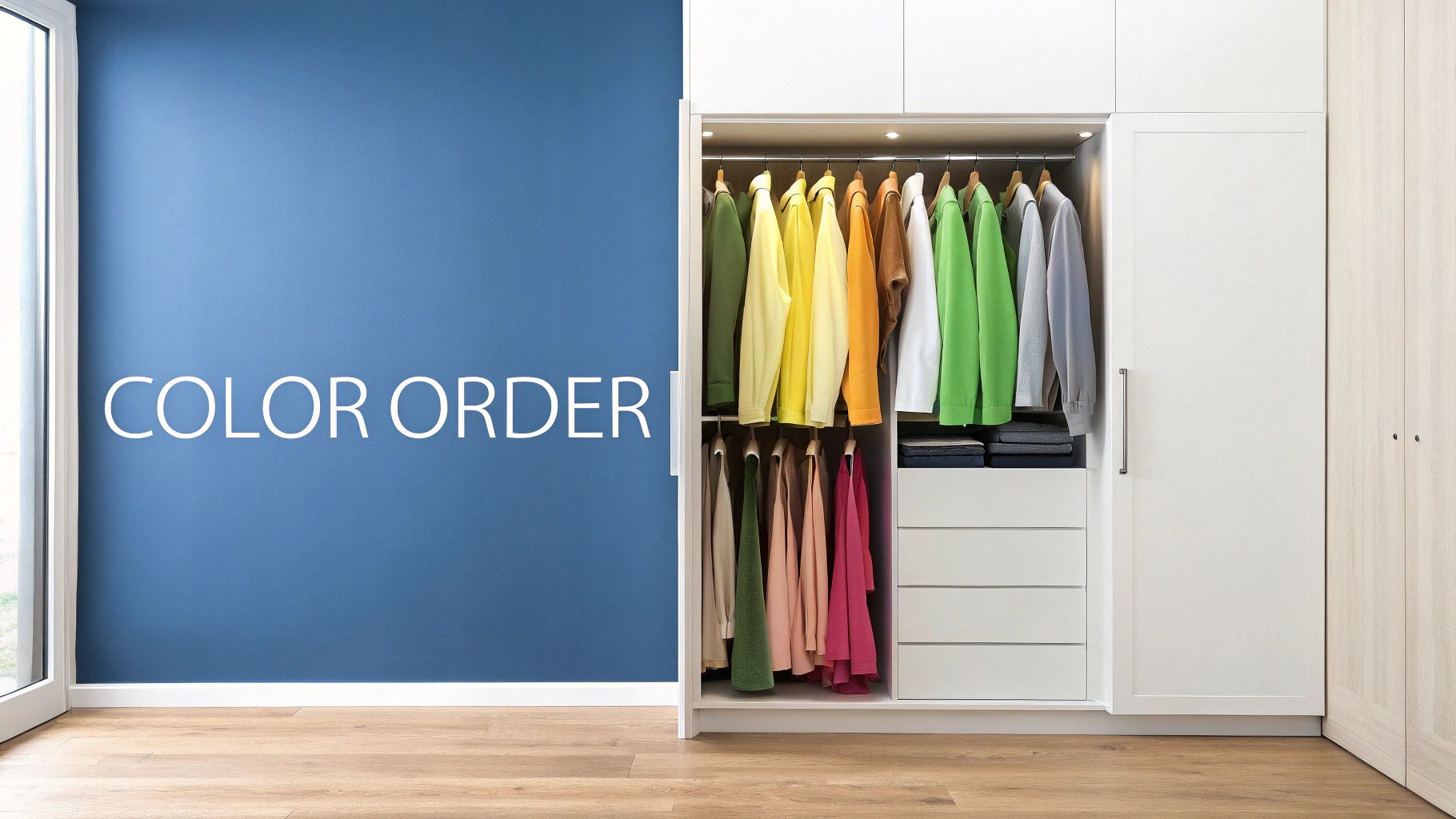
The result is a streamlined, boutique-like space that feels both luxurious and highly practical. Instead of searching through a jumble of clothes, your eyes are immediately drawn to the right section. This method is especially effective for visual thinkers and those with open closets or walk-in wardrobes where the beautiful arrangement can be fully appreciated.
How to Implement Color-Blocking Organization
Achieving this polished look is straightforward and can be combined with other organizational methods for maximum efficiency. Follow these steps to get started:
- Start with Categories: First, sort your clothes by type (e.g., shirts, pants, dresses). It's much easier to color-code within smaller, like-minded groups rather than trying to organize your entire wardrobe at once.
- Arrange by Color Spectrum: Within each category, organize items following the colors of the rainbow: red, orange, yellow, green, blue, indigo, and violet. Fit your neutrals (white, beige, gray, black) and browns at the beginning or end of the spectrum, whichever you prefer.
- Use Uniform Hangers: Create a cohesive, clean look by using matching hangers. This small detail prevents visual distraction and allows the colors of your clothing to be the main focus.
- Maximize with Cascading Hangers: For items within the same color family, such as various shades of blue tops or gray skirts, group them together on a single cascading hanger. MORALVE’s space-saving skirt hangers are perfect for this, allowing you to hang multiple items vertically to save space while keeping your color groups perfectly intact.
To master this technique, explore this detailed guide on how to arrange clothes by color.
3. The Capsule Wardrobe Approach
The Capsule Wardrobe Approach is a minimalist organizational method that transforms your closet from a chaotic collection into a curated gallery of versatile, essential pieces. This philosophy is less about organizing what you have and more about intentionally building a small, highly functional wardrobe of 30-50 items per season that can be mixed and matched effortlessly.
By focusing on quality over quantity, you eliminate decision fatigue and ensure everything you own is something you love to wear. This approach is perfect for those with limited space, a desire for a more sustainable lifestyle, or anyone who wants to simplify their daily routine. The result is a clean, visually calming closet where every item has a purpose.
How to Implement the Capsule Wardrobe Approach
Creating a capsule wardrobe requires a strategic mindset and a commitment to minimalism. Follow these steps to build your own:
- Define Your Base Palette: Start by selecting a few neutral base colors that complement each other, such as black, white, gray, navy, or beige. These will form the foundation of your wardrobe.
- Add Accent Colors: Choose one or two accent colors per season to add personality and variety to your outfits. These can be integrated through tops, accessories, or statement pieces.
- Select Versatile Basics: Focus on timeless, high-quality basics that can be dressed up or down. Think classic white shirts, well-fitting jeans, a versatile blazer, and a simple trench coat.
- Maximize Vertical Space: Since a capsule wardrobe contains fewer items, how you store them matters. To keep your closet organized and your key pieces in perfect condition, use efficient storage tools. MORALVE’s multi-pant hangers are ideal for this, allowing you to hang several pairs of trousers or jeans on a single hanger, saving valuable rod space while keeping everything visible and wrinkle-free.
This approach simplifies your closet by focusing on a limited, highly functional selection of clothes.
4. Category-Based Vertical Organization
Inspired by the clean, intuitive layout of high-end retail stores, this method organizes your wardrobe into distinct vertical zones based on clothing type. It's one of the most logical and visually appealing ways to organize your closet, transforming it from a jumble of items into a streamlined, easy-to-navigate space. Each category, like shirts, pants, or dresses, gets its own designated column, making it simple to see your entire inventory at a glance.
This system is ideal for anyone who wants to quickly assemble outfits without a frantic search. By dedicating specific vertical real estate to each clothing type, you create a natural flow that simplifies both your morning routine and the process of putting laundry away. It’s particularly effective in standard-sized closets where maximizing vertical hanging space is key to maintaining order and visibility.
How to Implement Category-Based Vertical Organization
This approach is highly scalable and can be adapted to any closet size. Follow these actionable steps to create a boutique-like experience at home:
- Define Your Categories: Start by sorting all your hanging clothes into clear categories: short-sleeve shirts, long-sleeve shirts, pants, skirts, dresses, jackets, etc. Be as specific as your wardrobe requires.
- Assign Vertical Zones: Designate a specific vertical section of your closet rod for each category. Use hanging closet dividers to create clear visual separation between zones, reinforcing the structure.
- Prioritize Accessibility: Place your most frequently worn categories, like work shirts or everyday pants, in the most accessible, eye-level zones. Seasonal or special-occasion items can be placed at the ends or on higher rods.
- Maximize Vertical Space: To prevent categories from becoming cramped and messy, use multi-level hangers. For example, MORALVE’s space-saving skirt hangers allow you to hang several skirts in a single vertical drop, keeping the entire category neat and visible within its assigned zone while freeing up valuable rod space.
5. The Four-Box Method
If the emotional journey of the KonMari method seems too abstract, the Four-Box Method offers a more pragmatic and decisive approach to decluttering. This straightforward system is one of the most fundamental ways to organize your closet, forcing you to make a clear decision about every single item you own. The process involves sorting everything into one of four designated boxes: Keep, Donate, Sell, or Trash.
The result is a clutter-free space achieved through logical categorization rather than emotional attachment. This method is incredibly effective as a first step before implementing a more complex organizational system, as it clears out the noise and leaves you only with the items you've actively decided to keep. It's perfect for anyone who feels paralyzed by indecision and needs a structured framework to get started.
How to Implement the Four-Box Method
This technique is simple to set up but requires honest self-assessment. Follow these actionable steps to reclaim your closet space:
- Prepare Your Boxes: Get four large boxes or bins and clearly label them: Keep, Donate, Sell, and Trash/Recycle. Place them in an open area near your closet.
- Sort Item by Item: Work through your closet section by section. Pick up each piece of clothing and decide which of the four boxes it belongs in. Be realistic about what you will actually wear again.
- Set Clear Criteria: Before you begin, define your "keep" rules. A common guideline is to let go of anything you haven't worn in the last year. For the "sell" pile, only include items in excellent condition that have resale value.
- Act Immediately: Once a box is full (especially Donate, Sell, or Trash), remove it from the room immediately to prevent second-guessing. Put it in your car or by the door. After sorting, organize the "Keep" items back into your closet using tools that maximize your newly freed space. MORALVE’s skirt hangers, for example, can hang multiple skirts in the space of one, ensuring your keepers stay visible and wrinkle-free.
This method provides a clean slate, making the final organization of your remaining wardrobe a much more manageable task.
6. Drawer Dividers and Shelf Organization
For those who crave structure and order, organizing with drawer dividers and shelf organizers transforms chaotic spaces into logical, easy-to-navigate compartments. This system is all about creating a designated home for every item, from socks and underwear to bulky sweaters and t-shirts. This approach uses bins, dividers, and tiered shelving to maximize vertical space and establish clear boundaries, preventing items from becoming a jumbled mess.
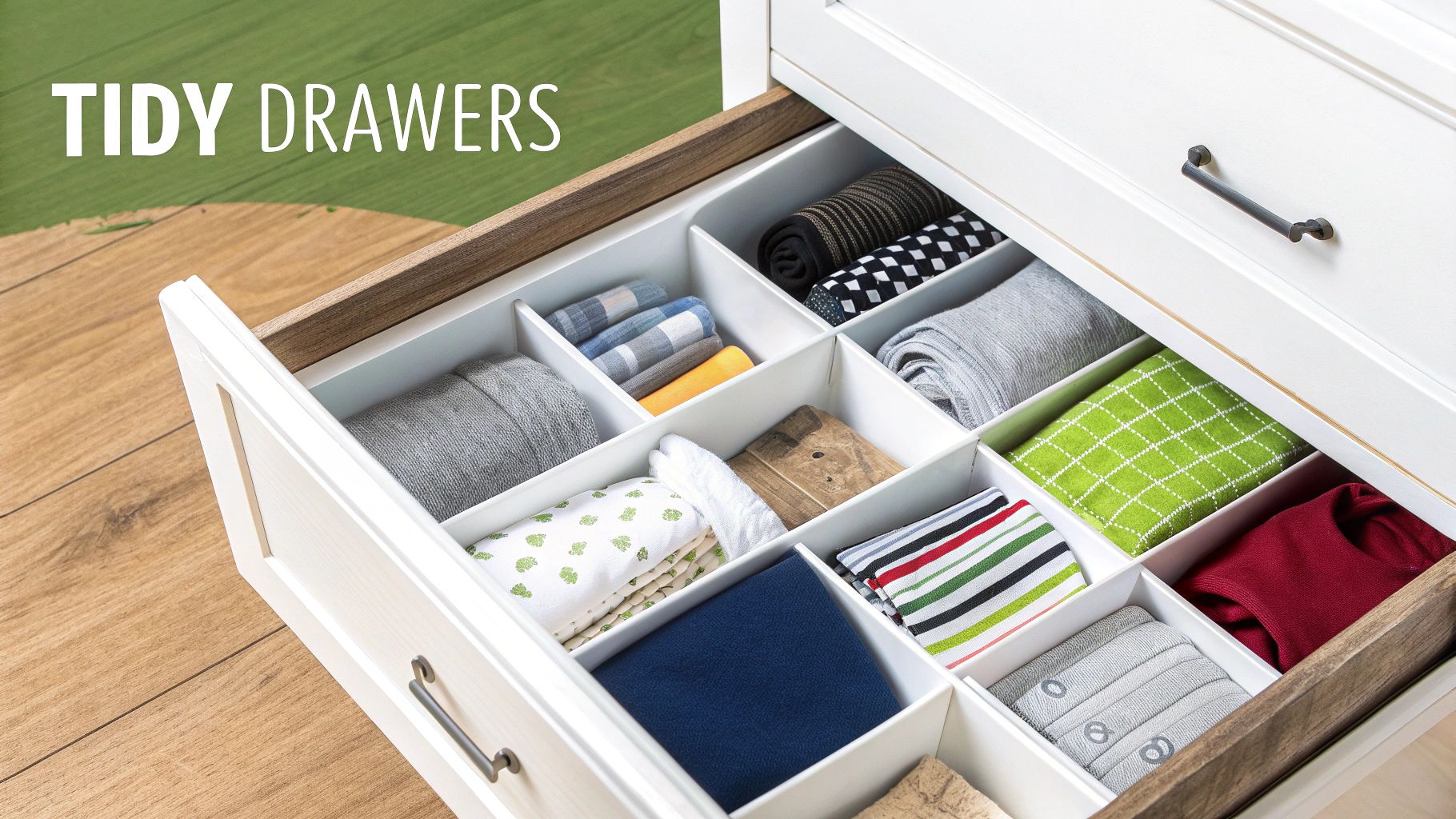
The result is a visually appealing and highly functional closet where you can see everything at a glance. Instead of digging through piles, you can effortlessly grab what you need, making your daily routine faster and more efficient. This method is one of the most effective ways to organize your closet if you have ample shelf and drawer space, and it works exceptionally well for smaller items that tend to get lost.
How to Implement Drawer and Shelf Organization
This systematic approach brings a sense of calm and control to your closet. Follow these actionable steps to set up your own compartmentalized system:
- Measure and Plan: Before buying anything, measure the interior dimensions of your drawers and the height and depth of your shelves. This ensures you purchase organizers that fit perfectly and maximize every inch of space.
- Categorize Your Items: Group similar items together. Think socks with socks, workout tops together, and pajamas in their own pile. This will help you determine the size and number of compartments you need.
- Choose the Right Tools: Use adjustable drawer dividers for flexibility as your needs change. Opt for clear bins and containers for shelves so you can see the contents without pulling them down. Label everything to help maintain the system, especially in shared family closets.
- Optimize Your Space: In addition to compartmentalizing drawers, think vertically for your hanging space. While dividers master the shelves, MORALVE’s multi-functional skirt hangers can bring the same level of order to your hanging items, allowing you to store multiple skirts in the space of one, creating a tidy and uniform look that complements your newly organized drawers.
Proper organization of drawers and shelves is essential for a completely tidy closet.
7. Seasonal Rotation System
The Seasonal Rotation System is a practical and highly effective strategy for managing your wardrobe by keeping only seasonally appropriate clothing in your primary closet. This method involves storing off-season items elsewhere, dramatically reducing clutter and making your daily dressing routine much simpler. Instead of digging through bulky sweaters in July, your closet remains a curated, accessible space filled with exactly what you need right now.
This approach is one of the most impactful ways to organize your closet, especially for those living in climates with distinct seasons or anyone with limited closet space. By focusing only on the current season's collection, you can see all your options clearly, create outfits more easily, and prevent your most-used items from getting lost among things you won't wear for months.
How to Implement the Seasonal Rotation System
Transitioning your closet between seasons can be a seamless process with a bit of planning. Follow these steps to master the rotation:
- Sort and Declutter: At the end of a season, go through all related clothing. Before storing, decide what to keep, donate, or discard. This prevents you from storing items you no longer love.
- Clean Before Storing: Always wash or dry-clean items before putting them into long-term storage. This removes oils and stains that can attract pests and become permanent over time.
- Use Proper Storage: Store off-season clothes in clear, labeled bins or vacuum-sealed bags to protect them from dust, moisture, and pests. Store them in a cool, dry place like a guest room closet or under the bed.
- Maximize Current Season Space: As you bring the new season's clothes into your closet, organize them for maximum visibility. Multi-garment hangers are perfect for this. For example, MORALVE’s space-saving skirt hangers allow you to hang multiple skirts or shorts in the vertical space of one, keeping your summer essentials neat and accessible without overcrowding the rod.
To learn more about preparing your clothes for storage, check out this guide on how to properly store seasonal clothing.
8. The Personal Uniform System
Taking the capsule wardrobe concept to its minimalist extreme, the Uniform System involves creating a signature outfit formula you wear almost daily. Think of iconic figures like Steve Jobs with his black turtleneck and jeans or Mark Zuckerberg with his gray t-shirt. This method radically simplifies closet organization by drastically reducing the number of decisions you need to make and the volume of clothing you own.
This approach streamlines your morning routine and creates an incredibly efficient, organized closet. By eliminating clothing that doesn't fit your "uniform," you are left with only the most functional, high-quality pieces that you know you look and feel good in. It’s one of the most direct ways to organize your closet for maximum efficiency and minimal stress, freeing up both mental and physical space.
How to Implement the Personal Uniform System
Building a personal uniform is about intentionality and investing in pieces that serve you well. Here’s how to create your own:
- Define Your Formula: Start by identifying a core outfit that suits your lifestyle, profession, and personal style. This could be a black t-shirt and dark-wash jeans, or a silk blouse with tailored trousers.
- Invest in Quality Multiples: Once you have your formula, purchase several high-quality versions of each core item. Choose durable, timeless pieces in a neutral color palette to ensure they last and can be worn across seasons.
- Plan for Subtle Variations: A uniform doesn't have to be boring. Introduce variety through different textures (like a cashmere vs. a cotton sweater) or subtle shifts in color (charcoal gray vs. heather gray). Accessories like scarves, jewelry, or shoes are perfect for adding personality.
- Store for Grab-and-Go Access: Since your outfits are standardized, storage becomes incredibly simple. To keep your core bottoms organized and wrinkle-free, consider using specialized hangers. MORALVE's space-saving pant hangers allow you to store all your uniform trousers or jeans on a single hanger, making your daily selection effortless and keeping your streamlined wardrobe perfectly tidy.
9. The Hanger-Turning Technique
The Hanger-Turning Technique is less of a one-time purge and more of a practical, long-term experiment to discover what you actually wear. This simple tracking method offers undeniable proof of your wardrobe habits by making your unworn items impossible to ignore. It’s one of the most insightful ways to organize your closet because it relies on your real-life actions, not just your intentions.
This technique is incredibly straightforward: you start by turning all the hangers in your closet so they face backward. After you wear an item, you return it to the closet with the hanger facing the correct, normal direction. Over a period of several months, a clear visual pattern emerges, separating the clothes you love from those you merely own. This method is perfect for anyone struggling to be objective about their clothing and needing concrete data to make decluttering decisions.
How to Implement the Hanger-Turning Technique
This low-effort method delivers powerful insights with minimal setup. Follow these actionable steps to apply it to your closet:
- Set a Start Date: Choose a specific day to begin and mark it on your calendar. Turn every single hanger in your closet backward so the hook faces out.
- Wear and Return: Go about your life as usual. When you wear an item and are ready to put it back, hang it with the hanger facing the correct direction. Don't cheat the system; be honest about what you're wearing.
- Review and Assess: After a set period, typically six months to a year, review your closet. Any hangers still facing backward are holding items you have not worn. This is your cue to evaluate why.
- Make Informed Decisions: For each unworn item, ask if it's due to seasonality, poor fit, or a style you no longer love. This data helps you declutter confidently and shop smarter in the future. As you refine your collection, using the best space-saving hangers can help you organize your remaining essentials more efficiently.
10. The 80/20 Principle in Closet Organization
The 80/20 Principle, also known as the Pareto Principle, is a powerful productivity concept that perfectly translates into one of the most strategic ways to organize your closet. The idea is simple: you likely wear 20% of your clothes 80% of the time. This method shifts your focus from managing every single item to prioritizing and highlighting the core pieces that form the backbone of your daily style.
By identifying and organizing this vital 20%, you streamline your morning routine and make getting dressed effortless. Instead of sifting through dozens of rarely-worn garments, your favorite, go-to items are front and center. This approach is ideal for anyone who feels they have a closet full of clothes but "nothing to wear," as it helps you build a functional wardrobe around what you genuinely love and use.
How to Implement the 80/20 Principle
This data-driven method helps you make objective decisions about your wardrobe. Follow these steps to curate your closet around your most valuable pieces:
- Track Your Outfits: For the next 2-4 weeks, keep a simple log of what you wear each day. You can use a notebook, an app, or even just take a quick photo. The goal is to gather real data on your clothing habits.
- Identify Your 20%: Review your log and identify the items that appear most frequently. These are your workhorses, your core 20%. Pull these key pieces out and designate them as your primary wardrobe.
- Reorganize Your Closet: Give your core 20% the prime real estate in your closet. They should be the most visible and accessible items. The remaining 80% (less-worn items) can be moved to higher shelves, the back of the closet, or into storage bins.
- Maximize Prime Space: Since your focus is on a smaller collection, how you store it matters. To keep your most-worn pants crisp and easy to grab, use MORALVE’s multi-tiered pant hangers. This lets you hang your key trousers and jeans vertically, making the most of your prime closet space and ensuring your favorite items are always ready to go.
This principle not only declutters your space but also provides valuable insight for future shopping, helping you invest in pieces you'll actually wear.
10 Closet Organization Methods Compared
| Method | 🔄 Implementation complexity | ⚡ Resource requirements | ⭐ Effectiveness | 📊 Expected outcomes | 💡 Ideal use cases |
|---|---|---|---|---|---|
| The KonMari Method | High — thorough, category-by-category sessions | High — time, space to lay out items, emotional effort | ⭐⭐⭐⭐⭐ | Significant item reduction; more intentional wardrobe | Those seeking emotional clarity and long-term change |
| Color-Blocking Organization | Medium — sorting by color across closet | Medium — time initially, matching hangers, good lighting | ⭐⭐⭐⭐ | Highly visual, faster item location; Instagram-friendly look | Walk-in closets, visually oriented users, stylists |
| The Capsule Wardrobe Approach | High — planning and selective purchasing | High — investment in quality basics; editing time | ⭐⭐⭐⭐⭐ | Small versatile collection; reduced decision fatigue | Minimalists, frequent travelers, sustainability-focused |
| Category-Based Vertical Organization | Medium — resectioning closet by type | Medium — slim hangers, vertical space, possible dividers | ⭐⭐⭐⭐ | Quick inventory by category; space-efficient for small closets | Small closets, retail-style organization, frequent users |
| The Four-Box Method | Low — simple sort into Keep/Donate/Sell/Trash | Low — four boxes and time for decisions | ⭐⭐⭐ | Fast declutter; clear action items but limited long-term structure | Beginners or those needing a quick purge |
| Drawer Dividers & Shelf Organization | Medium — measure and configure compartments | Medium-High — purchase dividers/containers, time to set up | ⭐⭐⭐⭐ | Maximized drawer space; neat compartments, easier retrieval | People with many folded items or deep drawers |
| Seasonal Rotation System | Medium — biannual rotation process | Medium — storage bins, off-site/climate-controlled space | ⭐⭐⭐⭐ | Reduced active-season clutter; better garment preservation | Homes with distinct seasons or limited closet space |
| The Personal Uniform System | Medium — define and acquire uniform pieces | Medium — buy multiples of core items, minimal upkeep | ⭐⭐⭐⭐ | Elimination of decision fatigue; consistent personal brand | Busy professionals or those wanting extreme simplicity |
| The Hanger-Turning Technique | Low — reverse hangers and track wear period | Low — existing hangers and discipline over months | ⭐⭐⭐ | Data-driven insight into wear habits; slow to yield results | People who want objective wear data before purging |
| The 80/20 Principle in Closet Organization | Medium — track usage and prioritize top items | Low-Medium — tracking method or app, storage for 80% | ⭐⭐⭐⭐ | Closet centered on most-used pieces; simplified choices | Those wanting data-informed minimalism without full purge |
Your Organized Closet Awaits
We've explored a comprehensive landscape of ten distinct and powerful ways to organize your closet, moving far beyond simple tidying into the realm of strategic, life-enhancing systems. From the mindful decluttering of the KonMari Method to the ruthless efficiency of the 80/20 Principle, each approach offers a unique pathway to a more streamlined and functional space. The journey has shown us that organization isn't a one-size-fits-all solution; it's a personalized process of aligning your physical space with your daily habits, lifestyle, and aesthetic preferences.
The core takeaway is that a truly organized closet is born from intention, not just action. It requires a thoughtful assessment of what you own, why you own it, and how you want to interact with your wardrobe. By committing to a system, whether it’s the visual simplicity of color-blocking or the minimalist discipline of a capsule wardrobe, you are fundamentally changing your relationship with your belongings and, by extension, your daily routines.
From Theory to Action: Your Next Steps
The knowledge you've gained is your blueprint, but the real transformation begins when you take the first step. Don't let the prospect of a complete overhaul intimidate you. True, sustainable change is often built on small, consistent actions rather than a single, monumental effort.
Here is your actionable plan to move forward:
- Choose Your Champion Method: Review the ten methods. Which one resonated most with you? Was it the logic of category-based vertical organization, the seasonal practicality of a rotation system, or the simplicity of a personal uniform? Select one primary method to guide your initial efforts. You can always integrate elements from others later.
- Schedule Your First Session: Look at your calendar right now and block out a non-negotiable two-hour window. This isn't "cleaning"; it's a "Closet Transformation Session." Putting it on your schedule elevates its importance and dramatically increases the likelihood you'll follow through.
- Gather Your Tools: Before you start, ensure you have the necessary supplies. This includes boxes for donating or sorting, cleaning supplies, and most critically, the right organizational tools. Investing in high-quality, space-efficient hangers and dividers is not a luxury; it's a foundational element of success.
The Lasting Impact of an Organized Closet
Mastering these ways to organize your closet provides benefits that ripple out into every facet of your life. It's about more than just finding your favorite shirt faster. It’s about reducing decision fatigue each morning, saving money by avoiding duplicate purchases, and creating a sense of calm in a space you interact with daily. An organized closet sets a positive, proactive tone for your entire day.
Remember the power of vertical space, the clarity that comes from decluttering, and the efficiency of a well-defined system. The hanger-turning technique can provide undeniable data on what you actually wear, while drawer dividers can turn a chaotic jumble into a perfectly segmented collection. Each strategy is a tool, and you are the architect of your new, serene, and perfectly functional wardrobe space. The clutter is not in charge; you are. It’s time to build a closet that not only holds your clothes but also supports your best life.
Ready to maximize every inch of your rod space and bring your new organization system to life? Equip yourself with the best tools for the job by exploring the innovative, space-saving hanger collections at MORALVE. From multi-tiered pant and skirt hangers to specialized tank top organizers, MORALVE provides the high-quality solutions you need to implement these ways to organize your closet effectively and maintain a clutter-free wardrobe for years to come.
Leave a comment