
Design My Closet: A Practical Guide to Perfect Closet Organization

Before you buy a single hanger or bin, the secret to a closet that actually works for you lies in the prep work. Mastering the principles of closet organization is the difference between a temporary fix and a long-term solution. It's about creating a system tailored to your life, not just tidying up.
Laying the Groundwork for Your Perfectly Organized Closet
Embarking on a closet redesign without a clear organizational plan is like building a house without a blueprint. You might end up with something that looks okay, but it won't be functional or sustainable. Rushing the process is a recipe for wasted money and a storage system that doesn’t solve your core clutter problems.
Let's start with a clear-eyed look at what you own and the physical space you have. This initial phase is all about gathering the right information to build a truly organized space.
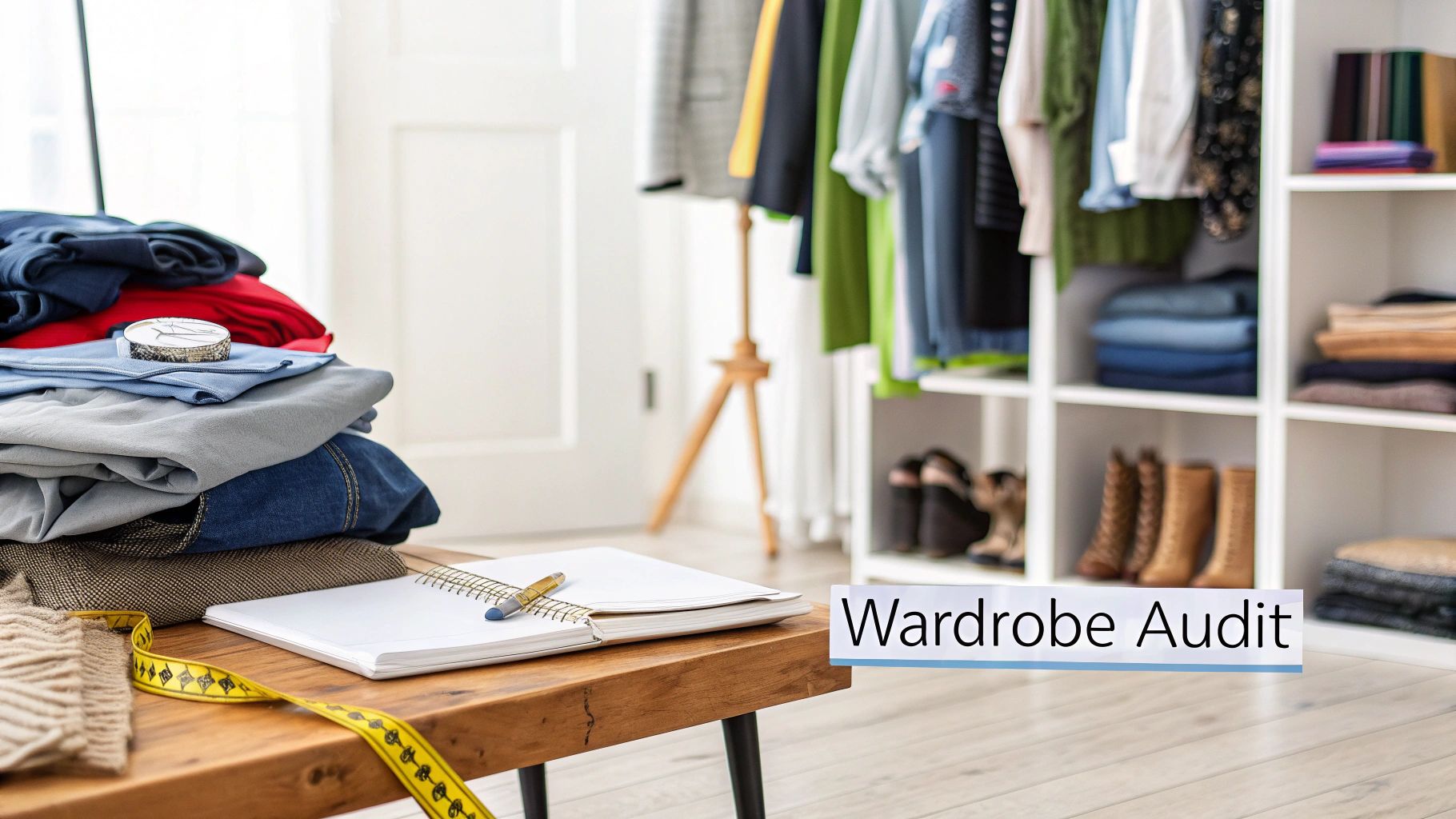
Start With an Honest Wardrobe Audit
First things first: you need to see what you’re working with. That means taking every single item out of your closet. And I mean everything. Piling it all up gives you a powerful visual of what’s been hiding in the dark corners.
Once it's all out, get sorting. An effective three-pile system is essential for good closet organization:
- Keep: The clothes you love, wear often, and feel good in. No exceptions.
- Donate/Sell: Anything in good shape that you simply don't wear anymore.
- Store Elsewhere: Bulky seasonal items (like winter parkas) or formal wear don't deserve prime real estate.
This isn't just about tidying up; it's a full-blown inventory check. For a deeper dive into this crucial step, our guide on how to declutter your closet will walk you through it.
A proper audit ensures you're organizing a closet for the wardrobe you actually have—not the one you think you have. This is the key to creating an organizational system that supports your daily routine.
Measure Twice, Organize Once
Now that you know what needs to be stored, it’s time to get intimately familiar with your space. Grab a tape measure and get down to the nitty-gritty details.
Jot down these critical dimensions:
- Width: Measure from one side wall to the other at the back.
- Height: Go from the floor all the way to the ceiling.
- Depth: Measure from the back wall to just inside the door frame.
Pay close attention to any organizational obstacles. Is there a sloped ceiling? A rogue electrical outlet? A light fixture in an awkward spot? These details are non-negotiable and can derail your plan if ignored. Getting these numbers right is the foundation for an efficient layout. If you’re thinking bigger picture, this level of detail is a core principle in professional custom home design services that create a cohesive feel.
There's a reason the global Closet Organizer Market is on track to hit USD 8.3 billion. More and more people are realizing that smart organization is about using every inch of vertical and horizontal space effectively. By taking the time to audit and measure, you're embracing the same strategic approach that’s driving this trend.
Designing Smart Zones for Effortless Organization
Think about the workflow in a well-organized kitchen. Spices are next to the stove, glasses are near the fridge, and silverware is close to the dishwasher. Everything has a logical home based on function. You can bring that same brilliant efficiency into your closet using a technique called closet zoning, which will completely transform your morning routine.
This is about more than just hanging all your shirts together. Zoning means creating dedicated areas in your closet that map to your real life. The goal is to group items so you can pull a full outfit together without that last-minute, frantic search. Your work clothes, weekend casuals, and gym gear should all live in their own intuitive organizational "neighborhoods."
Find Your Personal Zoning Method
There’s no single right way to zone your closet; the best organizational system is always the one that fits your lifestyle. Some people love organizing by clothing type, while others find that grouping by occasion is a total game-changer. Let's look at the two main approaches to figure out which one clicks for you.
Method 1: Organizing by Clothing Type This is the classic, go-to method where you group all similar items.
- All your blouses hang in one section.
- All your pants and trousers are together.
- Sweaters get folded and stacked on their own dedicated shelf.
This system is fantastic if you love to mix and match different pieces every day. It provides an at-a-glance inventory of every category, letting you quickly see all your top, bottom, and layering options.
Method 2: Organizing by Occasion or Activity This approach is perfect if your life is broken up into distinct activities. You’re essentially creating mini-capsule wardrobes right inside your closet.
- A Workwear Zone holds all your go-to office outfits.
- A Weekend Zone is for casual jeans, t-shirts, and comfy sweaters.
- An Activewear Zone keeps all your gym and workout gear ready to go.
- A Formal Zone is for those special occasion pieces you wear less often.
This method radically simplifies getting dressed for a specific event. On a busy Monday morning, you only have to look in your workwear zone, which instantly cuts down on decision fatigue.
Map Your Zones to Your Closet Layout
Once you’ve picked a zoning philosophy, it's time to map it onto your physical space. The most important rule for effective closet organization is to give your most-used zones the prime real estate.
If you go to the office five days a week, your workwear should be front and center. The formal dress you only wear a couple of times a year? That can go on a higher shelf or in a less convenient corner.
By strategically placing your most-used items where they are easiest to see and reach, you are building efficiency directly into your closet’s design. This simple act of prioritizing access can save you valuable minutes and mental energy every single day.
In a reach-in closet, this might mean your daily-wear clothes hang on the main rod while your workout gear lives in a bin on the floor. If you have a walk-in, you could dedicate an entire wall to your professional wardrobe. To make it all work, choosing the right closet storage organizer for each zone is absolutely crucial.
In the end, zoning is about making your closet serve you, not the other way around. It’s a personalized system reflecting your actual habits. By taking a little time to create these logical divisions, you’re not just organizing your clothes—you’re designing a calmer, easier start to every single day.
Choosing the Right Closet Storage Solutions
Okay, you've mapped out your zones—now for the fun part. It’s time to pick the hardware that will bring your organized closet to life. This is where we move from theory to reality, choosing the right combination of hanging rods, shelves, and drawers that will become the backbone of your new, streamlined space.
Making the right choices here is more than just about looks; it's about protecting your clothes. I’ve seen it happen too many times: heavy knit sweaters get stretched out on the wrong hangers, and delicate silk blouses are ruined by cheap, snag-prone plastic. The goal is to match the storage solution to the garment, keeping everything in great shape and easy to find.
Balancing Hanging, Shelving, and Drawer Space
Every functional closet is a blend of hanging, shelving, and drawer space. The perfect mix for you depends entirely on what you own. If your wardrobe is full of dresses, blazers, and suits, you’ll naturally need more hanging space. But if you live in denim and activewear, shelves and drawers will be your organizational best friends.
Let's break down what each one does best.
Hanging Rods for Every Garment Type
Hanging storage is the heart of most closets, keeping your go-to items visible and wrinkle-free.
- Single Rods: These are essential for longer pieces like maxi dresses, long coats, and jumpsuits. Install them high enough that nothing drags on the floor.
- Double Rods: This is the single best trick for maximizing organizational space. Stacking one rod above another instantly doubles your hanging capacity for shirts, blouses, folded trousers, and skirts.
Shelving for Folded Favorites
Shelves are the ideal home for anything bulky or items that shouldn't be hung, such as sweaters, jeans, and sweatshirts.
- Open Shelving: I love open shelves for quick, grab-and-go access. To keep things orderly, use acrylic or metal shelf dividers to prevent stacks of sweaters from toppling over.
- Cubby Systems: These are fantastic for giving items a designated "home." They work beautifully for shoes, handbags, and even neatly folded t-shirts, creating a clean, organized grid.
Drawers for Concealed Order
Drawers are your secret weapon for a clutter-free look and organizing small items. Use them for socks, underwear, workout gear, and accessories like scarves or belts.
Upgrading Your Hangers: The Ultimate Organizational Tool
If there's one change that delivers the biggest and most immediate organizational impact, it's upgrading your hangers. A random assortment of bulky plastic and wire hangers creates visual noise and wastes rod space. Switching to a uniform set of slim, high-quality hangers will instantly make your closet feel bigger and look incredibly polished.
This is where you stop thinking about generic hangers and start thinking about specialized organizational tools. If you truly want to design my closet for peak organization, the right hanger is non-negotiable.
Investing in the right hangers is like upgrading the tires on a high-performance car. It’s a seemingly small change that dramatically improves the overall function and efficiency of the entire organizational system.
For instance, MORALVE’s space-saving hangers are engineered to solve specific storage problems. A multi-pant hanger can hold five pairs of trousers in the same vertical space that one would normally take up. Tiered skirt hangers do the same, while our tank top organizers finally bring order to one of the most chaotic clothing categories. These aren't just hangers; they're organizational tools that can literally double or triple your hanging space.
To see all the possibilities, you can explore our full guide to the best clothing storage solutions.
Smart Tools and Accessories to Complete Your Setup
With the main structures in place, it’s the smaller details that really elevate closet organization from good to great. There's a reason the Home Organization Products Market was valued at USD 13.13 billion and is projected to hit USD 17.67 billion—people are realizing that smart, custom solutions make life so much easier. You can see more on this growing market on Verified Market Research.
Here are a few essential organizational accessories I always recommend:
- Drawer Dividers: Absolutely non-negotiable for creating order. They keep socks, ties, and underwear neatly separated.
- Clear Bins: Perfect for upper shelves. Use them for out-of-season clothes or accessories. You can see what’s inside at a glance, maintaining organization.
- Jewelry Trays: A simple velvet-lined tray inside a shallow drawer will keep necklaces, earrings, and watches from becoming a tangled mess.
- Belt and Tie Racks: These can be mounted on a wall or the back of the door, getting these awkward items organized and out of the way.
Now that we’ve covered the core components, let’s put it all together into a shopping list to make sure you have everything you need for ultimate closet organization.
Your Ultimate Closet Organizer Shopping Checklist
Here’s a checklist of the essential organizers and MORALVE hangers that will help you build your perfectly designed and organized closet.
| Organizer Type | Best For | MORALVE Solution & Tip |
|---|---|---|
| Slim Hangers | Everyday shirts, blouses, jackets | Velvet Hangers: Create a uniform, non-slip system that instantly saves space and boosts visual organization. |
| Multi-Pant Hangers | Jeans, trousers, slacks | 5-Tier Pant Hangers: An organizational powerhouse. Hang 5 pairs of pants vertically in the space of one. |
| Tiered Skirt Hangers | Skirts, shorts, capris | 4-Tier Skirt Hangers: Use adjustable clips to hang multiple skirts, maximizing rod space and keeping them organized. |
| Specialty Hangers | Tank tops, camisoles, bras | Tank Top Hangers: Finally, a way to organize up to 8 tank tops on a single hanger, keeping them tangle-free and easy to find. |
| Shelf Dividers | Sweaters, denim, handbags | Acrylic or Wire Dividers: Slide these onto shelves to create neat, stable stacks. The key to organized shelves. |
| Drawer Organizers | Socks, underwear, belts, scarves | Honeycomb or Adjustable Dividers: These create small, individual compartments inside your drawers for meticulous organization. |
| Storage Bins | Off-season clothing, shoes, accessories | Clear or Labeled Bins: Use them on high shelves. Being able to see the contents is crucial for long-term organization. |
| Accessory Hooks | Belts, ties, necklaces, handbags | Wall-Mounted or Over-the-Door Racks: A perfect way to utilize vertical space for better accessory organization. |
By thoughtfully choosing each piece of hardware—from the hanging rods down to the very last drawer divider—you’re not just tidying up. You’re building a custom organizational system that works perfectly for the clothes you own and the life you lead.
How to Maximize Every Inch of a Small Closet
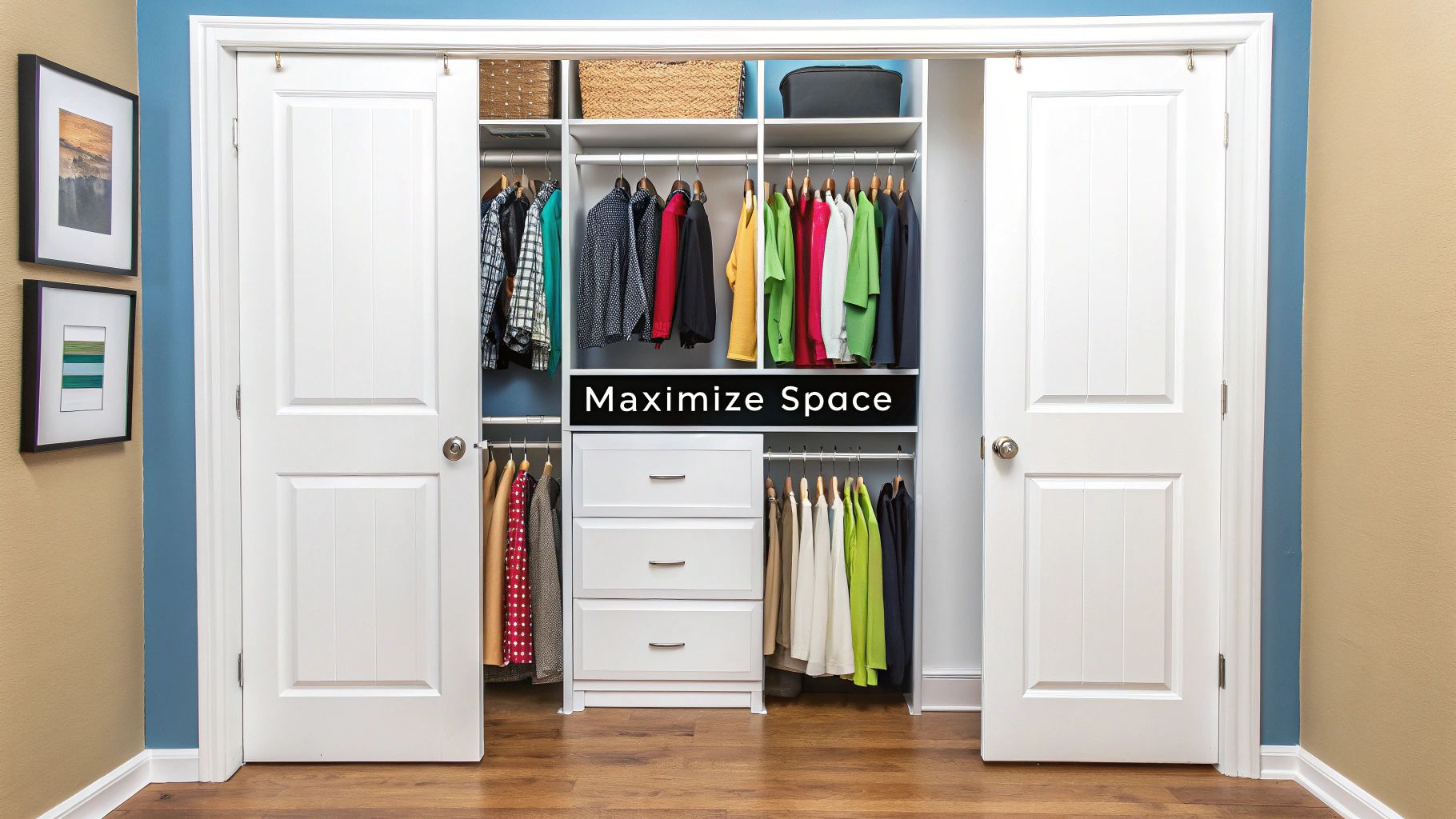
Living with a small closet isn't a sentence to a lifetime of clutter. A limited space forces you to get smart and creative with your organization, often leading to a closet that’s far more efficient than a larger, disorganized one. It's all about shifting your perspective—stop seeing the limitations and start seeing the hidden organizational potential.
Whenever someone asks me, "design my closet for a tiny apartment," I immediately focus on untapped real estate: the soaring vertical space, the forgotten floor area, and even the back of the door.
Unlock Your Vertical Real estate
Most closets have a huge amount of dead air between the top of the clothes and the ceiling. This is prime real estate for organization. By thinking vertically, you can add layers of storage without changing the closet's footprint.
The quickest win is installing a double-hang rod system. This simple move instantly doubles your capacity for shirts, skirts, and folded trousers. A good rule of thumb is to place the top rod around 80 inches from the floor and the bottom one around 40 inches.
Another fantastic organizational strategy is to add shelving high above your main rod. This becomes the perfect home for things you don't need every day, like:
- Out-of-season clothes, neatly packed in clear, labeled bins.
- Extra linens or guest towels.
- Special-occasion shoes or handbags.
Make the Most of Underutilized Spaces
Once you've gone vertical, it's time to claim those other forgotten zones. The floor and the back of the door offer seriously valuable storage opportunities for a hyper-organized closet.
The floor is perfect for low-profile solutions like a small set of drawers for workout clothes or a sleek shoe rack. Stackable bins are also great for getting footwear organized and off the ground.
And don't forget the back of the door—it’s an organizational game-changer. An over-the-door organizer with clear pockets can hold everything from scarves and belts to flats and accessories. Or, a few well-placed hooks are great for hanging your robe or planning tomorrow's outfit.
Your closet isn't just the space between four walls; it's every single surface within that space. By putting the door, the floor, and the full height to work, you're expanding your organizational capacity without any renovation.
Choose Tools Designed for Tight Quarters
In a small closet, your organizational tools matter immensely. Bulky, mismatched plastic hangers are space hogs. Swapping them for a uniform set of slimline velvet hangers can free up as much as 25% more rod space. It’s a single change that makes a huge organizational impact.
The demand for these kinds of smart solutions is exploding. The global Closet Organizer Market is on track to hit USD 11.15 billion as more people get serious about wardrobe optimization. In fact, 72% of millennials point to space-saving hangers as a top strategy for increasing closet capacity. It's clear that having the right organizational tools is non-negotiable. You can find more data on how homeowners are getting creative with their space at EIN News.
Beyond hangers, look for other clever organizers. Shelf dividers prevent stacks of sweaters from toppling over. For a deep but narrow reach-in, a pull-out pants rack can make it so much easier to get to the trousers in the back. Every single item you choose should solve a specific organizational problem, turning your small closet into a powerhouse of efficiency.
Bringing Your Vision to Life with Final Touches
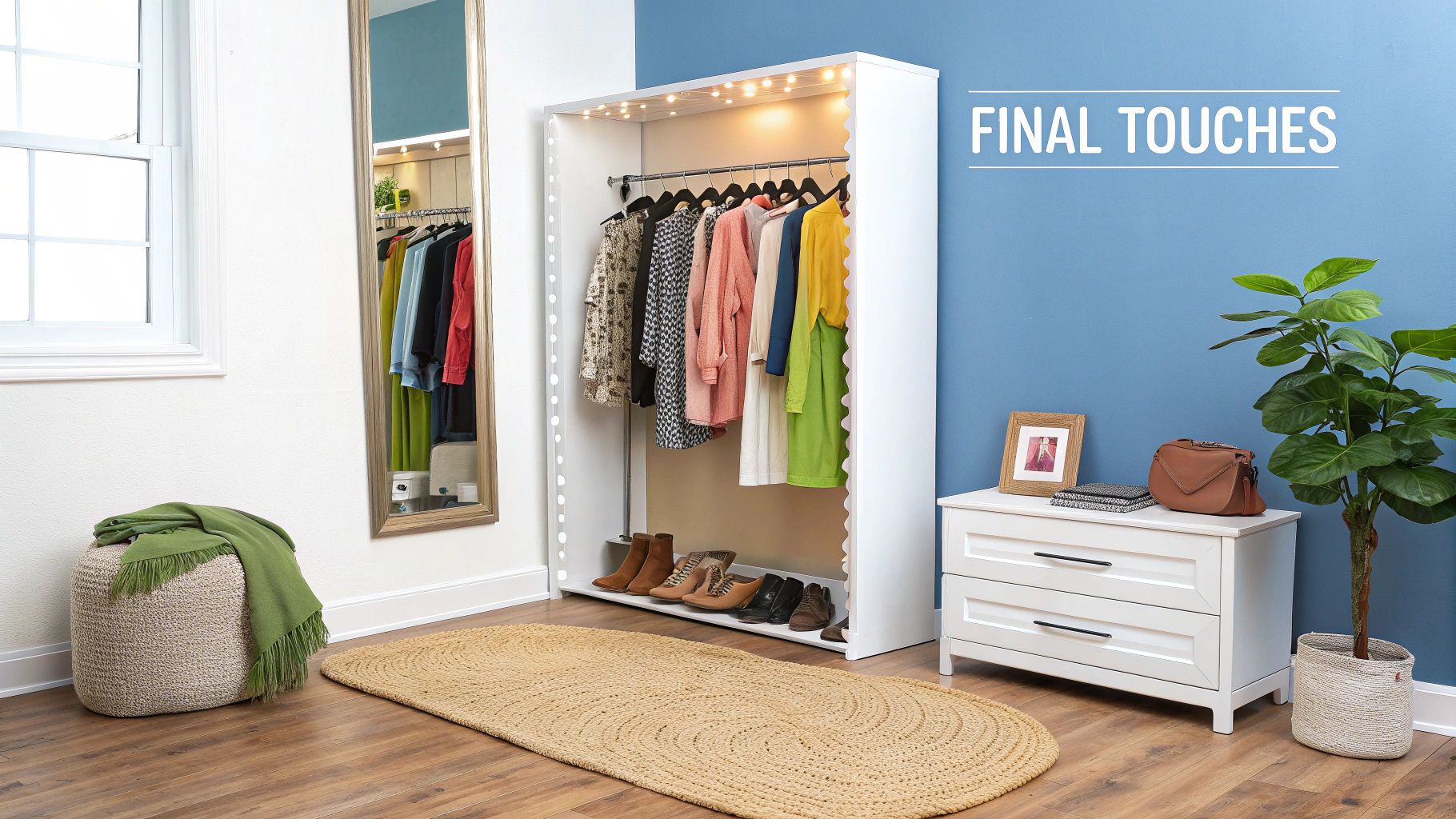
You’ve done the hard work of measuring and planning. Now comes the best part: bringing your organizational system to life. This is where a good closet becomes a great one, transforming from a simple storage box into your own personal sanctuary.
Putting your clothes back isn’t just about filling the space—it's your first chance to see that zoning plan in action. As you hang each piece, do it with purpose. Workwear goes in its designated zone, weekend clothes get their spot, and workout gear finds its home. Following through on this makes your new organizational system feel natural from day one.
Arranging for Visual Harmony and Function
Little details in how you arrange everything make a massive difference in closet organization. One of the easiest tricks is to organize your clothes by color, creating a satisfying gradient from light to dark. It’s not just visually stunning; it makes finding that one black shirt so much faster.
Here's another pro tip for instant organization: face all your hangers in the same direction. It’s a tiny change that creates a sense of calm and order. It’s these small, intentional choices that elevate a closet from chaotic to curated.
Elevate the Aesthetic with Simple Additions
A well-organized closet should feel good to be in. While storage is key, finishing touches make the space feel truly yours. And you don’t need a huge budget.
Think about adding a few of these simple but powerful elements:
- Cohesive Hangers: Using matching hangers is the fastest way to get a high-end, organized feel. The uniformity slashes visual clutter and makes your wardrobe look polished and intentional.
- Strategic Lighting: Closets are often dark corners. A few battery-powered, motion-activated LED lights under a shelf can be a total game-changer, helping you see your organized items.
- A Personal Touch: Why not bring a bit of your personality in? A small, stylish rug adds softness. A sleek, full-length mirror leaned against a wall makes the space feel bigger and gives you a dedicated spot for outfit checks.
When you design a closet that is both beautiful and highly organized, you create more than just storage. You build a space that supports your daily routine, simplifies your mornings, and brings a sense of calm and control to your life.
Ultimately, you're not just organizing hangers and shelves. You're creating a space you truly love, one that pays you back with effortless style and efficiency every single day.
Styling Your Shelves and Surfaces
Don't let your open shelves become a catch-all for clutter. Treat them with organizational care. Use attractive bins or woven baskets to hide away smaller odds and ends, keeping the overall look clean.
Display a favorite handbag or pair of shoes like art. Fold sweaters and jeans with care so the stacks are neat and even. You can even add a small decorative tray for jewelry or a scented sachet to make the space feel more personal. This is the final step in your journey to design my closet—making it an organized space that genuinely reflects you.
Answering Your Top Closet Design Questions
Even with the best-laid plans, a few questions always seem to pop up when you're in the middle of a closet redesign. Getting ahead of these common hurdles will keep your project moving smoothly and help you build a space you'll actually love using every day.
Let's tackle some of the most frequent questions people ask when they decide to finally design my closet with a focus on organization.
"Okay, I'm Overwhelmed. Where Do I Even Begin?"
Staring at a closet packed with years of clothes can feel paralyzing. The best first step, hands down, is a complete closet audit. Before you think about buying a single organizer, take everything out.
This isn't a step you can skip. It's the only way to truly see what you're working with—both in terms of your wardrobe and the potential of the empty space. Once it's all out, get ruthless with decluttering. Sort everything into three piles: keep, donate/sell, and toss. Be brutally honest. If you haven't worn it in a year, it's time for it to go. This whole process forces you to organize a closet for the person you are today, not for a wardrobe you've outgrown.
"How Can I Make My Tiny Closet Feel Bigger?"
Making a small closet work harder and feel more spacious is all about clever organization. Your number one goal is to conquer the vertical space. Think up, not out. Installing a second hanging rod below the first one (double-hanging) instantly doubles your capacity. Tall, narrow shelving units also work wonders, drawing the eye upward and creating new storage zones.
Next, and this is a game-changer, look at your hangers.
It sounds simple, but switching from chunky plastic or mismatched wire hangers to a uniform set of slim hangers can instantly give you back up to 25% more space on your clothing rod. It's a quick win for closet organization that makes a huge visual and practical impact.
Finally, claim those forgotten nooks and crannies. An over-the-door organizer is perfect for shoes, belts, or scarves. Even adding a simple stick-on LED light can make the space feel brighter and more open.
"What Are the Absolute Must-Have Organizers?"
While every closet has different needs, a few key products form the backbone of almost any great organization system. If you're putting together a shopping list, these are the non-negotiables.
- A Full Set of Matching Hangers: This is your organizational foundation. They create that clean, boutique-like look and, more importantly, treat your clothes with care.
- Specialized Hangers: Don't just stop with the basics. Things like multi-pant hangers, tiered skirt hangers, and camisole organizers from MORALVE are incredibly smart organizational tools. They condense bulky categories of clothing, saving a shocking amount of rod space.
- Shelf Dividers: These are a lifesaver for keeping those stacks of sweaters and jeans from toppling over. They create tidy, stable columns, so you can pull out the one you want without causing a clothing avalanche.
- Drawer Inserts: For all the small stuff—socks, underwear, belts, and accessories—drawer inserts or honeycomb organizers are essential. They turn a chaotic jumble into a neat grid where you can see everything at a glance.
Focusing on these core organizational tools first will solve your biggest clutter headaches and set up a system that's easy to maintain long after the project is finished.
Ready to build the closet of your dreams? The right tools make all the difference. Explore the full collection of space-saving solutions from MORALVE and discover how our innovative hangers can help you maximize every inch of your space. Start organizing today at https://moralve.com.
Leave a comment