
Design Your Closet: A Guide to Practical, Stylish Organization

Before you buy a single shelf or fancy new hanger, the most important work in designing your closet happens with a tape measure and an honest look at your wardrobe. To create a closet that actually works, you must first understand what you're working with—both your clothes and the physical space. This is the foundational step for achieving lasting closet organization. Skip it, and you'll likely end up with a closet that looks nice but can't handle your real-world needs.
Start with a Smart Audit: Measure Twice, Organize Once
I know it sounds like a lot of work, but trust me: empty your closet. Completely. It's the only way to get a true picture of what you have and the space you're trying to organize. Planning around existing clutter is a recipe for frustration and a disorganized outcome. Once it's empty, you can finally see the blank canvas and begin the real organizational planning.
Get to Know Your Space
Grab a tape measure and get precise. "Good enough" measurements are the enemy of a well-organized closet system. These numbers will guide your entire project.
- Width: Measure from wall to wall. Do this at the top, middle, and bottom, as walls are rarely perfectly straight. Use the smallest measurement to be safe.
- Height: Measure from the floor to the ceiling. This tells you how much vertical storage real estate you can use for double-hang rods or high shelves for off-season items.
- Depth: Measure from the back wall to the closet opening. For clothes to hang freely without getting crushed, you need at least 24 inches of depth.
A successful closet organization project is built on data, not guesswork. Your measurements and wardrobe inventory are the two most important pieces of data you'll collect.
Take a Full Inventory of Your Wardrobe
With measurements down, it’s time to face the mountain of clothes. This is more than just tidying up; it's about making organizational decisions that will dictate your closet's final layout.
Sort every single item into one of three piles: keep, donate/discard, or move to seasonal storage. Be ruthless! If you need help, our guide on how to declutter your closet can walk you through it. This decluttering step is non-negotiable for creating an organized space.
Now, categorize the "keep" pile for organizational purposes. Go beyond just "shirts" and "pants."
- Long-Hang: Dresses, long coats, jumpsuits.
- Short-Hang: Most of your items—shirts, blouses, skirts, trousers folded over a hanger.
- Folded: Sweaters, knits, t-shirts, and jeans that you prefer to stack.
- Accessories: Shoes, bags, belts, scarves, and ties.
Count everything. Seriously. Discovering you have 40 short-hang items but only five long-hang items is a game-changer for organization. It immediately tells you that a double-hang rod system is a far more efficient use of space than one long rod. This inventory is your personal blueprint for a closet organized around the clothes you actually own.
Mapping Out a Functional Closet Layout
You have your measurements and you know what clothes need a home. Now comes the best part: moving beyond the basic, single-rod-and-shelf setup that fails to keep anyone organized. The goal is to design a layout that makes sense for your life and simplifies your daily routine. Think of yourself as the architect of an efficient, organized morning. Strategic planning now will pay you back every single day.
The Power of Zoning and Double Hanging
The most effective organizational strategy is zoning. Just like a well-organized city, your closet should have dedicated districts. Create zones for different parts of your life: work clothes in one area, weekend wear in another, and gym gear in an easy-to-grab spot. This simple grouping habit stops frantic, last-minute searching and maintains order.
Once you have your zones, look up. For most people, adding a double-hang rod is the single most impactful organizational change you can make.
- Top Rod: Prime real estate for shirts, blouses, and shorter jackets.
- Bottom Rod: Perfect for skirts or pants folded over a hanger.
By installing a second rod, you literally double your hanging capacity without sacrificing floor space. It's a non-negotiable move for anyone serious about closet organization.
Customizing for Your Unique Wardrobe
A one-size-fits-all layout is a recipe for disorganization. Your closet design must reflect what you actually own.
For instance, if you're a shoe lover, dedicate a wall to sleek, angled shoe shelves. They store your collection efficiently and turn it into an organized display. But if you have a mountain of chunky knit sweaters, you'd be better off with deep drawers or shelving units with dividers to keep stacks from toppling over. For more ideas, check out our detailed guide on different closet system designs.
The best closet layout isn't the one that looks prettiest on Pinterest; it's the one that directly solves your specific organizational challenges. A functional design should feel like it was built just for you.
As living spaces shrink, smart organization is a necessity. The home storage market, valued at USD 46 billion in 2023, is booming because people are desperate for better organizational solutions. With studies showing 52% of millennials cite closet chaos as a top home frustration, getting the layout right is critical. This move towards clutter-free living is why a well-organized closet, tailored to you, is so valuable.
Choosing Smart Storage to Maximize Every Inch
With your layout mapped out, it's time to pick the organizers and hardware to bring your vision to life. This is where your plan becomes a functional, organized reality. The goal is to choose smart storage solutions that force every inch of your closet to earn its keep. The right products create more room and take better care of your clothes and accessories. Forget the old one-size-fits-all approach; effective closet organization comes from targeted, high-efficiency organizers that solve specific problems, like a jammed clothing rod or messy sweater piles.
The Vertical Space Advantage
Thinking vertically is the most important principle of closet organization. It’s about using the full height of your space, from floor to ceiling, not just the easy-to-reach middle section.
To maximize your closet’s height, borrow concepts from high-density storage design, which focuses on compact, multi-level systems. Tiered hangers are a perfect example. A standard hanger takes up a set amount of rod space. A cascading hanger, however, can hold five pairs of pants in that same horizontal footprint. You’ve just quintupled your capacity.
This visual shows how you can apply these organizational ideas to your closet plan, from double-hanging rods to creating specific zones.
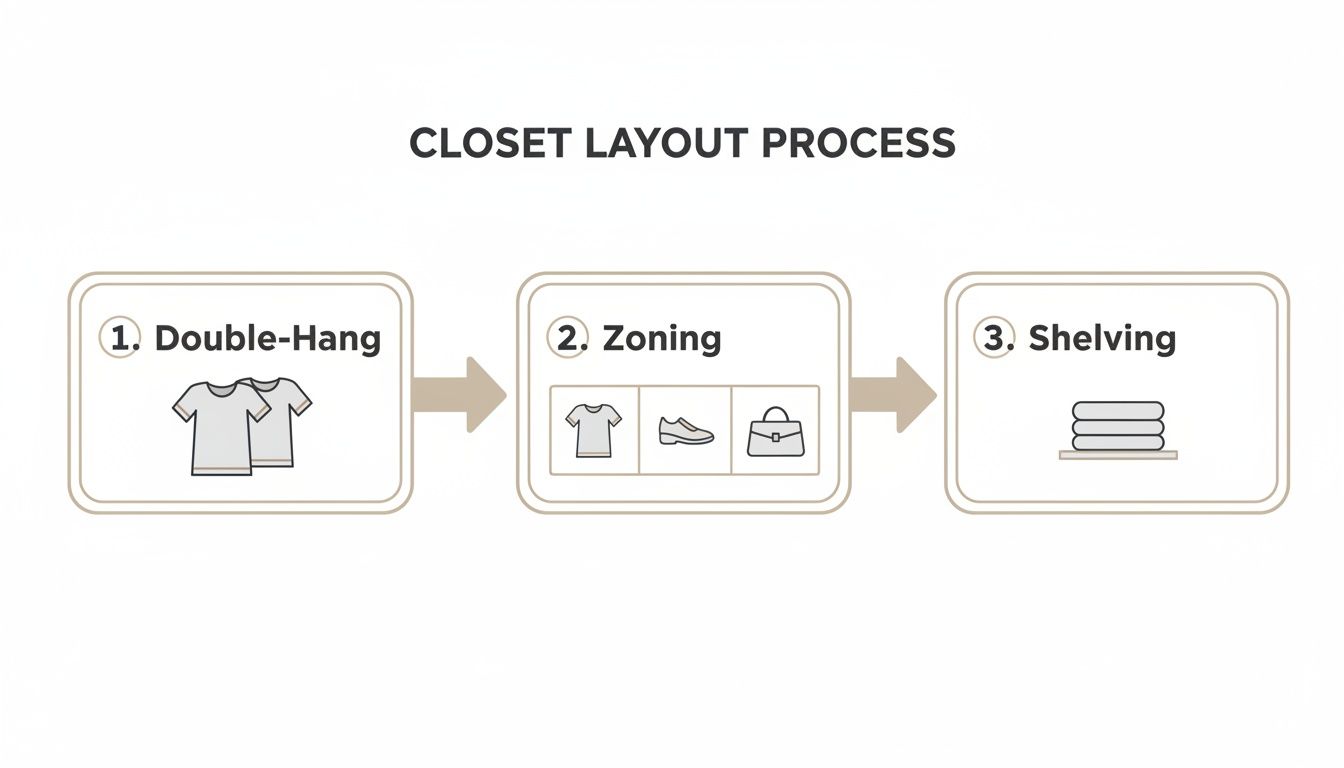
As you can see, a great closet design isn't one magic bullet; it's a sequence of smart organizational choices that build on each other, starting with maximizing hanging space and then organizing it all logically.
Must-Have Organizers for a Clutter-Free Closet
Beyond hangers, a few key pieces can make a massive organizational difference. These are the tools that tackle the most common closet frustrations and keep your space tidy day after day.
- Clear Storage Bins: Your best friend for the high top shelf. Use them for off-season items like chunky knits or scarves. Being able to see what’s inside prevents mystery boxes and makes retrieval easy.
- Shelf Dividers: A game-changer for open shelves. They stop tall piles of sweaters and jeans from collapsing into a messy heap, creating instant, neat columns.
- Over-the-Door Organizers: Don't forget the back of your closet door! This prime real estate is perfect for a slim pocket organizer to hold shoes, belts, or other small items that create clutter.
The rule of thumb for organization is to choose tools that give you both visibility and accessibility. If you can’t see it or get to it easily, you won’t use it. Smart storage keeps your entire wardrobe in play.
It's no surprise the closet organizer market is booming. Did you know traditional hangers can waste up to 40-50% of your closet's hanging space due to their bulky design? This is exactly the problem that specialized, space-saving hangers solve. Let's look at the real-world impact of switching to MORALVE's multi-garment solutions.
Traditional Hangers vs MORALVE Space-Saving Hangers
| Garment Type | Space Used with Standard Hangers (Estimate) | Space Used with MORALVE Hangers (Estimate) | Potential Space Saved |
|---|---|---|---|
| Pants (5 pairs) | 5 - 7 inches | 2 - 3 inches | Up to 60% |
| Skirts (4 skirts) | 4 - 6 inches | 1 - 2 inches | Up to 70% |
| Tank Tops (8 tops) | 6 - 8 inches | 2 - 3 inches | Up to 65% |
| Blouses (5 blouses) | 8 - 10 inches | 3 - 4 inches | Up to 60% |
The numbers speak for themselves. By using vertical space, MORALVE’s cascading pant hangers, skirt hangers, and tank top hangers can instantly double or even triple your closet's capacity. You can learn more about these innovative clothing storage solutions and see how they can transform a cramped, disorganized closet into a functional and peaceful space.
Bringing Your New Closet Design to Life
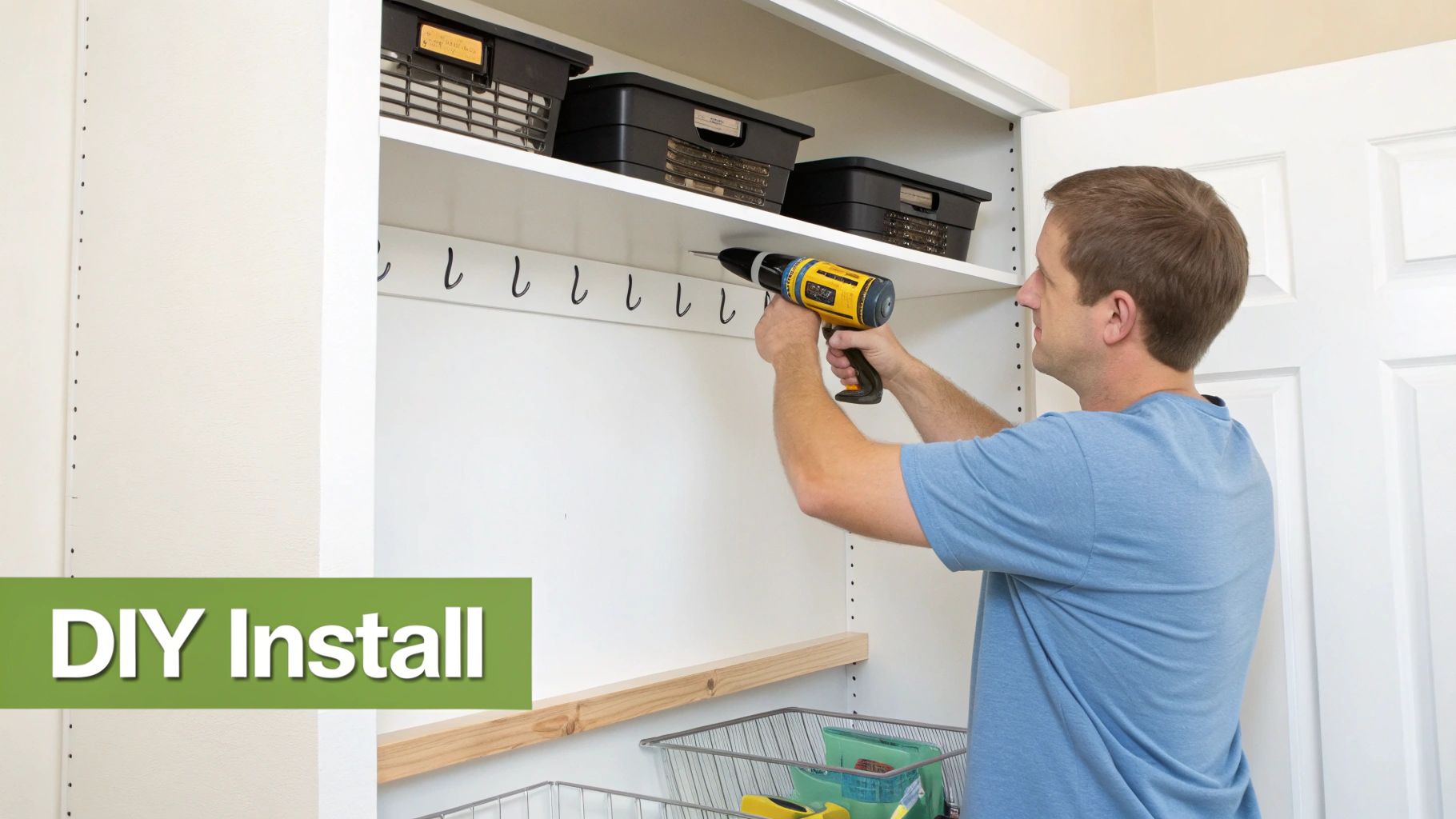
Alright, you've got your blueprint. Now it's time to make it happen. This is where your sketches and plans become a real, functional space. But before you start drilling, get all your tools ready. There's nothing worse than stopping mid-project to hunt for a screwdriver. The success of your new organized closet hinges on a solid installation. Whether you're putting up a single rod or a modular system, anchoring it to wall studs is a must. Drywall alone can't handle the weight of your wardrobe.
Getting the Installation Right
First, find the wall studs—the sturdy wood beams behind the drywall. A stud finder is a small investment that prevents your wall from looking like Swiss cheese. Once you locate a stud, mark it lightly with a pencil.
Your level will be your most important tool. Use it on every single piece you install: shelves, rods, drawer units, everything. Nothing undermines an organized look faster than a crooked shelf, and it's an easy mistake to avoid.
Your organized closet is only as good as its installation. Take the time to measure, level, and anchor everything securely. Rushing this stage leads to wobbly shelves and sagging rods.
With the main structure in place, add any finishing touches. This might be when you're installing sliding wardrobe doors if you want a clean, enclosed look that hides everything away.
The Art of the Organized Move-In
Once construction is done, it's time to move your clothes back in. Don't just toss everything inside! This is your chance to implement the organizational system you so carefully planned.
Start by grouping like items. All shirts go together, all pants in another section. This immediately puts the "zoning" from your layout plan into practice.
From there, add another layer of order. I'm a big fan of arranging clothes by color within each category. It gives the closet a calming, boutique-like feel and makes finding that one specific blue shirt a breeze. Another approach is organizing by frequency of use.
- Prime Real Estate: Items you wear most often should be front and center, at eye level. This includes work clothes, favorite jeans, and go-to sweaters.
- Secondary Zones: Things you wear less often, like formal wear or out-of-season clothes, can be placed on higher shelves or further back.
- Accessories: Give shoes, bags, and belts a dedicated spot. Using racks or cubbies keeps them from ending up in a pile on the floor, maintaining order.
This is the moment all that planning clicks into place. You’re not just filling a closet; you’re creating an organizational system that makes getting ready easier every day.
Maintaining Your Beautifully Organized Closet
You did it. You planned, designed, and built an organized closet that actually works for you. While the heavy lifting is over, the secret to keeping it that way isn't more work—it's about simple, consistent habits. A great closet is a living space, and a little regular attention is all it needs to stay functional and clutter-free. This last part of the journey is about building small routines that stop clutter before it starts, keeping your space as orderly as it is right now.
Building Sustainable Closet Habits
The difference between a closet that stays organized and one that descends back into chaos is a few key habits. The most effective is the classic 'one in, one out' rule. It’s simple: every time you buy a new piece of clothing, an old one must go. This isn't about deprivation; it's about curation. This habit forces you to constantly evaluate what you truly love, preventing your closet from becoming overstuffed.
Another game-changer is the seasonal reset. You don't need a massive cleanout twice a year, but a quick refresh as the weather changes works wonders.
- Swap and Assess: When moving winter coats to the back and bringing sundresses forward, take a moment with each piece. Did you wear that chunky sweater last year? If not, maybe it's time for it to go.
- Identify Gaps: This is also the perfect time to see what you might actually need, like a new lightweight jacket or a solid pair of sandals for summer.
A well-organized closet isn't just about storage; it's about a system that makes daily upkeep feel effortless. Think of it as a small investment of time that pays huge dividends in peace of mind.
This light-touch maintenance is far less intimidating than a massive annual cleanout and ensures your closet organization evolves with your style and your life.
Elevate Your Closet with Finishing Touches
With the core organization in place, you can add small details that make the space feel less like a storage unit and more like a personal boutique.
Start with your hangers. Switching to a uniform set of slim, velvet hangers is one of the fastest ways to create a cohesive, high-end look. They prevent clothes from slipping and create a sense of visual calm—a key component of an organized space.
Next, think about lighting. Most closets are dark, making it impossible to tell navy from black. You don't need an electrician. A few battery-powered, adhesive-backed LED "puck" lights are perfect for placing under shelves or in dark corners. They'll illuminate your wardrobe and make everything easy to find.
Finally, bring in a touch of something special. Tuck a few scented sachets into your drawers or hang one from a rod. A subtle scent like cedar or lavender keeps clothes smelling fresh and adds a bit of luxury to your organized routine.
Answering Your Top Closet Design Questions
Diving into a closet redesign can bring up dozens of questions. Where do I even begin? How do I make this tiny space organized and functional? Don't worry, these are the exact questions everyone has. Let's walk through the most common ones with practical advice focused on organization. Feeling overwhelmed is normal, but nailing the first step is what separates a successful project from a frustrating mess.
What’s the Very First Thing I Should Do?
Before you dream of shelving or buy a single bin, you must do a complete audit. Empty your entire closet. This sounds like a hassle, but it's the most critical part of the organization process. It’s the only way to get accurate measurements of your space and, more importantly, it forces you to assess everything you own. Sort every item into three piles: keep, donate, and store elsewhere (seasonal gear). This inventory isn't just about decluttering; it tells you exactly what kind of storage you actually need before you spend a dime.
How Can I Make My Small Closet Feel Bigger?
When you’re short on square footage, the only way to go is up. Vertical organization is your best friend in a small closet.
- Double Up: Install a double-hang rod. You’ll instantly double your hanging space for shirts, skirts, and folded pants without using more floor space.
- Go Cascading: Use space-saving hangers that let you stack garments vertically. This trick multiplies your storage in the same horizontal footprint.
- Use the Door: A slim, over-the-door organizer is a game-changer for organizing shoes, scarves, or belts.
- Store High: The top shelf is prime real estate for things you don't need daily. Use clearly labeled bins for seasonal items to keep the floor clear and the space feeling open.
The secret to a larger-feeling closet isn't more space—it's smarter organization. Maximize vertical areas and choose organizers that compact your wardrobe efficiently.
Are Custom Closet Systems Really Worth the Money?
This is the big question, and the honest answer is: it depends. A fully custom, professionally installed system is an amazing luxury, especially for an odd-shaped space. They can squeeze function out of every inch. However, you can achieve a "custom" feel for a fraction of the price. The key is creating your own semi-custom solution by cleverly combining affordable modular shelving, drawer units, and the right organizational accessories. A well-designed plan using high-quality space-saving hangers, good shelf dividers, and clear bins can give you 90% of the function for 30% of the cost. In the end, a smart organizational plan will always beat a big budget.
What’s the Most Common Mistake People Make?
Hands down, the biggest mistake is buying organizers before decluttering and measuring. It’s tempting to see a stylish set of bins or a cool gadget and click "buy now." But this backwards approach almost always leads to a closet full of products that either don't physically fit or don't solve your actual storage problems. You end up with wasted money and organizers that just become part of the clutter. Always, always, always plan your organization first, then shop for the specific tools that fit your unique plan.
Ready to conquer clutter and reclaim your space? The journey to an organized closet starts with the right tools. At MORALVE, we create high-quality, space-saving hangers that instantly multiply your storage capacity. Explore our collection and start your transformation today.
Leave a comment