

How to Organize a Closet and Reclaim Your Space

Diving into a closet organization project without a plan is a classic mistake. You pull everything out, get inspired, and then stand frozen in a mountain of clothes, completely overwhelmed.
To truly learn how to organize a closet and create a system that actually lasts, you need a strategy. It’s less about the "chore" and more about thoughtfully designing a space that works for you.
Setting The Stage For An Organized Closet
Before a single item leaves your closet, take a breath. This isn't just about making things look neat; it’s about creating a functional, stress-free part of your daily routine. A few minutes of planning now will save you hours of frustration later and prevent that all-too-common scenario of making an even bigger mess.
Define Your Closet's Purpose
First things first, what do you need this closet to do? This might sound obvious, but different closets serve very different functions. A closet for a busy professional who needs quick access to work attire is worlds away from a family’s shared coat closet or a fashion lover’s accessory hub.
Grab a notepad and jot down what you’re trying to achieve. Are you hoping to:
- Get ready faster in the morning? This means your go-to items need to be front and center.
- See everything you own at a glance? This points toward clear bins and creating specific zones.
- Maximize a tiny space? This tells you to focus on vertical storage and clever space-saving tools.
Getting this clarity is a game-changer. It helps you make purposeful decisions instead of just shuffling things around. You might realize your "shoe-pocalypse" zone could be better used for everyday items, with footwear stored more efficiently elsewhere.
By understanding the 'why' behind your organization project, you're more likely to create a system that you'll actually stick with. It connects the physical act of organizing to a tangible improvement in your daily life.
Assess Your Current Space
With your goals set, it's time to play detective in your own closet. Take a good, hard look at the physical layout. What are you working with? Most people completely ignore the prime real estate above the hanging rod or the awkward dead space in the corners. These are goldmines of untapped potential.
This push for smarter storage isn't just in our heads; it's a global trend. The closet organizers market is expected to balloon from USD 4,033.3 million in 2025 to a staggering USD 8,529.7 million by 2035. With over 56% of the world's population now living in cities where space is at a premium, we're all looking for better ways to manage our stuff. You can dive deeper into these market trends in closet organization on futuremarketinsights.com.
Once you've sized up the space, it's time to gather your supplies. Trust me, having everything you need within arm's reach will keep your momentum going and prevent you from getting sidetracked.
Before you get started on the physical work, use this simple checklist to make sure you're fully prepared. It’s a small step that makes a huge difference in keeping the project smooth and manageable.
Your Closet Organization Prep Checklist
| Category | Item or Action | Why It's Essential |
|---|---|---|
| Planning | Notebook & Pen | To jot down goals, measurements, and a rough sketch of your ideal layout. |
| Sorting | 4 Large Boxes or Bins | Label them Keep, Donate, Relocate, and Discard to make quick, decisive choices. |
| Cleaning | Vacuum, Microfiber Cloths, All-Purpose Cleaner | To give your closet a deep clean and a truly fresh start. |
| Measuring | Measuring Tape | Absolutely crucial for buying storage containers or systems that will actually fit. |
Having these items ready to go transforms the entire process from chaotic to controlled. Now, you’re ready to tackle the fun part.
The Four-Bin Method: Your Secret Weapon for Decluttering
Alright, you’ve carved out the time and you're mentally prepared. Now comes the hard part: facing the actual mountain of clothes. This is the exact moment where motivation can die a swift death, but I've got a strategy that cuts right through the chaos. It’s called the four-bin method, and it's the most effective way I've found to make decluttering a logical, less emotional process.
The idea is simple. You create a system that forces you to make a decision for every single item you touch. No more "I'll deal with this later" piles. You're creating a workflow that keeps you moving forward, one piece of clothing at a time.
Set Up Your Sorting Stations
First things first, grab four containers. These can be anything—cardboard boxes, laundry baskets, even just designated spots on the floor with a sticky note. The physical act of setting up these stations primes your brain for the task ahead.
Here’s the breakdown for each bin:
- Keep: This is the easy one. These are the clothes you love, wear all the time, and that make you feel great. No second-guessing here.
- Donate/Sell: For all the good-quality stuff that just isn't you anymore. Maybe it's a style you've outgrown or a color that doesn't do you any favors.
- Relocate: This bin is for everything that has mysteriously migrated into your closet but doesn't belong there. That book you finished last week? The coffee mug from this morning? Your kid's stray Lego? In the bin it goes.
- Discard: This is for the clothes that have lived a full life. Be ruthless. If it's stained, ripped, or hopelessly stretched out, it's time to say goodbye.
With these four stations ready to go, you've turned a potentially overwhelming mess into a straightforward sorting project.
The real magic of the four-bin method isn't just about sorting; it's about eliminating mental clutter. By giving every item a clear destination, you remove the guesswork and keep your momentum high.
How to Tackle Your Closet Without Losing Your Mind
Here's a pro tip: do not, under any circumstances, pull everything out of your closet at once. You'll create a clothing avalanche and instantly regret it. Instead, work in small, manageable chunks.
Start with one small section, like just your t-shirts or a single drawer of jeans. Pick up each item, one by one, and ask yourself a few honest questions. Your gut reaction is usually the right one.
- Have I worn this in the last year? If the answer is no, it’s a strong contender for the donate pile.
- Does this fit me right now? Not "someday." Not "after I lose 10 pounds." Your closet should serve the person you are today.
- Do I feel good when I wear this? Some clothes just don't feel right. If an item makes you feel uncomfortable or less than confident, it's just taking up space.
- Is it in good condition? Check for stubborn stains, pilling, or fabric that's seen better days.
This is how you thoughtfully edit your wardrobe. What about sentimental items you never wear, like that old band t-shirt? A great trick is to take a photo of it for the memories, then let the physical item go. Your goal is a closet filled with clothes you actually use. If you want to dig deeper into this, our guide on how to declutter your closet has even more specific strategies.
Believe it or not, this process pays you back in time and peace of mind. Studies show the average person spends 17 minutes a day deciding what to wear. That's over seven hours a month! A clean closet can slash that time, reduce stress by up to 35%, and it taps into the growing trend of people—like the 62% of millennials who declutter annually—organizing their space to improve their well-being.
Dealing with the Aftermath
Once the sorting is done, you need to act fast. Don't let your carefully sorted bins become new piles of clutter.
- Put the Keep pile back into your closet. We’ll get to how to organize it in the next section.
- Bag up the Donate/Sell items and stick them in the trunk of your car right away. Drop them off next time you're out.
- Take the Relocate bin on a tour of your house, putting everything back where it actually belongs.
- Haul the Discard bin to the trash or recycling. If you've unearthed a ton of stuff that can't be donated or tossed in the regular bin, finding a great junk removal company can be a lifesaver.
Finishing this last step is crucial. It gives you that clean slate you've been working toward, leaving you with only the items you truly value and a perfect foundation for a truly organized closet.
Choosing Smart Storage to Maximize Your Space
Alright, you’ve sorted through your wardrobe and now you’re left with only the good stuff. The next phase is where the real transformation happens: choosing smart storage. This isn't just about finding a place for everything; it's about making every single inch of your closet work for you. The right tools can double, or even triple, your closet's capacity and make getting dressed feel effortless.
So many people just grab a few plastic bins and call it a day, but that’s a rookie mistake. Real organization means matching the right solution to the right problem. That toppling pile of sweaters? The tangled mess of belts? The mountain of shoes on the floor? Each of those issues has a specific, simple fix.
Revolutionize Your Rod Space with Smart Hangers
If you only make one change, make it this: upgrade your hangers. That random collection of bulky plastic and wire hangers is eating up valuable real estate on your closet rod and creating a ton of visual clutter. Switching to a uniform set of slim, space-saving hangers is an instant game-changer. I've seen it free up 20-30% more rod space overnight.
But to really take it to the next level, you need specialty hangers. These are the tools that pack the biggest punch:
- Cascading Hangers: These are absolute magic for vertical space. You can hang several shirts, blouses, or skirts in a single chain, effectively turning one hanger's footprint into five. It’s a total game-changer for small closets.
- Multi-Pant Hangers: Instead of five separate hangers for five pairs of pants, one of these can hold them all. Whether it's a tiered bar or vertical clips, it compresses your collection and lets you see all your options in one glance.
This is the point where you have to be ruthless about what deserves to go back in the closet. This little decision tree can help you make the call without overthinking it.
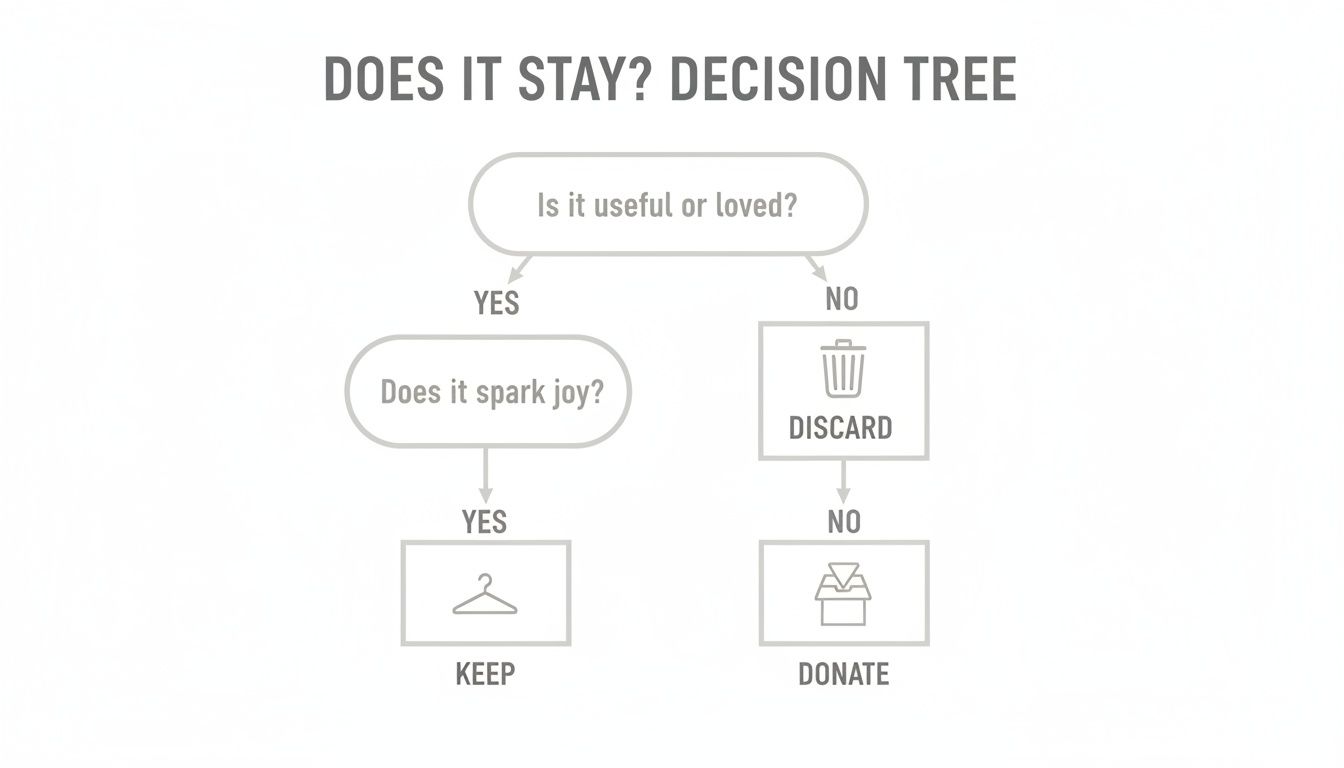
Use this to make quick, confident choices. If it’s not a definite "Keep," it doesn't earn a spot on one of your new, high-efficiency hangers.
Conquer Shelves and Drawers
Beyond the hanging rod, shelves and drawers are the next biggest clutter culprits. We’ve all been there—you pull one sweater from the bottom of a neat stack and the whole thing collapses into chaos. Drawers are even worse, becoming a black hole for socks and accessories.
This is where dividers are your best friend. For shelves, get some simple slide-on dividers. They create neat, separate cubbies for folded sweaters, jeans, or even handbags, preventing those frustrating avalanches.
For drawers, inserts are non-negotiable.
- Honeycomb dividers are fantastic for corralling socks, underwear, and ties into their own little cells.
- Adjustable rectangular inserts can be customized to create perfect-sized slots for belts, scarves, and other odds and ends.
You'll stop rummaging and start seeing everything you own at a glance.
See-Through Storage for Easy Access
For anything you don’t use daily—think seasonal clothes, formal wear, or extra linens—clear storage is the only way to go. Opaque bins are where your favorite items go to be forgotten. If you can't see it, you probably won't use it.
Using clear containers removes the guesswork from storage. It transforms your top shelf from a 'Bermuda Triangle' of forgotten items into a visible, accessible library of your less-frequently-used wardrobe.
I highly recommend clear, stackable boxes for shoes. They keep the dust off while letting you spot the exact pair you need instantly. For bigger things like winter parkas or guest bedding, grab some clear zippered bags. And even if they're see-through, label everything. A quick tag that says "Winter Sweaters" will save you from pulling down the wrong box.
Make Every Inch Count
To truly master your closet, you need to hunt for every pocket of wasted space. The most overlooked spots often have the most potential.
Over-the-Door Organizers: Never, ever forget the back of your closet door! This is prime real estate. A hanging pocket organizer can hold a surprising number of shoes or accessories without taking up a single inch of shelf or floor space.
Under-Shelf Baskets: These are one of my favorite little hacks. They just slide onto your existing shelves to create a new layer of storage underneath. They’re perfect for small things like clutches, flat sandals, or scarves. You’ve just doubled a shelf's capacity.
If you're looking for more specific product ideas, diving into a guide on the best clothing storage solutions can give you even more targeted options. And honestly, the core principles apply everywhere. You can even find great tips in articles about maximizing efficiency in small spaces, because a well-organized closet uses the same smart thinking as a well-designed kitchen.
By investing in a few of these solutions, you're doing more than just tidying up—you're building a functional system that makes your daily routine smoother and respects the clothes you love.
Creating Closet Zones for an Effortless Routine
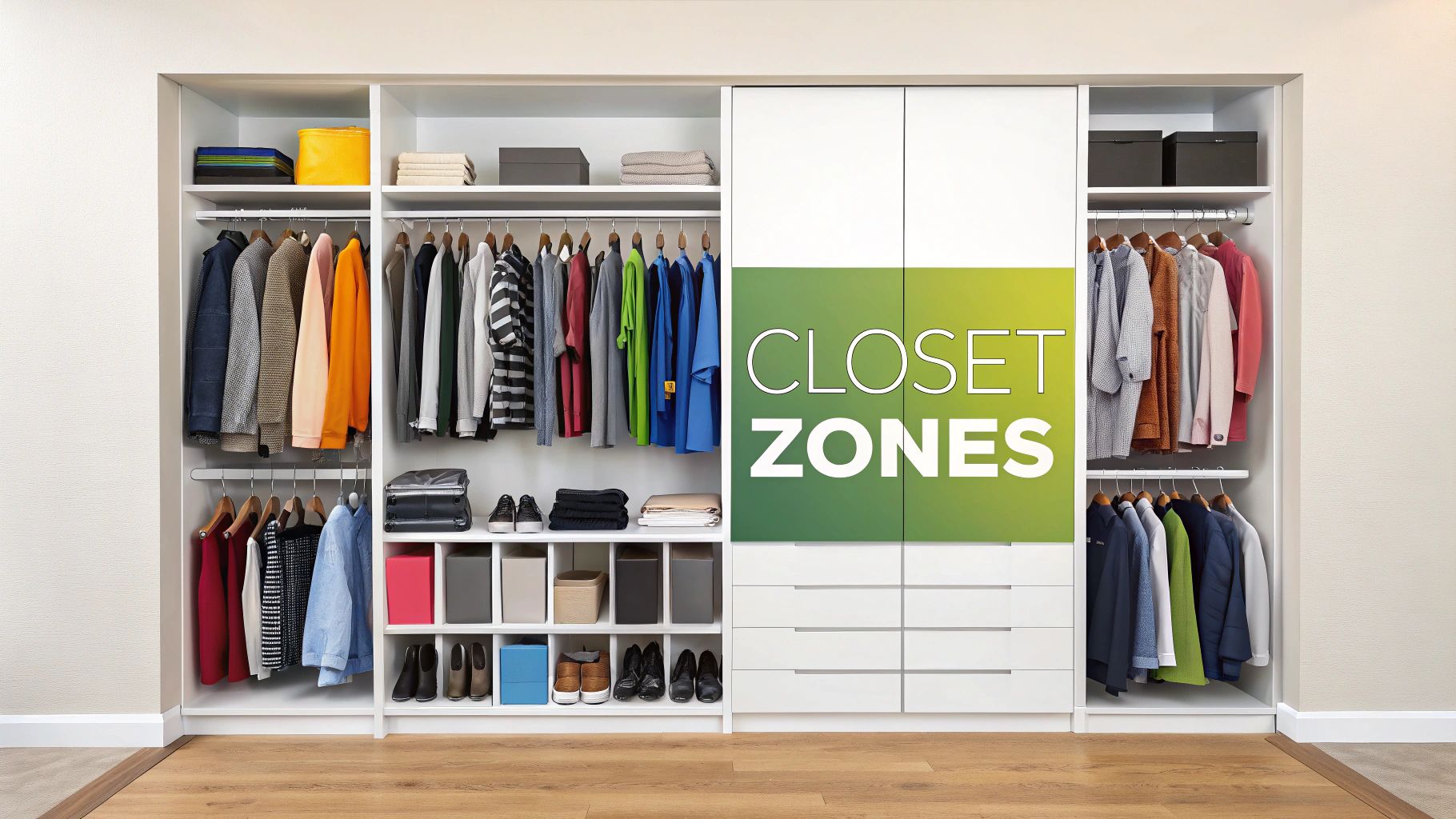
Now that you've sorted through your wardrobe, it's time to put things back—but with a new game plan. A truly organized closet isn't just neat; it's intuitive. The goal here is to stop thinking of your closet as a storage container and start treating it like your own personal boutique, where everything has a logical home.
This is where closet zoning completely changes the game. It's a simple idea: instead of just grouping all your shirts together, you create dedicated zones based on how you actually live. This small shift makes getting ready faster and turns your closet into a tool that works for you, not against you.
Identify Your Personal Wardrobe Zones
Take a minute to think about your real-life weekly schedule. What different hats do you wear, and what clothes do they require? Most of us can break our lives down into a handful of core categories.
Your personal zones might look something like this:
- Work Attire: Everything you reach for during your 9-to-5, from blouses and slacks to blazers.
- Casual & Weekend Wear: This is your go-to stuff—jeans, comfy tees, and sweaters for errands or relaxing.
- Workout Gear: All your athletic wear in one spot, from leggings and sports bras to tops and shorts.
- Special Occasions: That cocktail dress, suit, or formal gown you don't wear often but need to find easily.
By creating these distinct sections, you eliminate that frantic morning search for the right top. Need to hit the gym? You'll head straight to your workout zone instead of digging through a pile of work clothes.
Claim Your Closet’s Prime Real Estate
Let's be honest, not all closet space is created equal. The area that’s easiest to see and reach—generally the space between your shoulders and your knees—is what I call prime real estate. This valuable spot should be reserved for the items you wear the most.
If you’re in casual clothes five days a week and dress up just twice, your casual zone belongs front and center. It makes no sense to give your most accessible space to outfits you only pull out a few times a year.
The items you use 80% of the time should be in the 20% of your closet that is easiest to access. This single principle can dramatically streamline your morning routine and make your closet feel infinitely more functional.
Less-used items, like out-of-season clothes or that formal wear, can be stored on higher shelves or at the far ends of the closet rod. This simple bit of strategy keeps your daily essentials right where you need them.
Arrange Everything for Visual Clarity
With your zones mapped out, you can fine-tune them for an even smoother experience. There are a few tried-and-true methods for arranging items within each zone, and combining them is where the magic really happens.
Here’s a trick I learned from professional organizers: hang things in the order you put them on your body. For a closet with a double hanging rod, that means:
- Top Rod: Blouses, shirts, jackets, and sweaters.
- Bottom Rod: Pants, skirts, and shorts.
It’s a subtle thing, but this setup makes building an outfit feel incredibly natural. You can scan your tops, then glance down to easily find a matching bottom. It’s a small detail with a huge impact.
Use Color Coding for the Finishing Touch
The final layer of organization is color. Arranging clothes within each category by color—whether from light to dark or following the ROYGBIV spectrum—is more than just pretty. It’s practical. It helps your brain quickly find exactly what you’re looking for.
Think about it: you need a black t-shirt. Instead of rifling through every shirt in your casual zone, your eyes go directly to the black section. This method is a lifesaver for hanging clothes. You can start with white, move to creams, then pinks, reds, oranges, and so on, ending with gray and black.
What about patterned items? A simple trick is to squint at the garment from a distance. Whatever color stands out the most determines its color family. If you have a lot of patterns, like stripes or florals, you can even give them their own little sub-section at the end of a color block.
By combining zoning, smart placement, and color coding, you move beyond just being tidy. You create a logical, personal system that makes your daily routine feel effortless.
Building Habits to Keep Your Closet Organized
You did it. You tackled the big project—sorting, decluttering, and arranging everything just so. Your closet finally looks like one of those magazine photos, but here’s the real secret: keeping it that way is less about that one big overhaul and more about the small things you do every day.
The real challenge isn’t what your closet looks like right now; it’s what it will look like in three months. The key to long-term organization is building a few simple habits that stop the chaos from slowly creeping back in. This is where you create a sustainable system that just becomes part of your routine, turning maintenance from a chore into a quick, automatic task.
Adopt the One-In, One-Out Rule
I've seen it a thousand times: the number one reason a perfectly organized closet goes rogue is simple accumulation. A new shirt here, a pair of jeans on sale there—it adds up faster than you think. The one-in, one-out rule is your best defense against this kind of clutter creep.
It’s a beautifully simple idea: for every new item you bring home, a similar item has to go. Found a new pair of sneakers you love? Great! That means an old, worn-out pair gets donated or tossed. This isn’t about depriving yourself; it’s about being mindful. It forces you to look at what you already own and decide if that new purchase really deserves a spot.
This habit is a cornerstone of an organized life. If you find this concept clicks with you, you might be interested in exploring a minimalist lifestyle further. You can see how other small habits create massive change by reading about minimalist lifestyle tips in our guide.
Implement the 10-Minute Weekly Reset
A full reorganization is a huge undertaking, but a quick weekly touch-up? That’s easy. Just set aside 10 minutes once a week—Sunday evening is a great time—to give your closet a quick reset. This isn't about another decluttering session; it's just about tidying up.
Here’s what your 10-minute reset could look like:
- Finally put away that pile of clothes that’s been living on “the chair.”
- Straighten out your shoes on the rack.
- Quickly refold any sweaters or jeans that have gotten messy on the shelves.
- Slide all your empty hangers to one end of the rod. This is a game-changer on laundry day—you can grab what you need in one go instead of hunting for them.
This tiny investment of time is what prevents little messes from snowballing into an overwhelming project. It keeps the order you worked so hard to create.
A weekly reset is like making your bed every morning. It's a small, consistent action that sets the tone for an organized space and prevents the slow slide back into disarray.
Master the Seasonal Refresh
At least twice a year, as the weather turns, it’s time for a seasonal refresh. Think of it as a mini-version of your initial big cleanout—a chance to rotate your wardrobe and make sure your system is still working for you.
Here’s how to tackle it:
- Store off-season clothes: Pack away the bulky winter coats or light summer dresses you won't be touching for months. I recommend clear, labeled bins so you know exactly what’s inside without having to dig.
- Bring current clothes forward: Move everything you'll be wearing for the upcoming season to the front and center of your closet. This makes getting dressed so much faster.
- Do a quick edit: As you handle each piece from the previous season, be honest with yourself. Did you actually wear it? If an item went untouched all last winter, that’s a pretty good sign it’s time to let it go.
This simple process keeps your closet relevant and functional, preventing it from turning into an archive of unworn clothes. By embracing these habits, you’re not just organizing your closet once; you’re setting yourself up for a lifetime of order.
Common Questions About Closet Organization
Even the best-laid plans can hit a snag. When you're deep in a closet organization project, a few common questions always seem to surface. Getting the answers right can be the difference between a closet that stays tidy and one that’s a mess again in a month. Let's tackle some of the most frequent challenges I hear about.
How Often Should I Declutter My Closet?
The big, deep-dive closet cleanout? I recommend doing that at least twice a year. The shift from warm to cold weather (and back again) is the perfect natural reminder. It's your chance to take a hard look at what you actually wore over the last six months and what just collected dust.
But don't wait for a full seasonal overhaul to keep things in check. A quick 15-minute "mini-declutter" once a month works wonders. Just scan your closet for anything that’s damaged, doesn't fit anymore, or has been shoved in the wrong spot. It's a small habit that prevents chaos from creeping back in.
What Is the Best Way to Store Shoes to Save Space?
Shoe storage is a classic closet puzzle. Honestly, there isn't one "best" way—the right solution is whatever works for your specific closet layout and collection.
To figure out what's best for you, think about the space you have:
- Got Vertical Space? An over-the-door organizer with clear pockets is a game-changer. It keeps shoes off the floor and uses up what is otherwise completely wasted space.
- Working with Shelves? I love clear, stackable shoe boxes. They protect your shoes from dust, but you can still see everything you own at a glance. No more forgetting about that pair you tucked away in the back!
- Mainly Floor Space? A good multi-level shoe rack is your best bet for keeping pairs visible and accessible. And a quick tip for taller boots: use boot shapers to keep them standing upright. It prevents those annoying creases and saves space.
The most effective shoe strategy is simply one that gets your footwear off the floor and gives it a designated, visible home. Whether it's on a door, a shelf, or a rack, the goal is to make every pair easy to find and just as easy to put away.
Should I Use the Same Type of Hangers in My Closet?
One hundred percent, yes. If you only make one change, make it this one. Switching to a uniform set of hangers is the fastest way to make your closet look and feel instantly more organized and serene. It sends a visual signal that everything is in its place.
It's not just about looks, though. Slim hangers—especially quality velvet or wooden ones—are designed to save a surprising amount of space. Clothes hang neatly without slipping or bunching up, which means you can often fit 20-30% more items on the rod. It’s a simple upgrade that makes a huge difference.
Ready to reclaim your closet and create a system that actually sticks? The right tools are half the battle. Check out the collection at MORALVE and see how our space-saving hangers can help you make the most of every single inch. Start organizing today at MORALVE.
Leave a comment