

The Best Ways to Organize Your Closet from Chaos to Calm

The secret to a closet that actually stays organized? It’s all about having a solid, four-part plan: ruthlessly declutter, categorize everything, map out your layout, and then optimize the space with the right tools. This isn't just about a quick tidy-up; it's about creating a system that works for you, day in and day out, making the simple act of getting dressed easier.
Your Blueprint for a Perfectly Organized Closet
Let's face it—a messy closet is a real source of daily frustration. Digging through a mountain of clothes for that one specific shirt or wrestling with a tangled mess of hangers is a maddening way to start the day. So many of us try a weekend purge, only to watch the clutter creep back within a few weeks. That’s because a lasting fix requires a real plan, not just a cleanup.
A truly organized closet needs a good foundation. You have to think like an architect and create a blueprint before you start building. This strategic mindset ensures every choice you make contributes to a functional, stress-free space.

The Four Pillars of Closet Organization
The craving for better organization is more than just a passing trend. The market for closet organizers is booming—it was valued at $8.5 billion and is expected to climb to $15.2 billion by 2033. This isn't just a number; it shows a real shift as families and apartment dwellers look for smarter ways to manage their space.
In fact, one survey revealed that 67% of people trying to get organized said their biggest frustration was simply 'limited closet space.' Good organization can literally double the amount of your wardrobe you can actually use.
To get there, you need a plan. I've always found that breaking it down into four core phases makes the whole process feel manageable.
Here's a quick look at that framework:
| Phase | Primary Goal | Key Action |
|---|---|---|
| Declutter | Create a curated collection | Edit your wardrobe down to only what you love and wear. |
| Categorize | Establish logical order | Group similar items together (e.g., all jeans, all sweaters). |
| Plan | Design an efficient layout | Measure your space and sketch out where everything will go. |
| Optimize | Maximize every inch | Choose smart tools like slim hangers and shelf dividers. |
This isn't about perfection; it's about building a system that makes sense for your life and your stuff.
You can dive deeper into how to approach your closet system design in our detailed guide, but these four pillars are the bedrock of any successful project.
Getting in the Right Mindset
To really move from chaos to calm, you need a small mental shift. Stop thinking of your closet as just a box to shove things into. Instead, start seeing it as your own personal, curated boutique. This perspective makes it so much easier to make those tough decluttering decisions and inspires you to keep things looking great.
The real goal isn't just a tidy closet. It's about getting back your time and cutting down on decision fatigue. When everything has a designated home, your morning routine becomes practically effortless.
This guide will walk you through each step of this blueprint, and we're starting with the most important one next: the big closet cleanout. By following this plan, you’re not just organizing for a week—you're building a system for a simpler life.
The Unskippable First Step: The Great Closet Cleanout
Before you even think about buying those sleek new hangers or stylish bins, we have to tackle the hardest part first: the purge. Every truly organized closet is built on the foundation of a ruthless decluttering session. This isn’t just about tidying; it’s about being honest with yourself and what you actually wear.
First things first, you need to see what you're working with. And I mean everything. Pull every single item out of your closet—every sock, every forgotten t-shirt, every belt you haven't seen in years. Pile it all onto your bed.
Yes, it will probably look like a clothing catastrophe, but seeing the sheer volume of stuff you own is often the reality check we all need to get serious about making a change.
The Four-Pile Triage
With your mountain of clothes staring back at you, it’s time to sort. Grab four boxes, bins, or just mark out four distinct zones on your floor. Label them: Keep, Donate, Store, and Toss. This simple system takes the guesswork out and forces you to make a decision on every single piece.
- Keep: These are your all-stars. The clothes you love, wear often, and feel fantastic in. They fit you right now and suit your current life.
- Donate: Perfectly good stuff, just not for you anymore. Someone else will be thrilled to find it.
- Store: Think seasonal gear, like your heavy winter parkas or breezy summer dresses. This is also the spot for sentimental pieces you just can't part with but don't need taking up prime real estate.
- Toss: Anything that’s stained, ripped, or just too worn out to be passed on. Be honest and let these items go for good.
Once you’ve committed to this process, you can focus on a core goal: to truly save space at home and turn that cluttered closet into a functional haven.
Asking the Hard Questions
Stuck deciding what goes where? It's easy to get bogged down by "what-ifs" and sentimental attachments. To cut through the noise, ask yourself these direct questions for every single item you pick up:
- Does this fit me right now? Not the person you were last year or hope to be next year. If it doesn't fit today, it doesn't belong.
- Does this suit my actual life? If you work from home now, that closet full of corporate power suits might not be serving you anymore.
- Have I worn this in the last 12 months? Barring special occasion wear, if it hasn't seen the light of day in a year, it's a strong contender for the donate pile.
- If I saw this in a store today, would I buy it? This is a killer question for cutting through emotional clutter and getting to the truth.
- Do I feel good when I wear this? Your clothes should empower you, not make you feel "less than." Ditch anything that brings you down.
You're curating a wardrobe that works for the person you are today. It’s an incredibly powerful way to reclaim your space and your sanity.
It's okay to get a little emotional when letting go of certain clothes. Just remember, you’re not tossing the memories, you’re just making room for new ones. Thank the item for its service and move on.
The data backs this up. A common best practice is to purge first, especially when you consider that a staggering 80% of our clothes go unworn each year. Once you've culled the excess, you can organize what's left with smart tools like multi-use hangers. This one-two punch leads to 90% satisfaction rates, turning closet chaos into a source of calm.
By the time you're done, that mountain on your bed will be gone. All that's left will be a curated collection in your "Keep" pile—clothes you genuinely love and will actually wear. Now you’re ready to build the organized closet of your dreams.
Designing a Smarter Closet with Strategic Zoning
Alright, with your "keep" pile ready to go, we get to the fun part: playing closet designer. This is where you move beyond just cleaning up and start building a genuinely functional, intuitive system from the ground up. The secret sauce that professional organizers swear by is a simple concept called closet zoning.
Think of your closet like your favorite grocery store. The milk and bread are right where you expect them, easy to grab. The specialty stuff? That's a few aisles over. Your closet should operate on the same principle. Zoning is just a fancy way of saying you’re giving every single category of clothing and accessory its own dedicated home.
This whole sorting process is laid out perfectly in the chart below, which shows how to think about your categories after the big cleanout.
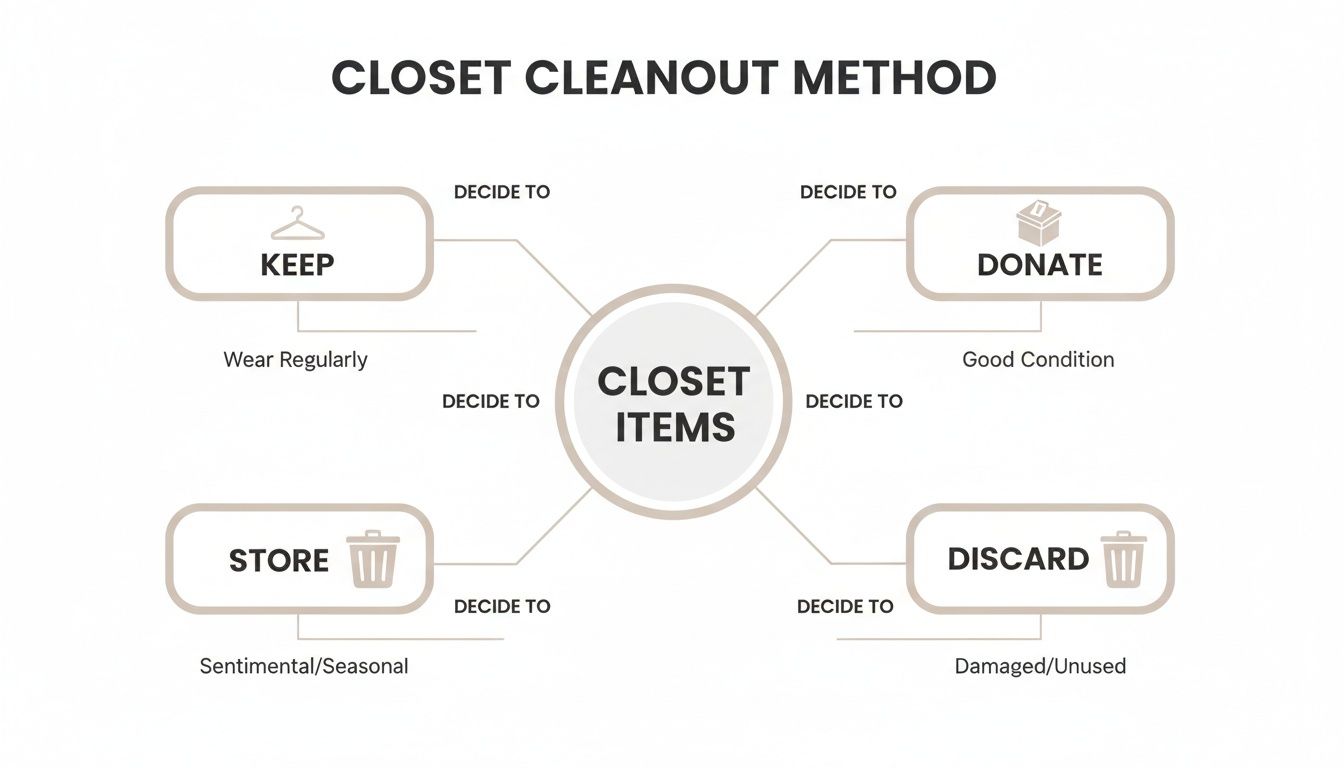
As you can see, everything you purged should have landed in one of four piles. Now, we focus on that "keep" pile to build our zones.
Map Out Your Prime Real Estate
Before a single hanger goes back in, stand back and really look at your empty closet. Pinpoint the most accessible spots—this is what I call your prime real estate. Usually, it’s the space at eye level, right in the front and center of your main clothing rod.
This prime zone is reserved exclusively for the things you wear all the time. For most of us, that means work blouses, go-to jeans, and a few favorite sweaters. Putting these items in the easiest-to-reach spot means no more frantic morning searches. It just works.
The less accessible areas, of course, are for the less-used items.
- High Shelves: Perfect for off-season storage, like stashing bulky winter coats in July or holding onto sentimental pieces you don't need to touch often.
- Back Corners: This is the ideal hideout for formal wear, like that cocktail dress you pull out once a year.
- Floor Space: Best used for shoes, handbags, or storage bins filled with accessories.
By treating your closet like a map, you create a natural flow that makes finding anything feel almost automatic. If you want to dive deeper into layouts and get some great visual inspiration, check out these walk-in closet layout ideas.
Creating Your Dedicated Zones
Now it's time to group your clothes into logical categories. The goal is simple: keep like with like. This is the bedrock of any good organization system, and it’s what stops you from digging through a pile of dresses just to find one t-shirt.
Start with broad categories, and then get more granular if you have the space.
- By Item Type: This is the classic, most effective method. Group all your shirts together, all your pants, all your dresses, and so on.
- By Occasion: This works wonders if your life demands different dress codes. Create distinct zones for workwear, casual weekend clothes, gym gear, and formal attire.
- By Color: Once your items are categorized, arrange them by color from light to dark. Not only does it look incredible, but it makes grabbing that specific black t-shirt a ten-second job.
Here’s a little trick I love: think about how you actually wear your clothes. Try hanging tops on the top rod and pants or skirts on the bottom rod, mirroring how they sit on your body. It's a small psychological shift that makes getting dressed feel surprisingly more intuitive.
Maximizing Every Vertical Inch
One of the biggest mistakes people make is ignoring all that vertical space. The area above your top shelf and the open space below your hanging clothes is often completely wasted potential. Getting creative here can practically double your storage capacity.
Think about adding stackable clear bins on that top shelf for things like scarves, hats, or clutches. Down on the floor, a small set of drawers can become the perfect home for folded items like bulky sweatshirts that have no business being on a hanger anyway. To see how great design and smart functionality come together, reviewing some practical bedroom design use cases can offer fantastic ideas for optimizing spaces, including closets.
This approach ensures every square inch has a purpose, transforming your closet from a cluttered mess into a perfectly mapped-out wardrobe.
Choosing the Right Tools and Storage Solutions
Alright, you’ve got a clean slate and a solid plan. Now for the fun part: picking the hardware that will bring your vision to life. The right tools are the secret weapon behind a closet that actually works, turning those crammed corners and overstuffed rods into a streamlined, functional space. This is where a few smart investments can solve years of frustration and unlock every last inch of potential.
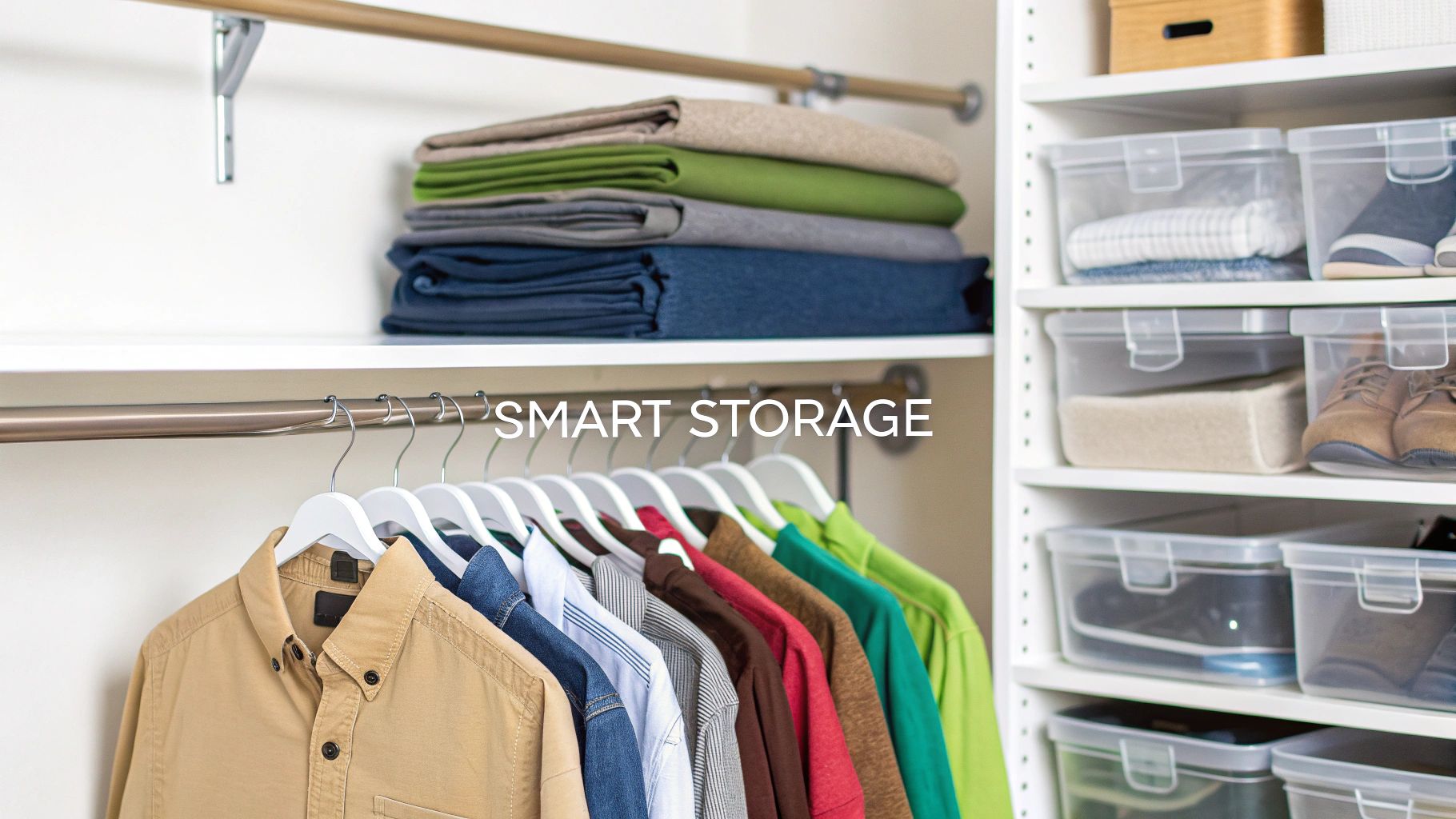
If you only make one change, let it be your hangers. I can't stress this enough. A chaotic mix of plastic and wire hangers doesn't just look messy; it physically eats up your hanging space. Making the switch to a uniform set of slim, velvet hangers is an instant game-changer. Not only does it create a clean, boutique-like feel, but you can also boost your hanging capacity by up to 30%. Seriously.
Beyond the Basic Hanger
Getting a matching set of slim hangers is a fantastic first step, but the real magic begins with specialized hangers. These are the tools designed to compress your wardrobe vertically, freeing up horizontal rod space you never knew you had. You don’t need a major renovation to totally transform your closet's capacity.
Think about adding a few of these game-changers to your arsenal:
- Multi-Pant Hangers: These are true workhorses. They let you hang up to five pairs of pants in the same vertical space a single hanger would occupy. They're perfect for keeping work slacks or your favorite jeans crease-free and easy to grab.
- Tiered Skirt Hangers: Similar to the pant hangers, these feature multiple clips on one vertical frame. I use them for everything from skirts and shorts to strapless tops that always seem to slide off regular hangers.
- Tank Top and Camisole Organizers: A simple cascading hanger can neatly store eight or more camisoles, clearing dozens of individual hangers off your main rod in one go.
The impact of these simple tools is huge. In fact, using space-saving hangers can cut down on closet clutter by as much as 60%. It’s a solution for a common problem: an estimated 70% of wardrobes in average US homes are underutilized simply because of poor hanging methods. For families, durable, tiered hangers mean you can accommodate kids' growth spurts and add up to 50% more capacity annually. To get a deeper dive into these numbers, you can explore the closet organizers market at reanin.com.
Smart Storage for Shelves and Floors
Hanging space is only half the battle. Your shelves and floor are prime real estate, but they often become a dumping ground for bulky sweaters and accessories. The key here is to contain and categorize things so you can finally put an end to messy, toppling piles.
Shelf dividers are one of my favorite, deceptively simple tools. They just slide onto your existing shelves to create stable, tidy stacks of sweaters or jeans, preventing that dreaded Jenga-like collapse. For smaller things like scarves, clutches, or belts, clear bins are the way to go.
By using clear bins, you get the benefit of dust-free storage without losing visibility. You can see exactly what you have at a glance, eliminating the need to rummage through multiple boxes to find what you need.
And for your shoe collection, you have to think vertically. A stackable shoe rack on the floor keeps pairs off the ground and neatly organized. If you’re tight on space, an over-the-door shoe organizer is a fantastic trick. It uses that otherwise dead space on the back of your door for shoes, rolled-up t-shirts, or other small accessories. This kind of multi-purpose thinking is at the heart of finding the best clothing storage solutions for any home.
Building Your Essential Toolkit
Feeling a bit overwhelmed by all the options? Don't be. You really don't need every gadget out there to get organized. A few well-chosen items will make all the difference.
To get you started, here is a practical checklist of must-have items that will form the backbone of your new system.
Essential Closet Organizer Checklist
| Organizer Type | Best For | Space-Saving Benefit |
|---|---|---|
| Slim Velvet Hangers | Blouses, shirts, dresses | Prevents slipping and doubles hanging space compared to plastic hangers. |
| Multi-Pant Hangers | Trousers, jeans, slacks | Compresses 5 items into the vertical space of one. |
| Shelf Dividers | Sweaters, jeans, towels | Creates neat, tidy stacks and prevents items from toppling over. |
| Clear Storage Bins | Accessories, scarves, hats | Provides dust-free, visible storage for smaller items on high shelves. |
| Stackable Shoe Racks | All types of footwear | Utilizes vertical floor space to neatly organize shoes. |
These core tools provide the foundation for a closet that’s not just organized for a day, but is easy to maintain for the long haul. When you choose the right solutions for your specific wardrobe and space, you’re doing more than just tidying up—you’re building a lasting system that makes your daily routine simpler and calmer.
Keeping Your Closet Organized for Good
You did it. You wrestled the chaos into submission and created a closet that actually works. But let's be honest—the real challenge isn't the big overhaul; it's keeping it that way. The secret to a permanently organized closet isn't a one-and-done project. It's about building a few simple, almost effortless habits that prevent clutter from ever gaining a foothold again.
The great news? This doesn't mean another weekend-long cleaning marathon. A few minutes here and there is all it takes to protect your hard work and enjoy that feeling of calm every time you open your closet doors.
The "One In, One Out" Golden Rule
If you only adopt one new habit, make it this one. The idea is wonderfully simple: for every new item you bring home, a similar item has to go. Scored a great new pair of jeans? Fantastic. Now, pick a pair you don't wear much anymore and add it to the donation bag.
This single rule transforms you from a passive consumer into the active curator of your wardrobe. It forces you to pause before you buy, asking yourself if the new item is truly worth giving something else up. Before you know it, you’ve stopped the slow, steady creep of clutter that caused the original problem.
This isn't just about decluttering; it's about respecting the physical limits of your space. The "one in, one out" rule guarantees your closet never gets overstuffed, which is the root cause of so much frustration.
The 10-Minute Weekly Tidy-Up
Closet chaos doesn't just appear overnight. It builds up from one shirt left on a chair, a pair of shoes kicked into the corner, and a small pile of "I'll deal with it later." The antidote is a quick, weekly reset. I find Sunday evening works perfectly—it sets a calm, organized tone for the week ahead.
This isn’t a deep clean. You're just spending 10 minutes putting things right before they have a chance to multiply.
- Round up the strays. Grab any clothes draped over furniture and put them away.
- Straighten the shoes. Quickly line them up on their rack or tuck them back into their spots.
- Neaten the stacks. A quick refold of sweaters or T-shirts on the shelves makes a world of difference.
- Group empty hangers. Slide all your empty hangers to one end of the rod. It looks cleaner and makes putting laundry away so much faster.
Think of this as your weekly maintenance check. It's a tiny investment of time that pays off big by keeping disorder at bay.
Master the Seasonal Swap
For most of us, a huge chunk of our closet is occupied by clothes we can't even wear right now. Performing a seasonal swap is one of the most impactful things you can do to reclaim valuable, everyday space. Set aside an hour or two, twice a year, to rotate your wardrobe as the weather changes.
When you're packing away your off-season clothes, the goal is to protect them and get them completely out of your prime closet real estate.
- Wash Everything First. This is non-negotiable. Storing dirty clothes can cause stains to set permanently and attract pests. Give everything a final wash or dry clean before it goes into hibernation.
- Choose the Right Storage. Ditch the cardboard boxes—they attract bugs and don't protect from moisture. Airtight plastic bins or breathable fabric bags are a much better bet. For bulky sweaters and coats, vacuum-sealed bags are a game-changer for saving space.
- Find a Smart Hiding Spot. Store your bins somewhere cool, dry, and dark. Under the bed is a classic for a reason, but the top shelf of a guest room closet or even a dry basement can work, too.
This process does more than just free up space. It gives you a built-in checkpoint to re-evaluate your wardrobe twice a year. As you're packing things away, it's the perfect time to ask, "Do I really love this enough to store it for six months?"
Your Closet Organization Questions, Answered
Even with a solid plan, you're bound to hit a few snags. Maybe you're staring at a tiny closet wondering how to fit another pair of shoes, or you're curious how often you really need to do a full-blown clean-out.
Let's walk through some of the most common questions I hear. Think of this as your go-to guide for clearing those final hurdles and making your organized space stick.
How Often Should I Declutter My Closet?
The big, pull-everything-out declutter is best tackled once or twice a year. I find the change of seasons is the perfect trigger. As you're packing away your winter coats or bringing out your summer dresses, you have a natural opportunity to assess what you actually wore and what you didn't.
For day-to-day tidiness, a quick 15-minute closet sweep every month or two makes a world of difference. This isn't a massive overhaul—it's just a quick scan to pull out anything that's damaged, doesn't fit, or you've simply fallen out of love with.
The best habit you can possibly build? The ‘one in, one out’ rule. Every time you buy a new shirt, an old one has to leave. It’s a simple rule that forces you to be intentional and is the absolute key to preventing closet overflow.
What Is the Best Way to Organize Shoes in a Small Closet?
When your floor space is practically non-existent, the only way to go is up. Vertical space is your best friend in a small closet, and it’s shocking how much of it goes unused. Getting your shoes off the floor is a total game-changer.
Here are a few solutions that have worked for countless clients:
- Over-the-Door Organizers: They’re brilliant. You're using dead space behind the door to get every pair of shoes visible and within easy reach. No more digging around on the floor.
- Tiered or Stackable Racks: A slim, vertical shoe rack can triple your storage without eating up your entire closet floor. It corrals everything neatly in one small footprint.
- Clear Shoe Boxes: These are my go-to for shoes you don't wear every day, like special occasion heels or off-season boots. They keep everything protected from dust, and you can see exactly what's inside without having to open a dozen boxes.
My Closet Has No Built-In Shelves. What Are My Options?
A closet with just a hanging rod can feel like a bottomless pit for anything folded. But a lack of built-ins isn't a deal-breaker—it's actually a blank canvas. You just need to add the structure yourself.
The fastest fix is a hanging fabric organizer. It hangs right on the closet rod and instantly gives you cubbies for sweaters, jeans, and tees. It’s basically portable shelving.
Another great move is to add a small, freestanding shelving unit or a set of drawers on the closet floor. This carves out a dedicated home for folded items and accessories. For a really effective setup, try using a hanging organizer up top and a small drawer unit below—you'll create a super functional, layered system without needing a single tool.
Ready to create that perfectly organized closet you've been dreaming of? MORALVE offers a complete range of innovative, space-saving hangers designed to help you maximize every inch of your rod space. See our closet solutions and start building a better wardrobe system today at https://moralve.com.
Leave a comment